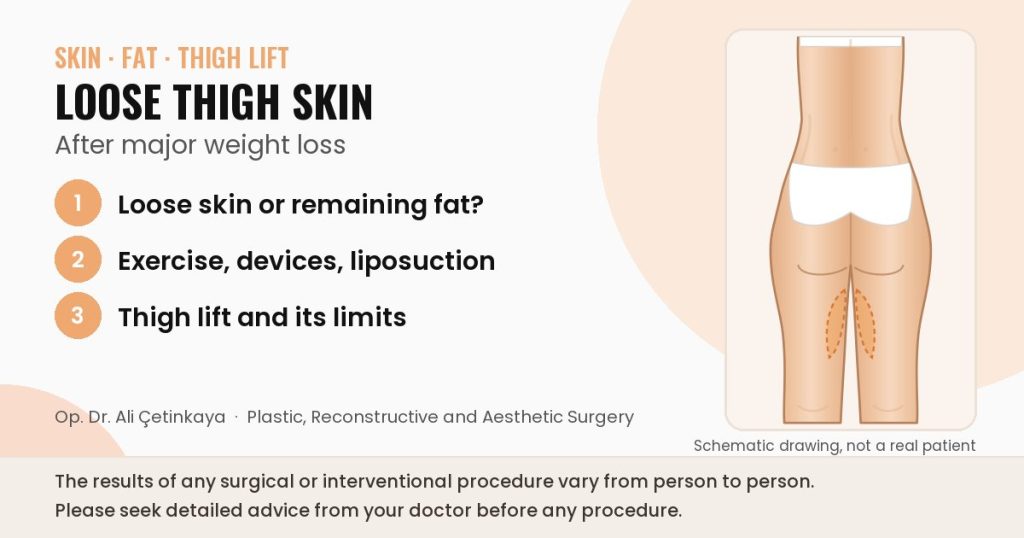
After major weight loss, loose skin often remains on the thighs – especially on the inner side and above the knees. The skin looks creased, hangs when you walk and can rub between the legs. Many people find this an unexpected downside of what is really a big success.
What helps depends on whether excess skin or remaining fat mainly shapes the thigh. Here you can read what exercise, skin care and devices can do, when liposuction makes sense and when only a thigh lift removes the skin – along with the limits.
In short
- Skin that was stretched for a long time often does not fully shrink back after major weight loss.
- Exercise builds muscle and improves shape, but excess skin cannot be “trained away”.
- Liposuction removes fat, not skin; with loose skin it can even make sagging worse.
- A thigh lift removes the skin but often comes with minor wound-healing problems: in one series 68% had at least one complication, mostly small wound openings [1][2].
- After weight-loss surgery, body contouring improved physical, psychological and social wellbeing in a review [3].
Why Does the Skin on the Thighs Become Loose?
- Major weight loss: if the skin was stretched for a long time, its elastic fibres often do not fully contract after weight loss – especially after obesity surgery or very fast weight loss.
- Age: collagen and elastic fibres decrease over the years; the skin becomes thinner and less firm, even without weight change.
- Genetics: how well skin recovers is partly inherited.
- Weight cycling: repeated gain and loss stretches the skin again and again.
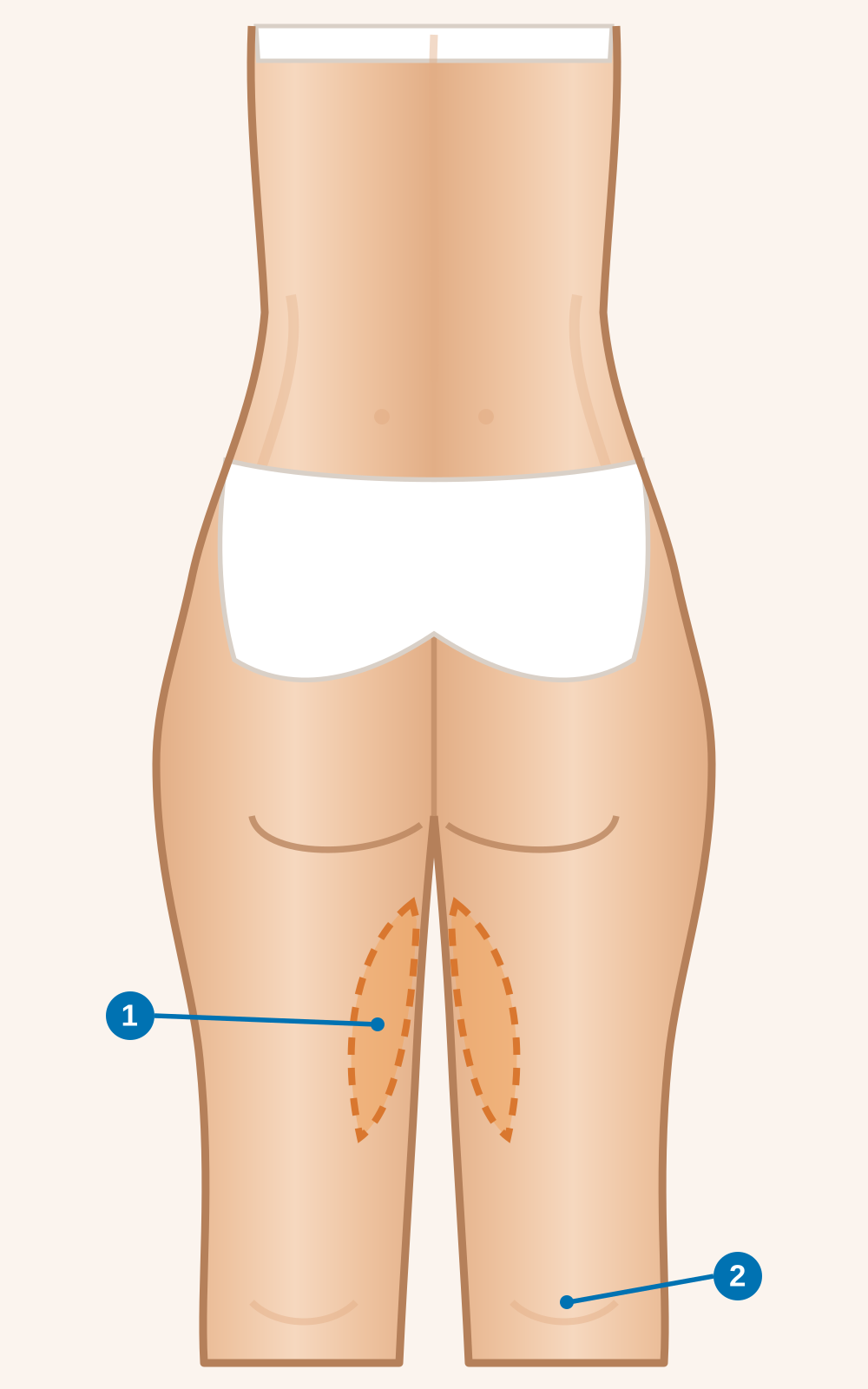
- 1Loose skin on the inner thigh
- 2Area above the knee
Loose Skin or Remaining Fat?
This distinction decides which treatment makes sense:
| Finding | How you recognise it | What can help |
|---|---|---|
| Mainly fat | Thigh looks full, the skin is still firm | Weight loss, targeted liposuction |
| Mild laxity | Skin slightly soft, little creasing | Strength training, skin care, possibly devices |
| Clear excess skin | Skin hangs on the inner side and forms folds when standing | Thigh lift |
| Skin and remaining fat | Full inner thigh with hanging skin | Thigh lift, often with liposuction |
Signs the Skin Will Not Tighten by Itself
- The skin on the inner thigh visibly hangs down when standing or forms folds above the knees.
- The inner thighs rub together when walking, causing redness or sore patches.
- Your weight has been stable for months, but the skin has hardly changed in that time.
What Helps Without Surgery?
- Strength training: exercises such as squats and lunges build muscle and improve shape. Excess skin, however, cannot be trained away.
- Creams and skin care: skin-care products improve how the skin feels but do not measurably tighten hanging skin.
- Devices: radiofrequency and similar methods can improve mild laxity to a limited extent; in a small study of microneedle radiofrequency above the knee, results and satisfaction varied [4]. They do not remove clear excess skin.
- Protection from chafing: long underwear or anti-chafing bands and good skin care relieve soreness between the legs.
When Is Liposuction Enough?
Liposuction removes fat tissue but no skin. It suits you if the skin is still firm and mainly fat deposits bother you. If the skin is already loose, liposuction alone can even make the sagging worse. During a thigh lift it is often used in addition. Read more under liposuction.
Thigh Lift: When Skin Has to Be Removed
In a thigh lift, excess skin on the inner thigh is removed and the remaining skin tightened. How far the laxity extends determines the technique and therefore where the scar lies:
- Groin incision (horizontal): for limited laxity in the upper third of the inner thigh; the scar lies in the groin crease.
- Vertical technique: for laxity that reaches down to the knee, typical after major weight loss; the scar runs in the groin crease and along the inner thigh.
Removed skin does not grow back, but weight changes and ageing continue to affect the result. You can read about the procedure and recovery under thigh lift and thigh lift recovery.
When Is the Right Time?
Your weight should have been stable for several months. If you are still losing weight, it is better to wait; otherwise new loose skin can form. You should stop smoking in good time before the operation, and enough protein supports wound healing. After weight-loss surgery, decide on the timing together with your treatment team.
Risks and Warning Signs
Minor wound-healing problems along the scar and fluid collections under the skin (seroma) are common; temporary swelling of the legs also occurs. In a series of 106 thigh lifts after major weight loss, 68% had at least one complication, most often small wound openings; the full-length vertical technique was linked to longer-lasting swelling [1]. A review of 16 studies with 447 patients found complications in 42.7%, mainly wound openings (18.3%) and seroma (8.1%); major complications such as thrombosis were not observed in these studies [2]. A small residual risk of thrombosis nevertheless exists with any operation.
Contact your treatment team the same day if after the operation you have a fever, increasing redness or swelling of the wound, discharge of pus, or a swollen, painful calf on one side. If you suddenly become short of breath or have chest pain, call emergency services straight away (112 in Turkey, 999 in the UK).
Is It Covered by Insurance?
A thigh lift for cosmetic reasons is usually not covered by public health systems or private insurers. With marked excess skin and persistent problems – such as recurring skin inflammation despite treatment – funding may be possible in individual cases; in the UK this depends on local NHS criteria. Clarify this before planning, especially if the operation is to take place abroad.
Frequently Asked Questions
Does skin tighten by itself after weight loss?
In younger people and with moderate weight loss, the skin often improves somewhat in the first months. Clear excess skin after major weight loss, however, usually does not fully recover.
Which exercises help loose skin on the thighs?
Squats, lunges and exercises for the inner thigh strengthen the muscles and improve shape. The excess skin itself does not disappear.
Is there a scar after a thigh lift?
Yes. Depending on the technique, it lies in the groin crease or additionally on the inner thigh. It is red at first and fades over months; how visible it remains varies.
Does this also affect the upper arms?
Often, yes. After major weight loss, skin often remains in several places. Read more under saggy arm skin after weight loss and sagging belly skin.
Does body contouring improve quality of life?
In a review of studies after weight-loss surgery, body contouring improved physical functioning, psychological wellbeing and social functioning [3].
Personal Assessment

References
- Gusenoff JA, Coon D, Nayar H, Kling RE, Rubin JP. Medial thigh lift in the massive weight loss population: outcomes and complications. Plast Reconstr Surg. 2015;135(1):98–106. doi:10.1097/PRS.0000000000000772
- Sisti A, Cuomo R, Zerini I, et al. Complications associated with medial thigh lift: a comprehensive literature review. J Cutan Aesthet Surg. 2015;8(4):191–197. doi:10.4103/0974-2077.172189
- Toma T, Harling L, Athanasiou T, Darzi A, Ashrafian H. Does body contouring after bariatric weight loss enhance quality of life? A systematic review of QOL studies. Obes Surg. 2018;28(10):3333–3341. doi:10.1007/s11695-018-3323-8
- Alexiades M, Munavalli GS. Single treatment protocol with microneedle fractional radiofrequency for treatment of body skin laxity and fat deposits. Lasers Surg Med. 2021;53(8):1026–1031. doi:10.1002/lsm.23397
This article is for general information and does not replace a medical examination. The results of any surgical or interventional procedure vary from person to person. Please seek detailed advice from your doctor before any procedure.