



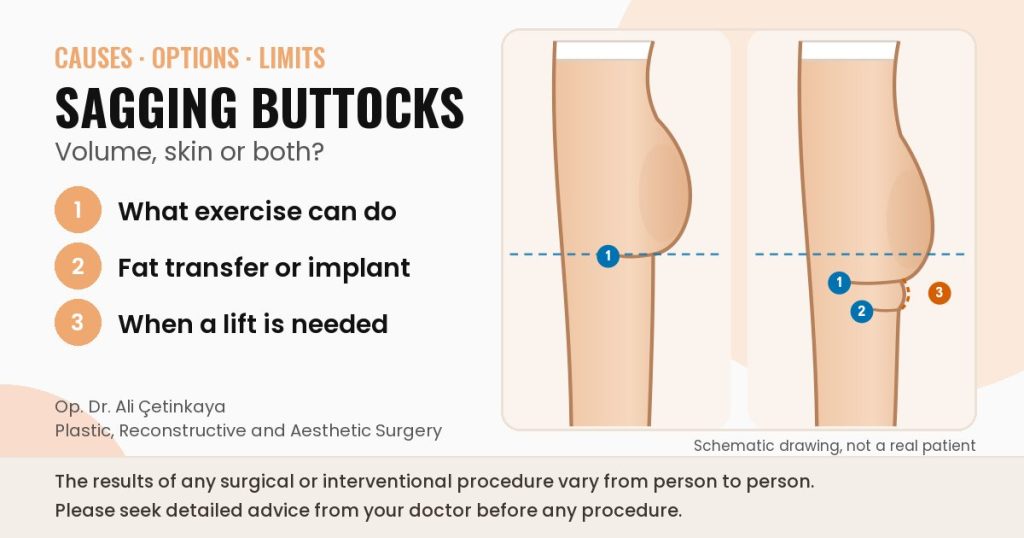
Sagging buttocks have dropped lower: the fold under the buttock gets longer, an extra crease often forms beneath it, and the curve looks flatter. This often happens after major weight loss or simply with age.
What helps depends on whether the main problem is lost volume, loose skin, or both. This guide explains what exercise can do, and when fat transfer, an implant or a buttock lift may be considered.
In short
- The first question is whether the buttock has lost volume, has excess skin, or both. The answer decides which treatment makes sense.
- Glute training builds muscle and gives the buttock more shape. It is the first step when mainly volume is missing.
- Loose skin cannot be trained away. If the skin clearly hangs over the fold, only surgery removes it.
- Fat transfer (Brazilian butt lift) or an implant adds volume but does not lift hanging skin; a buttock lift removes skin but adds no volume. After major weight loss they are often combined.
- Your weight should be stable for several months before a lift. A higher weight and smoking are linked to more complications.
Why Do Buttocks Sag?
Buttocks usually sag because volume is lost and the skin no longer springs back. Several factors play a part:
- Major weight loss: when fat is lost, volume goes with it, and the stretched skin often does not shrink back fully. The buttock loses support and drops.
- Age: collagen and elastic fibres decrease, and the skin and connective tissue become softer.
- Little muscle: a weak gluteal muscle gives the buttock less shape.
- Genes: where the body stores fat and how firm the connective tissue is are partly inherited.
Volume, Skin or Both?
Telling these apart is the key step, because each needs a different treatment.
| Finding | How you recognise it | What can help |
|---|---|---|
| Mainly volume loss | The buttock looks flat, but the skin is still firm | Exercise; fat transfer or an implant |
| Mainly excess skin | Skin hangs over the buttock fold, with an extra crease below it | Buttock lift |
| Volume loss and excess skin | A flat buttock with hanging skin, typical after major weight loss | Buttock lift, often combined with fat transfer |
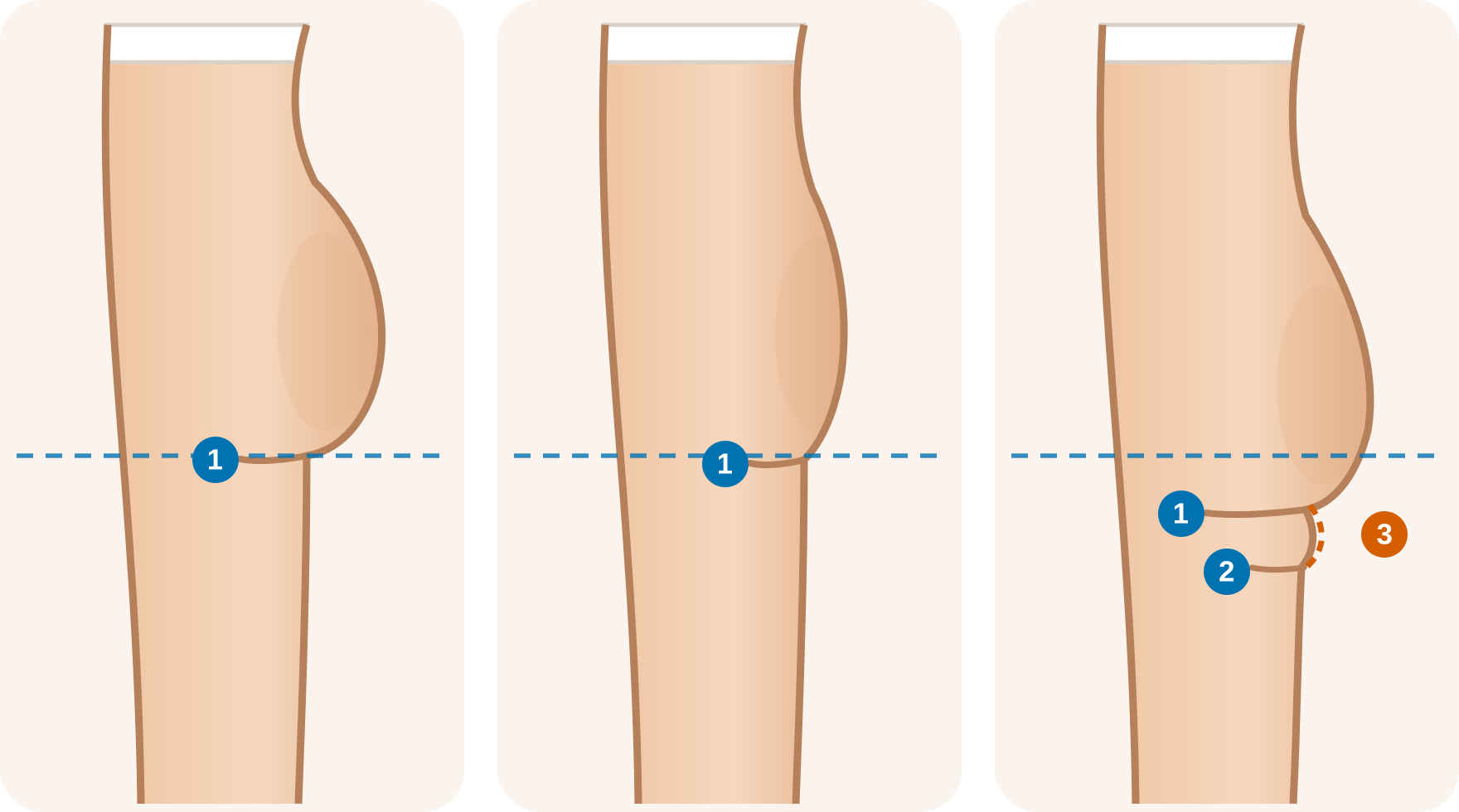
- 1Buttock fold (infragluteal fold)
- 2Extra crease forming under the buttock
- 3Hanging skin
Can Exercise Fix Sagging Buttocks?
Partly. Targeted glute training, such as hip thrusts, squats, lunges and resistance-band exercises, builds muscle and gives the buttock more shape and roundness. If mainly muscle volume is missing, this is the first and most important step.
Excess skin, however, cannot be trained away. Creams can improve how the skin feels, and devices may at most improve mild laxity to a limited degree. If the skin clearly hangs, only a procedure will help.
Which Procedures Are Considered?
| Procedure | What is done | Who it suits |
|---|---|---|
| Fat transfer (Brazilian butt lift) | Fat is removed by liposuction elsewhere and transferred to the buttock | Wish for more volume, enough donor fat, skin still firm |
| Buttock implant | A silicone implant gives the buttock more volume | Wish for more volume with little donor fat |
| Buttock lift | Excess skin and fat are removed and the buttock is lifted | Clearly hanging skin, often after major weight loss |
Volume alone does not lift hanging skin, and a lift alone adds no volume. That is why the procedures are often combined after major weight loss. An overview of all buttock procedures is on our butt aesthetics page.
Fat Transfer: Why the Layer Matters
The most dangerous complication of buttock fat transfer is fat embolism: fat enters a large vein and travels to the lungs. It is rare, but it can be fatal. This is why the technique matters so much.
A task force of the Aesthetic Surgery Education and Research Foundation surveyed 692 surgeons who together reported 198,857 buttock fat transfers. Over their careers they reported 32 deaths and 103 non-fatal cases of fat embolism in the lungs. Surgeons who injected fat into the deep muscle had a significantly higher rate of these complications [3]. Fat is therefore placed in the layer under the skin, above the muscle, and not deep into the muscle near the large veins.
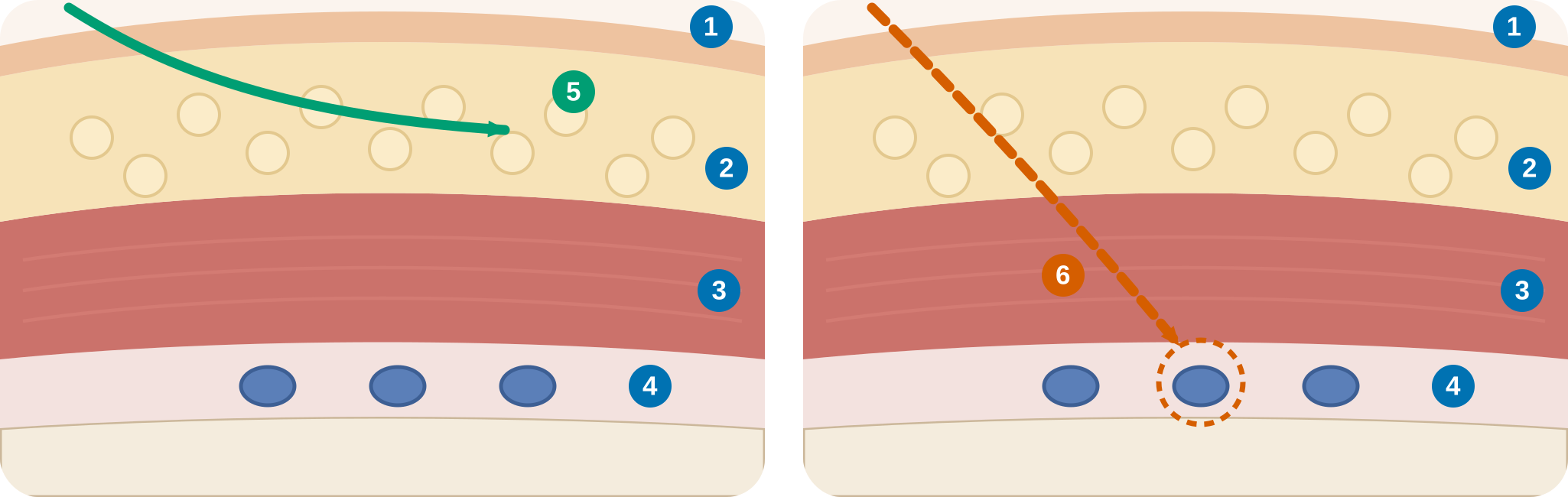
- 1Skin
- 2Fat layer under the skin
- 3Large gluteal muscle (gluteus maximus)
- 4Large veins beneath the muscle
- 5Fat placed under the skin, above the muscle
- 6Injection into the muscle, towards the large veins (risk)
Ask your surgeon in advance which layer the fat is injected into and how this is checked during the operation. More on the procedure itself is on our Brazilian butt lift page.
How Is a Buttock Lift Done?
A buttock lift is done under general anesthesia. Depending on the findings, the incision runs above the buttocks, kept within the underwear line where possible, or in the buttock fold. After major weight loss, the lift is often planned as part of a circular lift of the abdomen, flanks and buttocks (lower body lift).
Sitting and bending are restricted in the first weeks; your surgeon decides for how long, depending on how the wound heals. Removed skin does not grow back, but weight changes and ageing continue to affect the result.
When Is the Right Time?
Your weight should be stable for several months; if you are still losing weight, it is better to wait. In a study of 100 patients after major weight loss, complications after a lower body lift were linked to body mass index before surgery and to smoking [2]. A stable, lower weight and stopping smoking well before surgery reduce the risk. After weight-loss (bariatric) surgery, agree on the timing with your care team.
What Are the Risks?
The most common problems are delayed wound healing along the scar and fluid collecting under the skin (seroma). In a study of 50 patients after major weight loss, 70% had at least one complication after a lower body lift, most often wound opening and seroma; 10% needed another operation [1]. With fat transfer, fat embolism is the most dangerous, although rare, complication (see above).
Warning signs after surgery: contact your care team the same day if you have a fever, increasing redness or swelling of the wound, discharge of pus, or one calf that is swollen and painful. If you have sudden shortness of breath or chest pain, call emergency services straight away (112 in Turkey, 999 in the UK).
Coming to Istanbul for an Assessment
If you are travelling from abroad, the consultation, surgery, check-ups and journey home are planned together. The examination takes place at the practice in Ataşehir, Istanbul; operations take place in a hospital operating theatre (Memorial Göztepe Hospital).
- Before you travel: photos or a video call give preliminary information. Whether volume, skin or both need treatment is only confirmed at the in-person examination.
- Length of stay: it depends on the procedure and whether procedures are combined, and is decided at the examination.
- Flying home: after buttock and body-contouring surgery, long periods of sitting are restricted and the risk of blood clots is higher. Your surgeon decides when you can fly after a check-up; walk regularly on board.
- After you return: agree in advance how remote follow-up will work and what to do if a wound problem appears at home.
Is It Covered by Insurance?
A buttock lift for cosmetic reasons is usually self-funded. With marked excess skin that causes lasting problems, cover may be possible in individual cases after review by the insurer. In the UK, the NHS does not usually fund cosmetic procedures. Check this with your insurer before planning, especially if the operation is to take place abroad.
Frequently Asked Questions
Which exercises help sagging buttocks?
Exercises that strengthen the large gluteal muscle: hip thrusts, squats, lunges, deadlifts and resistance-band work. Doing them regularly over months matters more than any single exercise.
Does a Brazilian butt lift lift sagging buttocks?
Only to a limited extent. Fat transfer adds volume and can improve the shape. If the skin clearly hangs, a lift is needed, combined with fat transfer if necessary.
Does a buttock lift leave a scar?
Yes. It is planned to lie within the underwear line or in the buttock fold where possible. It is red at first and fades over months; how visible it stays varies from person to person.
Does weight loss affect other areas too?
Often, yes. After major weight loss, loose skin often remains on the abdomen and thighs as well. More in our articles on sagging belly skin and the thigh lift.
Personal Assessment

References
- Kitzinger HB, Cakl T, Wenger R, Hacker S, Aszmann OC, Karle B. Prospective study on complications following a lower body lift after massive weight loss. J Plast Reconstr Aesthet Surg. 2013;66(2):231–238. doi:10.1016/j.bjps.2012.09.006
- Poodt IG, van Dijk MM, Klein S, Hoogbergen MM. Complications of lower body lift surgery in postbariatric patients. Plast Reconstr Surg Glob Open. 2016;4(9):e1030. doi:10.1097/GOX.0000000000001030
- Mofid MM, Teitelbaum S, Suissa D, et al. Report on mortality from gluteal fat grafting: recommendations from the ASERF Task Force. Aesthet Surg J. 2017;37(7):796–806. doi:10.1093/asj/sjx004
This article is for general information and does not replace a medical examination. The results of any surgical or interventional procedure vary from person to person. Please seek detailed advice from your doctor before any procedure.


