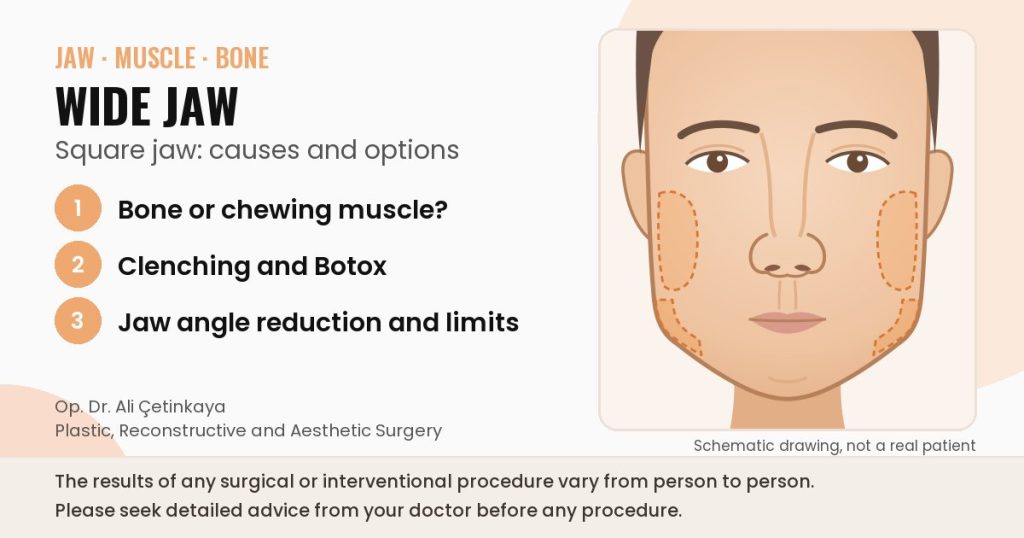
A wide, square jaw gives the lower face a strong, angular outline. Some people like it; others feel it makes their face look harder or more masculine than they would like.
Two different structures can be behind it: the bone at the angle of the jaw or a large chewing muscle (masseter), and often both. Here you can read how to tell them apart, what clenching has to do with it, what Botox can do and when surgery on the jaw angle may be considered, along with its limits.
In short
- A wide jaw is caused by a prominent jaw angle (bone), a large chewing muscle (masseter), or both.
- Clenching or grinding the teeth can enlarge the chewing muscle.
- Botulinum toxin in the masseter improved jaw prominence compared with placebo in randomised trials; the effect is temporary [1].
- When the bone is the main cause, only surgery on the jaw angle narrows the lower face; satisfaction and quality of life improved after it in a prospective study [2].
- Removing too much or unevenly is a typical reason for revision surgery [3].
Bone or Muscle?
The width of the lower face mainly depends on two structures at the angle of the jaw:
- The jaw angle (bone): the corner of the lower jaw can be wide and flared by nature. This is largely inherited.
- The chewing muscle (masseter): it lies on the outside of the jaw angle and can be thick and prominent.
A simple self-check: place your fingertips on the angle of your jaw and clench your teeth. If a firm bulge pushes out clearly, the muscle plays a large part. If the corner feels wide even when you relax, the bone is more likely the cause. Often both are present; an examination, sometimes with imaging, makes the distinction.
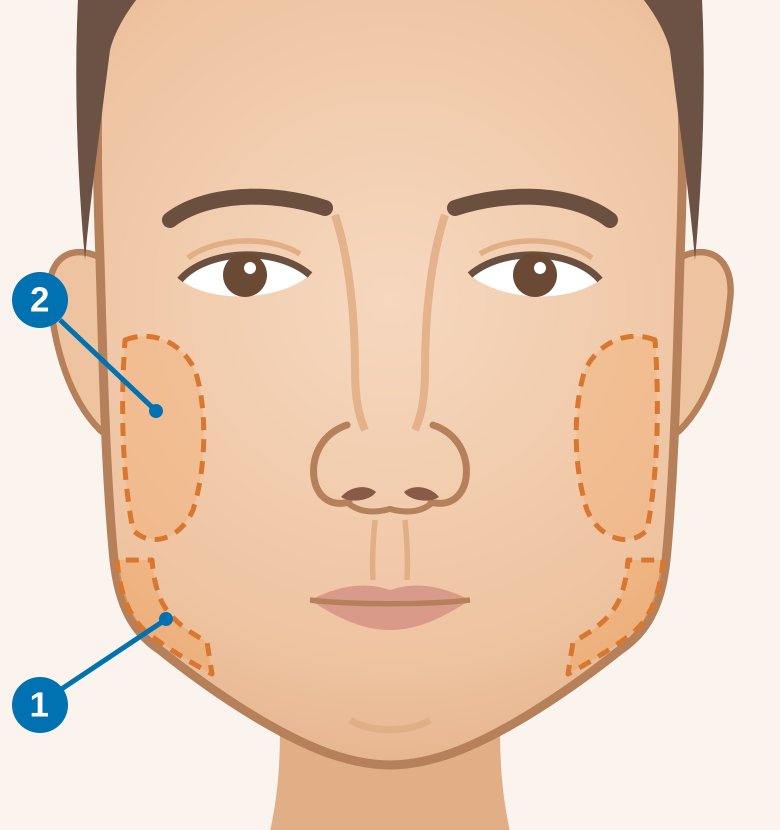
- 1Angle of the lower jaw (bone)
- 2Chewing muscle (masseter)
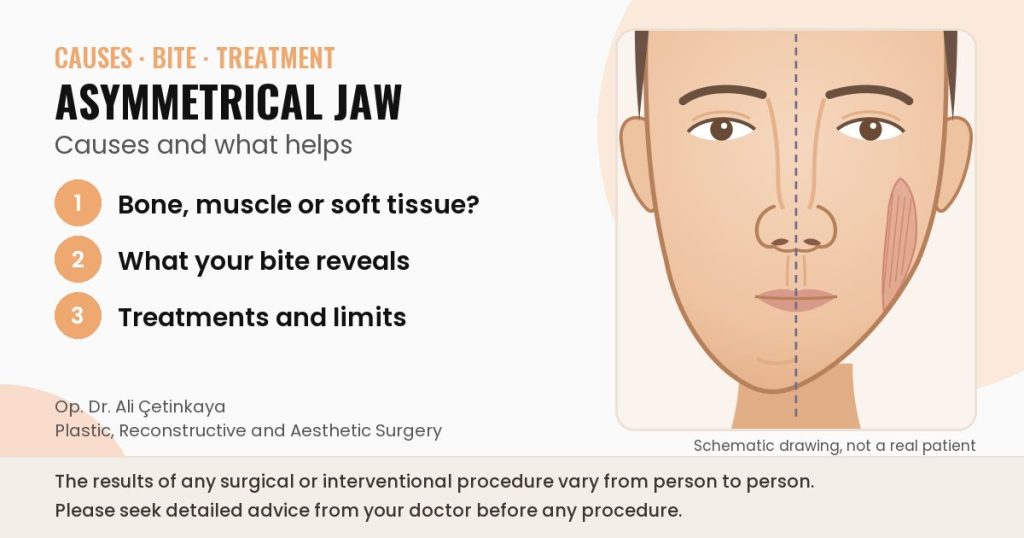
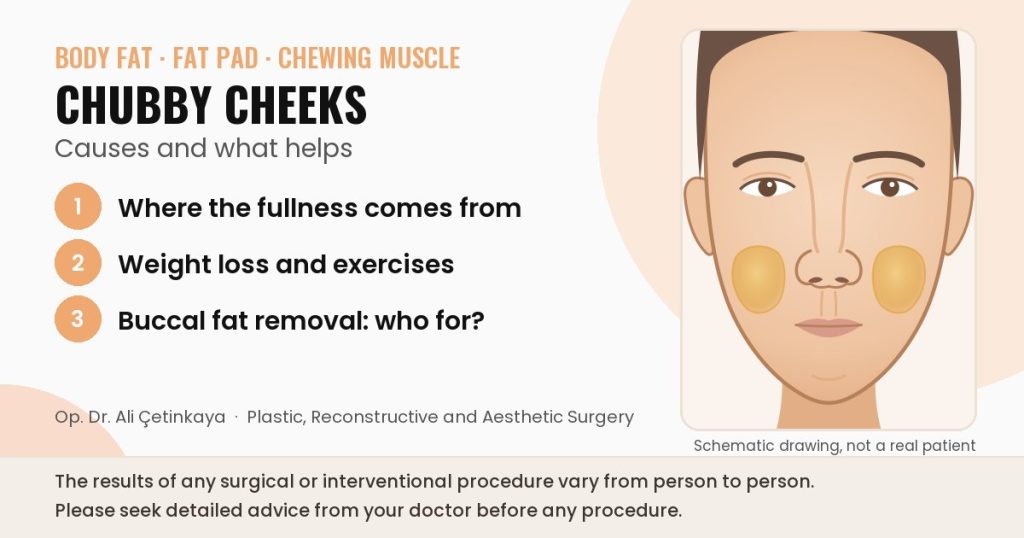
Full cheeks are a different issue: here fat in the cheeks makes the face look round rather than square; see chubby cheeks. If one side is wider than the other, see asymmetrical jaw.
Does Clenching Make the Jaw Wider?
It can. Like any muscle that works hard, the masseter can grow with frequent clenching or night-time grinding (bruxism). Stress often plays a role, and many people do not notice it; signs include tired jaw muscles or headaches in the morning and worn teeth. A dentist can confirm grinding and, if needed, provide a night guard to protect the teeth.
See a doctor or dentist if one side of the jaw swells, if a lump grows, if the jaw is painful or hard to open, or if the swelling comes with fever. A new swelling in front of the ear can also come from the parotid salivary gland and needs to be checked.
What Helps Without Surgery?
- Botulinum toxin in the masseter: relaxes the chewing muscle so that it becomes thinner over the following weeks. In a meta-analysis of five randomised, placebo-controlled trials with 536 participants, it improved masseter prominence, reduced muscle thickness and increased satisfaction; the authors describe the benefit as short-term and call for longer studies [1]. The effect wears off over months unless the treatment is repeated. Read more under masseter Botox.
- Less clenching: stress management and a night guard from the dentist can reduce the strain on the muscle.
- Make-up: contouring along the jaw angle can soften the outline visually.
Neither Botox nor exercises change the bone. If the jaw angle itself is wide, these measures soften only the muscle part.
Jaw Angle Reduction
If the bone is the main cause, the angle of the lower jaw can be reshaped surgically (reduction mandibuloplasty). The procedure is usually performed through the mouth, so there is no visible scar on the face. How much bone is removed and along which line depends on the face as a whole: the goal is a balanced outline, not the narrowest possible jaw.
In a prospective study using the FACE-Q questionnaire, satisfaction with the overall appearance, the lower face and jawline, and quality of life improved clearly one year after the operation, reaching levels similar to the general population; younger patients improved more than those over 30 [2]. In a series of 184 patients who needed a revision, most (78.8%) felt that their face was still not slim enough from the front, while others had an unnatural or uneven result from too much or inaccurate bone removal [3]. Careful planning matters more than the amount removed.
If the chin itself is long or prominent, a different procedure may be considered; see chin reduction surgery.
Risks and Warning Signs
After Botox in the masseter, temporary chewing weakness, tenderness at the injection site and, rarely, an uneven smile can occur. After jaw angle surgery, swelling of the lower face lasts for several weeks; numbness of the lower lip or chin, asymmetry, sagging of the soft tissue over the angle, infection and bleeding are possible.
Contact your treatment team the same day if after the operation you have increasing swelling on one side, fever, discharge of pus inside the mouth, or difficulty swallowing. If you have difficulty breathing, call emergency services straight away (112 in Turkey, 999 in the UK).
Is It Covered by Insurance?
Botox or jaw surgery for cosmetic reasons is usually not covered by public health systems or private insurers, including the NHS. Treatment of tooth grinding by a dentist may be covered depending on your system. Clarify costs and follow-up before planning, especially if the treatment is to take place abroad.
Frequently Asked Questions
Is a wide jaw genetic?
The bony part largely is. A large chewing muscle can also be inherited but may grow with clenching or grinding.
Can jaw exercises make a wide jaw slimmer?
No. Exercising the jaw trains the chewing muscle and can make it larger rather than smaller.
How long does masseter Botox last?
The effect is temporary and wears off over months; regular repeat treatments are needed to maintain it. Your doctor will plan the interval with you.
Does jaw angle reduction leave a scar?
It is usually performed through the mouth, so there is no visible scar on the face.
Can a jaw be too narrow after surgery?
Yes, if too much bone is removed or the line is uneven, the result can look unnatural. This is a known reason for revision surgery, which is why the plan aims at balance rather than maximum reduction [3].
Personal Assessment

References
- Machado GF, De Freitas LR, Ribeiro LFS, Andrade GRO, Silva VP, da Silva TVD, et al. Efficacy of botulinum toxin for masseter muscle hypertrophy: a systematic review and meta-analysis. J Plast Reconstr Aesthet Surg. 2026;119:212–225. doi:10.1016/j.bjps.2026.06.012
- Du H, Liang H, Qi Z, Jin X. Patient-perceived improvement in facial appearance and quality of life: FACE-Q as a tool to study reduction mandibuloplasty outcomes. Aesthetic Plast Surg. 2025;49(3):596–606. doi:10.1007/s00266-024-04312-7
- Lee SW, Heo JW, Myung Y, Kim KK, Jin US. A revision mandibuloplasty: causes, indications, surgical methods and treatment outcomes. Aesthetic Plast Surg. 2019;43(3):726–732. doi:10.1007/s00266-019-01333-5
This article is for general information and does not replace a medical examination. The results of any surgical or interventional procedure vary from person to person. Please seek detailed advice from your doctor before any procedure.