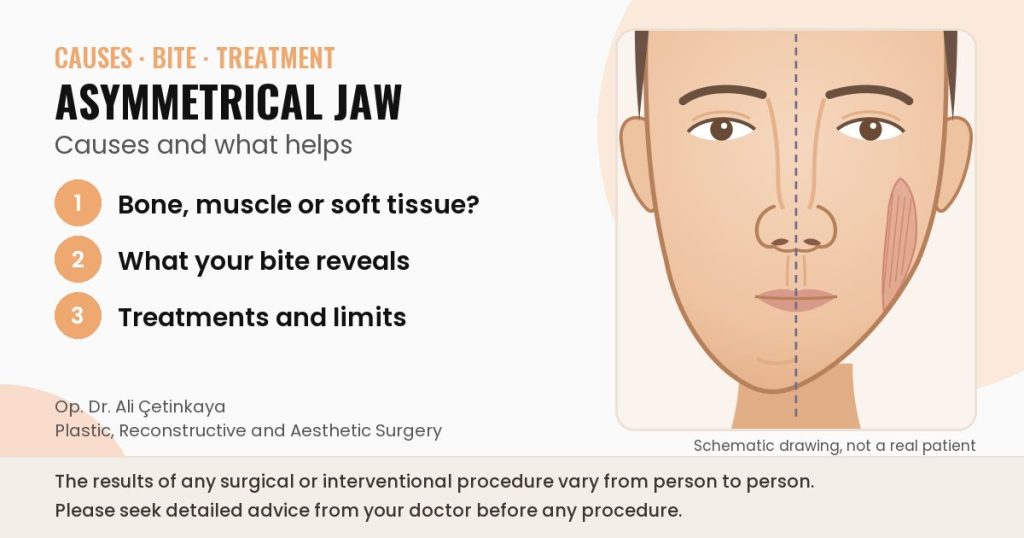
A slightly asymmetrical jaw or chin is common and usually harmless: hardly any face is perfectly symmetrical. It becomes a concern when the chin clearly points to one side, when your bite no longer fits, or when the asymmetry is getting worse.
Here you can read where an uneven jaw comes from, how to tell whether bone, the chewing muscle or soft tissue is behind it, and which treatment fits which situation – along with the limits.
In short
- Small differences between the two sides of the face are normal and often inherited [1][2].
- Among people with jaw deformities, visible facial asymmetry is common, and it most often affects the chin [3].
- Your bite is the key clue: if the teeth do not meet properly, the cause usually lies in the jawbone, and orthodontics plus jaw surgery are needed [1][6].
- With a normal bite, smaller differences in the chin, chewing muscle or soft tissue can be balanced, for example with filler, masseter Botox, a chin implant or genioplasty.
- If the asymmetry increases in adulthood, the jaw joint should be examined [5].
Is an Asymmetrical Jaw Normal?
Yes, to a mild degree. Small differences between the right and left side of the face are common in the general population and are usually not noticed by others [1]. In a study of 1,800 orthodontic patients, when the chin deviated to one side, it pointed to the left in 79.3% of cases; the authors consider this tendency to be inherited rather than acquired [2].
When an uneven jaw becomes noticeable varies. In a survey using edited facial photographs, laypeople noticed a rotation of the lower jaw from about 3 degrees, but only saw a need for treatment from about 7 degrees [4].
What Causes an Uneven Jaw or Chin?
An asymmetrical chin can come from the bone, the chewing muscle or the soft tissues. Often several causes work together.
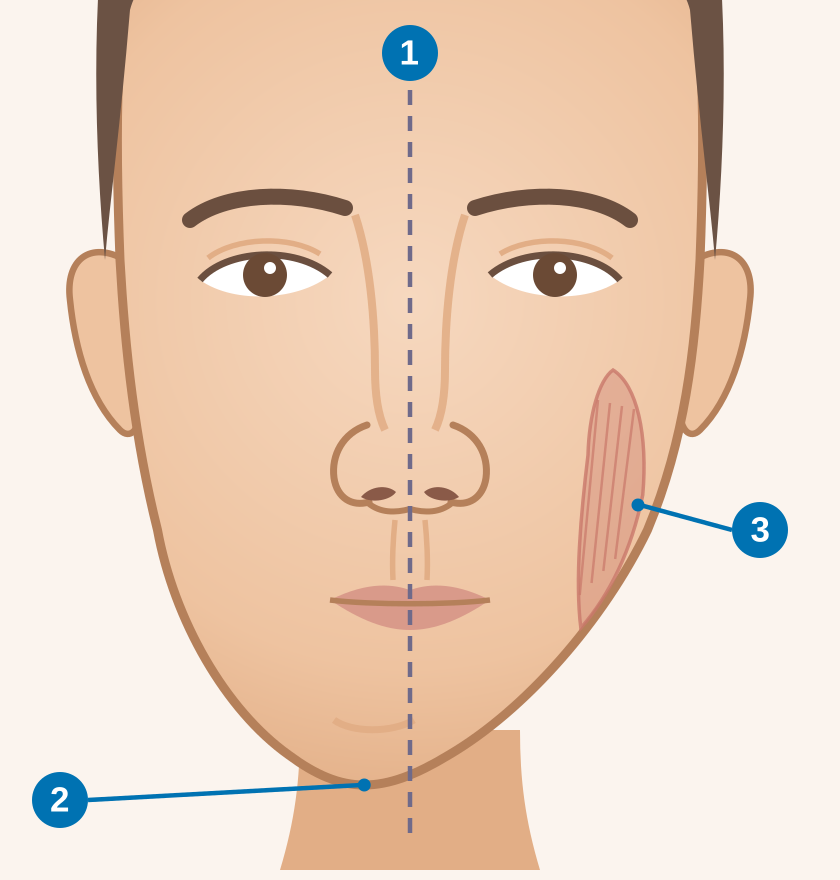
- 1Facial midline
- 2Chin tip shifted away from the midline
- 3Stronger chewing muscle (masseter) on one side
- Bone: the lower jaw has grown more or less on one side, either from birth or after an injury. Among people assessed for a jaw deformity, 34% had visible facial asymmetry, and in 74% of these the chin was affected [3].
- Jaw joint: if one of the jaw’s joint processes keeps growing on one side (condylar hyperplasia), the chin gradually shifts sideways. In a series of 61 patients this occurred between the ages of 11 and 80; two thirds came because of increasing facial asymmetry [5].
- Chewing muscle: a stronger chewing muscle (masseter) on one side makes the lower face look wider there, without the bone being uneven.
- Soft tissue: uneven fat distribution, scars or weakness of the facial muscles can make one side look different.
Bone or Soft Tissue: Your Bite Gives the Clue
Whether the cause lies in the bone often shows in your bite. Signs that point to a bony cause:
- Your teeth do not meet properly, or the midline of the lower front teeth is shifted to one side.
- The row of teeth is tilted; when you smile, one corner of the mouth sits visibly higher.
- Jaw joint problems, clicking or pain when chewing.
- The asymmetry has increased over recent months or years.
If the cause lies in the jawbone, treatment usually consists of orthodontic preparation followed by surgery on the upper and lower jaw [1]. In a study of 27 adults, this corrected the deviation of the chin, and the result remained stable; the whole treatment took about 15 months on average [6]. This kind of operation belongs in the hands of a specialised oral and maxillofacial surgery team.
Which Treatment Fits?
| Cause | Possible treatment | Evidence and limits |
|---|---|---|
| Small soft-tissue differences, normal bite | Hyaluronic acid filler to the chin or jawline | Rated safe and effective for the chin in a randomised trial [8]; temporary, needs top-ups |
| Stronger chewing muscle on one side | Masseter Botox (botulinum toxin into the chewing muscle) | High-quality comparative trials are lacking [7]; temporary effect |
| Chin tip shifted sideways, normal bite | Bony chin correction (genioplasty) or chin implant | Balances the chin but does not correct the lower jaw; an operation |
| Uneven jaw with a bad bite | Orthodontics and jaw surgery | Chin deviation corrected and stable in one study [6]; long treatment |
| Asymmetry increasing in adulthood | Assessment of the jaw joint | Sometimes caused by one-sided growth of the joint process [5] |
You can read more about the individual options under chin reduction surgery, chin implant surgery, masseter Botox and jawline filler.
Do Exercises Help?
Not for a jaw that is uneven because of the bone. Exercises do not change the jawbone, and there is no evidence that facial exercises straighten an asymmetrical chin. In children and teenagers whose jaws are still growing, an orthodontic assessment is the right first step; treatment depends on age, cause and severity [1]. In growing teenagers, botulinum toxin to the chewing muscle is used cautiously: in an animal study, an injection on one side slowed the growth of the lower jaw on that side [9].
Risks and Warning Signs
- Filler: swelling and bruising are common; rarely, filler can block a blood vessel, which in the face can even affect vision [10].
- Masseter Botox: temporarily weaker chewing, uneven effect.
- Chin implant: infection, shifting, visible edges, possibly a further operation.
- Genioplasty: swelling, temporary numbness of the lower lip and chin, rarely lasting changes in sensation.
Call emergency services straight away (112 in Turkey, 999 in the UK) if one side of your face suddenly droops, together with weakness, speech or vision problems – this can be a stroke. See a doctor promptly if your chin keeps moving to one side over months or if jaw joint pain develops.
Coming to Istanbul for an Assessment
Whether bone, chewing muscle or soft tissue is causing the asymmetry can only be judged reliably at an examination. It takes place at the practice in Ataşehir, Istanbul.
- Before you travel: photos from the front with a relaxed face and when smiling, plus a photo of your teeth when biting together, give first clues.
- At the examination: your face, bite and chewing muscles are assessed. It is then decided whether the asymmetry can be balanced at the chin or in the soft tissues, or whether an orthodontic and maxillofacial assessment is needed first.
Is It Covered by Insurance?
If there is a marked jaw deformity with a bad bite, combined orthodontic and jaw surgery may be funded by public health systems under certain conditions; in the UK this is decided after referral to an NHS orthodontic or maxillofacial team. Correction for cosmetic reasons is usually not covered by public health systems or private insurers.
Frequently Asked Questions
Is a slightly asymmetrical jaw normal?
Yes. Small differences between the two sides of the face are common and usually inherited [1][2].
Can an uneven jaw be fixed without surgery?
Smaller soft-tissue differences can often be balanced with filler [8]; the effect is temporary. A jaw that is uneven because of the bone can at most be partly compensated with orthodontics without surgery [1].
Does masseter Botox help an uneven face?
Only if a stronger chewing muscle on one side is the cause. High-quality comparative trials are lacking, and the effect is temporary [7].
Which doctor should I see?
With a bad bite or increasing asymmetry, start with an orthodontist and an oral and maxillofacial surgeon. With a normal bite and differences in the chin or soft tissues, a plastic surgery assessment can be useful.
Does an asymmetrical jaw get worse with age?
Usually not. If the asymmetry increases in adulthood, the jaw joint should be examined [5].
Personal Assessment

References
- Thiesen G, Gribel BF, Freitas MPM. Facial asymmetry: a current review. Dental Press J Orthod. 2015;20(6):110–125. doi:10.1590/2177-6709.20.6.110-125.sar
- Haraguchi S, Iguchi Y, Takada K. Asymmetry of the face in orthodontic patients. Angle Orthod. 2008;78(3):421–426. doi:10.2319/022107-85.1
- Severt TR, Proffit WR. The prevalence of facial asymmetry in the dentofacial deformities population at the University of North Carolina. Int J Adult Orthodon Orthognath Surg. 1997;12(3):171–176. PMID: 9511487
- Tayyebi K, Arab S, Razmara F, Geramy A, Kharazifard MJ, Kamali E. Perceptions of mandibular asymmetry among orthodontists, oral and maxillofacial surgeons, and laypersons. Dent Res J (Isfahan). 2023;20:107. doi:10.4103/drj.drj_215_23
- Nitzan DW, Katsnelson A, Bermanis I, Brin I, Casap N. The clinical characteristics of condylar hyperplasia: experience with 61 patients. J Oral Maxillofac Surg. 2008;66(2):312–318. doi:10.1016/j.joms.2007.08.046
- Ko EWC, Huang CS, Chen YR. Characteristics and corrective outcome of face asymmetry by orthognathic surgery. J Oral Maxillofac Surg. 2009;67(10):2201–2209. doi:10.1016/j.joms.2009.04.039
- Fedorowicz Z, van Zuuren EJ, Schoones J. Botulinum toxin for masseter hypertrophy. Cochrane Database Syst Rev. 2013;(9):CD007510. doi:10.1002/14651858.CD007510.pub3
- Nikolis A, Metelitsa A, Raco L, Safran T. Safety and effectiveness of two high-G′ soft tissue fillers for chin augmentation: a prospective, randomized, comparator-controlled, evaluator-blinded trial. Aesthet Surg J. 2026;46(5):503–508. doi:10.1093/asj/sjaf222
- Li S, Mei L, Chen Q, Gao K, Zheng W, Li Y. Unilateral injection of botulinum toxin type A into the masseter muscle induces mandibular asymmetry in adolescent rats by suppressing the angular process growth. Am J Orthod Dentofacial Orthop. 2024;165(2):232–244. doi:10.1016/j.ajodo.2023.09.009
- Beleznay K, Carruthers JDA, Humphrey S, Carruthers A, Jones D. Update on avoiding and treating blindness from fillers: a recent review of the world literature. Aesthet Surg J. 2019;39(6):662–674. doi:10.1093/asj/sjz053
This article is for general information and does not replace a medical examination. The results of any surgical or interventional procedure vary from person to person. Please seek detailed advice from your doctor before any procedure.