High, defined cheekbones give the face contour and make it look fresh. How clearly they show depends less on the bone alone than on the fat that lies above and below it, and on how both change with age.
Here you can read what shapes the cheekbones, why they can look flatter over time, what weight loss and exercises can do, and what filler, fat transfer, implants or buccal fat removal can achieve – along with their limits.
In short
- The face is made up of several separate fat compartments; how they change with age shapes the contour of the cheeks [1]. The facial bones also recede over the years [2].
- Losing weight can make the cheekbones stand out more; very large weight loss, however, often makes the midface look hollow and older [3].
- There is no evidence that facial exercises make the cheekbones more prominent [4].
- In a randomised trial, hyaluronic acid filler to the cheekbone improved cheek contour in 85.6% of those treated after six months; in almost half, the correction lasted two years [5].
- Fat transfer, cheek implants and buccal fat removal are further options, each with its own limits and risks [6][7].
What Shapes the Cheekbones?
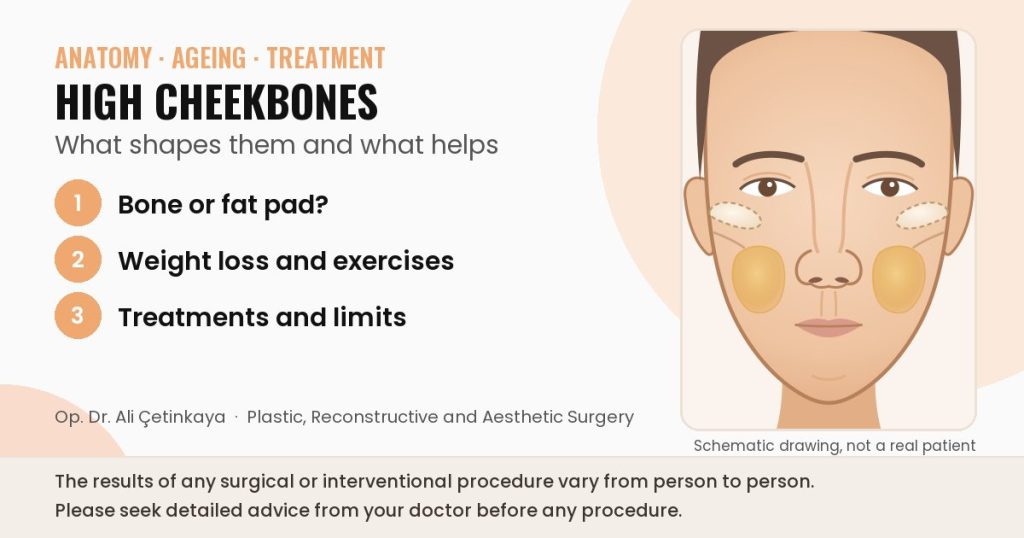
The cheekbone (zygoma) forms the outer, highest point of the cheek below the outer corner of the eye. Above it lie several separate fat compartments, and deeper down lies the buccal fat pad [1]. Whether a face shows “high cheekbones” comes from the interplay of bone shape, these fat pads and the slight shadow that forms below the bone.
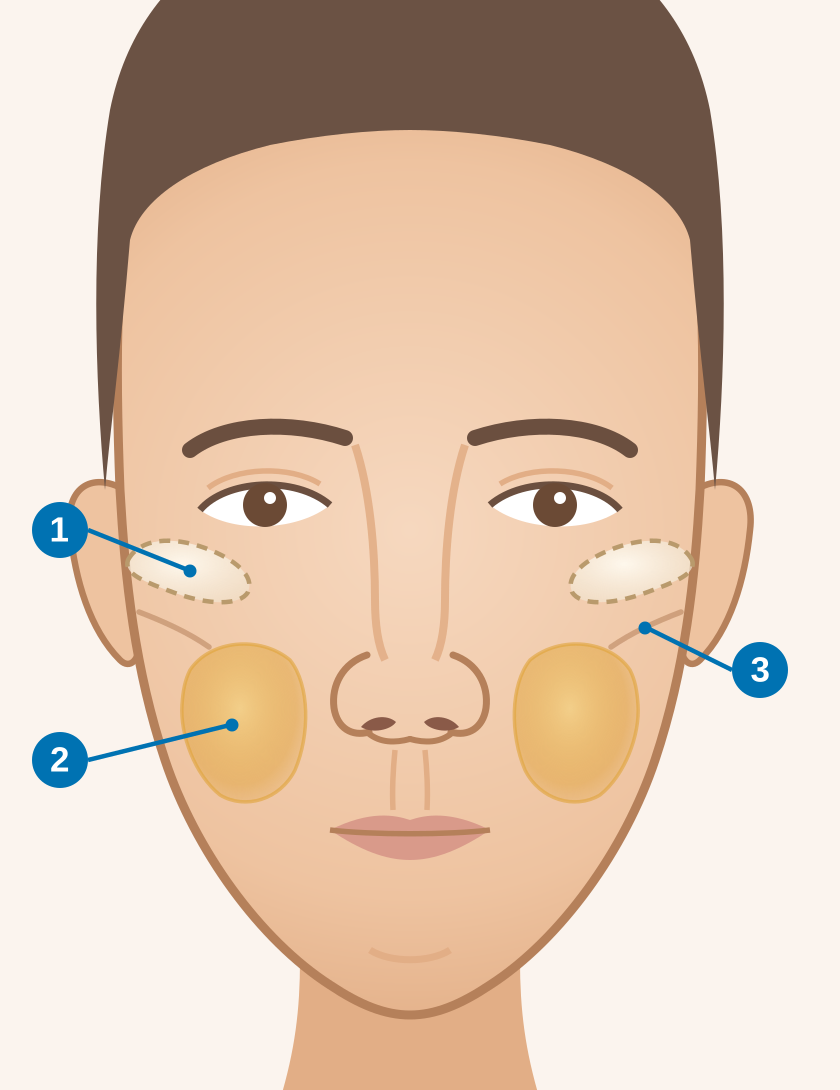
- 1Cheekbone (zygoma)
- 2Buccal fat pad
- 3Shadow below the cheekbone
A prominent buccal fat pad can make the cheek look fuller and rounder and fill in the shadow below the cheekbone. How to tell full cheeks from other causes is explained under chubby cheeks.
Why Do They Look Flatter Over Time?
The fat compartments of the face do not age evenly: some lose volume, others descend [1]. In addition, the facial bones recede; a review describes the height of the upper jaw decreasing by about 8–15% into older age [2]. Together, this makes the midface look flatter and the cheekbones lose contour. Read more under hollow cheeks.
Weight Loss and Exercises
Weight loss: if you are overweight, a lower body fat percentage can make the cheekbones stand out more. Very large weight loss, for example after obesity treatment, often comes with volume loss in the midface in particular, and the face then looks older [3].
Exercises: facial exercises cannot change the bone, and there is no evidence that they make the cheekbones more prominent [4].
Treatments: What the Studies Show
| Treatment | Principle | Evidence and limits |
|---|---|---|
| Hyaluronic acid filler | Adds volume and contour to the cheekbone and midface | In a randomised trial, contour improved in 85.6% after six months; in almost half, the correction lasted two years [5]. Temporary, needs top-ups |
| Fat transfer | Your own fat is taken and injected into the midface | An established way to restore volume [6]; part of the fat is reabsorbed, so the result is less predictable |
| Cheek implant | An implant is placed on the cheekbone | 15 studies with 796 patients: with access through the mouth, infections occurred in 2.0% and revision surgery in 4.3% [7]; a lasting change |
| Buccal fat removal | Part of the buccal fat pad is removed through a cut inside the mouth | Only for cheeks that are full because of a large fat pad; brings out the contour indirectly but does not build up the cheekbone |
Which option fits depends on whether volume is missing, the bone is flat or the buccal fat pad hides the contour. Read more about the individual procedures under cheek filler, fat injection and facial implants.
Buccal Fat Removal: Who Is It For?
Buccal fat removal is only an option if the cheeks look full mainly because of a large buccal fat pad – not with excess weight, not with a strong chewing muscle and not if the midface is already losing volume. Because the face loses volume with age anyway [1], fat is removed cautiously and only after a careful examination. See buccal fat removal.
Risks and Warning Signs
- Filler: swelling and bruising are common; rarely, filler can block a blood vessel, which in the face can even affect vision [8].
- Fat transfer: uneven reabsorption, lumps, asymmetry.
- Implant: infection, shifting, asymmetry, possibly a further operation [7].
- Buccal fat removal: swelling, rarely injury to nerve branches or salivary ducts, hollow cheeks later on.
Contact your doctor the same day if after a filler injection the pain increases or the skin turns pale or bluish. Sudden loss of vision is an emergency: call emergency services straight away (112 in Turkey, 999 in the UK).
Coming to Istanbul for an Assessment
Whether volume loss, bone shape or the buccal fat pad determines the contour can only be judged reliably at an examination. It takes place at the practice in Ataşehir, Istanbul.
- Before you travel: photos from the front, at a three-quarter angle and from the side, relaxed and smiling, give first clues.
- At the examination: bone, fat pads and skin quality are assessed; only then is it decided whether and which treatment makes sense.
Is It Covered by Insurance?
Enhancing the cheekbones for cosmetic reasons is usually not covered by public health systems or private insurers. In the UK, the NHS does not fund cosmetic treatments of this kind.
Frequently Asked Questions
Can you get higher cheekbones without surgery?
Yes, often with hyaluronic acid filler; the effect is temporary and lasted two years in almost half of patients in one study [5].
Do facial exercises give you high cheekbones?
No. Exercises do not change the bone, and there is no evidence that they make the cheekbones more prominent [4].
Do cheekbones become more visible when you lose weight?
Often, yes, if you are overweight. Very large weight loss can, however, make the midface look hollow and older [3].
Which lasts longer: filler or an implant?
An implant changes the contour in a lasting way but is an operation with its own risks [7]. Fillers are less invasive but need topping up [5].
Does buccal fat removal create high cheekbones?
It does not build up bone. With cheeks that are full because of a large fat pad, however, the contour above can look more defined.
Personal Assessment

References
- Rohrich RJ, Pessa JE. The fat compartments of the face: anatomy and clinical implications for cosmetic surgery. Plast Reconstr Surg. 2007;119(7):2219–2227. doi:10.1097/01.prs.0000265403.66886.54
- Lee KWA, Zamin RZ, Sobchyshyn M, et al. Facial bone aging: an update and literature review. JPRAS Open. 2026;48:828–845. doi:10.1016/j.jpra.2026.01.011
- Jafar AB, Jacob J, Kao WK, Ho T. Soft tissue facial changes following massive weight loss secondary to medical and surgical bariatric interventions: a systematic review. Aesthet Surg J Open Forum. 2024;6:ojae069. doi:10.1093/asjof/ojae069
- Alam M, Walter AJ, Geisler A, et al. Association of facial exercise with the appearance of aging. JAMA Dermatol. 2018;154(3):365–367. doi:10.1001/jamadermatol.2017.5142
- Jones D, Murphy DK. Volumizing hyaluronic acid filler for midface volume deficit: 2-year results from a pivotal single-blind randomized controlled study. Dermatol Surg. 2013;39(11):1602–1612. doi:10.1111/dsu.12343
- Shomorony A, Melley LE, Deane EC, Bloom JD. Autologous fat grafting of the periorbital and midface areas. Facial Plast Surg Clin North Am. 2026;34(1):55–62. doi:10.1016/j.fsc.2025.08.010
- Kauke-Navarro M, Knoedler L, Klimitz FJ, et al. Strategies for malar implant placement: a review of access, planning, and outcomes. Plast Reconstr Surg Glob Open. 2026;14(4):e7554. doi:10.1097/GOX.0000000000007554
- Beleznay K, Carruthers JDA, Humphrey S, Carruthers A, Jones D. Update on avoiding and treating blindness from fillers: a recent review of the world literature. Aesthet Surg J. 2019;39(6):662–674. doi:10.1093/asj/sjz053
This article is for general information and does not replace a medical examination. The results of any surgical or interventional procedure vary from person to person. Please seek detailed advice from your doctor before any procedure.