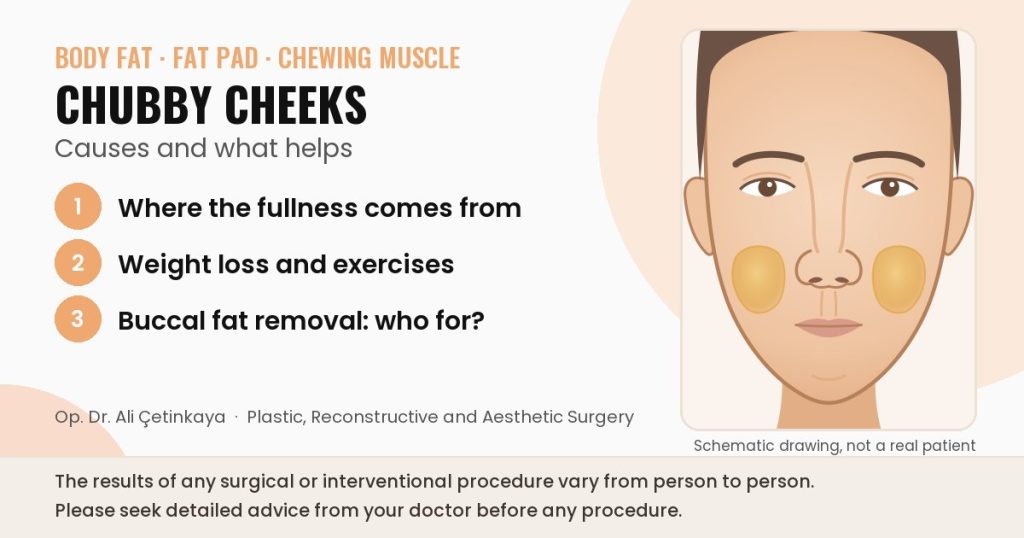
Full, round cheeks make a face look young, but they can also make it look wider than you see yourself. Where the fullness comes from is what matters: body fat, the deep cheek fat pad, the chewing muscle or, less often, the salivary glands.
Here you can read how to tell these causes apart, what weight loss and exercises can do, and when buccal fat removal may be an option – along with its limits.
In short
- How full a face looks is closely linked to body fat: in a pooled analysis, body mass index could be estimated well from the face alone [1].
- Losing weight often makes the cheeks slimmer if you are overweight; very large weight loss, however, can make the midface look hollow [3].
- There is no evidence that facial exercises or massage reduce cheek fat.
- A strong chewing muscle or enlarged salivary glands can also make the cheeks look full; in that case fat removal does not help [4][5].
- After buccal fat removal, reviews reported complications in between 4% and 25% of patients, depending on what was counted; long-term data are lacking [6][7].
What Causes Chubby Cheeks?
The face is made up of several separate fat compartments. Deep in the cheek, below the cheekbone, lies the buccal fat pad (Bichat’s fat pad) [2]. How large it is is partly inherited.
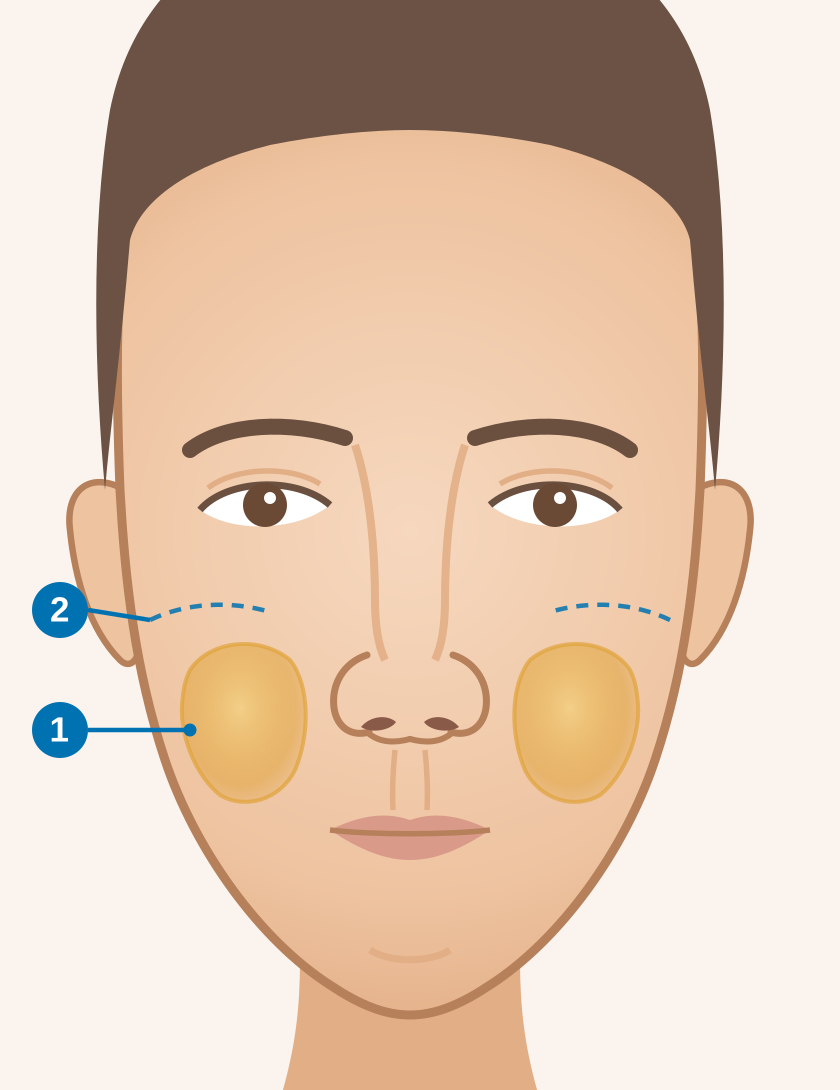
- 1Buccal fat pad (Bichat’s fat pad), deep in the cheek
- 2Level of the cheekbone
- Body fat: how full the face looks is closely linked to overall body fat [1].
- Deep buccal fat pad: if it is large, the cheeks stay full even with a slim figure.
- Chewing muscle (masseter): a strong chewing muscle, for example with teeth grinding, widens the lower face at the angle of the jaw.
- Salivary glands: the parotid glands in front of the ears can enlarge on both sides, for example with a long-standing eating disorder [5].
- Fluid retention and medication: taking steroid (cortisone) tablets for a long time can make the face round.
How to Recognise the Cause
- Soft fullness below the cheekbone: points to fat – body fat or the buccal fat pad.
- Width at the angle of the jaw that becomes hard when you clench: points to a strong chewing muscle; read more under wide jaw and masseter Botox.
- Swelling in front of the ear, on one or both sides: may come from the salivary glands and should be examined by a doctor.
If your cheeks look flat and hollow rather than full, read hollow cheeks instead; for an uneven lower face, see asymmetrical jaw.
Weight Loss and Exercises
Weight loss: if you are overweight, a lower body fat percentage is the main way to slimmer cheeks, because the face reflects body fat well [1]. You cannot lose weight from the face alone. Very large weight loss, for example after obesity surgery, can make the midface look hollow and older [3].
Exercises and massage: facial exercises, face yoga or massage can reduce swelling for a short time. There is no evidence that they reduce cheek fat.
Treatments: What the Studies Show
| Cause | Option | Evidence and limits |
|---|---|---|
| Overweight | Weight loss | The face reflects body fat [1]; very large weight loss can hollow the midface [3] |
| Large buccal fat pad | Buccal fat removal: partial removal through a cut inside the mouth | Lower face measurably slimmer, high satisfaction; small studies, short follow-up [7] |
| Strong chewing muscle | Masseter Botox | High-quality comparative trials are lacking [4]; temporary effect |
| Enlarged salivary glands | Treatment of the cause | Assessment by an ENT or maxillofacial specialist; fat removal does not help here [5] |
Buccal Fat Removal: Who It Suits and Who It Does Not
Partial removal of the buccal fat pad is only an option if, at a normal weight, the cheeks look full mainly because of a large fat pad. It is less suitable for a narrow face, for people who are overweight, when a strong chewing muscle is the main cause, and with increasing age, because the face loses volume anyway [2][3]. In one of the studies included in a review, 1.6% later had a hollow appearance; long-term results have hardly been studied [7]. Read more about the procedure under buccal fat removal.
Risks and Warning Signs
Two systematic reviews reached different figures: one found some form of complication in 81 of 308 patients (25%), most often swelling, limited mouth opening and pain; facial nerve weakness was rare [6]. The other counted 39 complications in 921 procedures (4.2%), mostly minor [7]. Part of the difference is likely whether normal swelling was counted as a complication.
- Swelling, pain, temporarily limited mouth opening [6]
- Unequal sides [6]
- Rarely infection, bruising, injury to a branch of the facial nerve [6]
- Hollow cheeks later on, especially with age [7]
Contact your doctor the same day if after the procedure the swelling increases sharply, you develop a fever, you can hardly open your mouth, or a corner of your mouth or your lip can no longer move. Have a swelling in front of the ear checked promptly if it is new, growing or painful.
Coming to Istanbul for an Assessment
Whether body fat, the buccal fat pad, the chewing muscle or the salivary glands are behind the fullness can only be judged at an examination. It takes place at the practice in Ataşehir, Istanbul.
- Before you travel: photos from the front and at a three-quarter angle, relaxed and while clenching, give first clues. Please have a swelling in front of the ear checked at home first.
- At the examination: weight, fat distribution, chewing muscle and skin quality are assessed; only then is it decided whether and which treatment makes sense.
Is It Covered by Insurance?
Slimming the cheeks for cosmetic reasons is usually not covered by public health systems or private insurers. In the UK, the NHS does not fund cosmetic treatments of this kind. Investigation of a swollen salivary gland, on the other hand, is a medical matter.
Frequently Asked Questions
Can you lose weight from your face only?
No. You cannot target the face; how full it looks depends on your overall body fat [1].
Do facial exercises help chubby cheeks?
There is no evidence that they reduce cheek fat. They can reduce swelling for a short time.
Do full cheeks get slimmer with age?
Often, yes. The face loses volume over the years, especially in the midface [2][3]. That is a reason to be cautious with fat removal.
Is buccal fat removal permanent?
The removed fat does not grow back. How the face looks after many years, however, has hardly been studied [7].
Does masseter Botox help chubby cheeks?
Only if a strong chewing muscle is causing the width. High-quality comparative trials are lacking, and the effect is temporary [4].
Personal Assessment

References
- de Jager S, Coetzee N, Coetzee V. Facial adiposity, attractiveness, and health: a review. Front Psychol. 2018;9:2562. doi:10.3389/fpsyg.2018.02562
- Rohrich RJ, Pessa JE. The fat compartments of the face: anatomy and clinical implications for cosmetic surgery. Plast Reconstr Surg. 2007;119(7):2219–2227. doi:10.1097/01.prs.0000265403.66886.54
- Jafar AB, Jacob J, Kao WK, Ho T. Soft tissue facial changes following massive weight loss secondary to medical and surgical bariatric interventions: a systematic review. Aesthet Surg J Open Forum. 2024;6:ojae069. doi:10.1093/asjof/ojae069
- Fedorowicz Z, van Zuuren EJ, Schoones J. Botulinum toxin for masseter hypertrophy. Cochrane Database Syst Rev. 2013;(9):CD007510. doi:10.1002/14651858.CD007510.pub3
- Garcia Garcia B, Dean Ferrer A, Diaz Jimenez N, Alamillos Granados FJ. Bilateral parotid sialadenosis associated with long-standing bulimia: a case report and literature review. J Maxillofac Oral Surg. 2018;17(2):117–121. doi:10.1007/s12663-016-0913-7
- Albuquerque MC, Arruda KAR, Xavier Junior GF, Cerqueira ACDSG, Massignan C, Rocha FS. Prevalence of complications of buccal fat removal: a systematic review and meta-analysis. J Craniomaxillofac Surg. 2025;53(4):363–369. doi:10.1016/j.jcms.2024.12.014
- Shapiro J, Zgardau A, Pundkay G, et al. Aesthetic outcomes, complications, and reported long-term effects of buccal fat pad reduction: a systematic review. Facial Plast Surg. 2026. doi:10.1055/a-2875-0465
This article is for general information and does not replace a medical examination. The results of any surgical or interventional procedure vary from person to person. Please seek detailed advice from your doctor before any procedure.