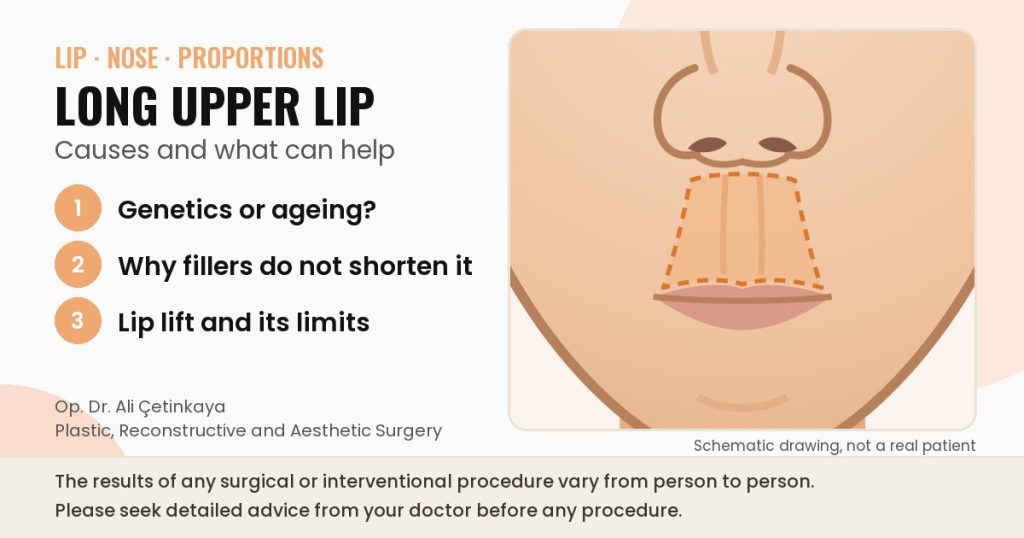
A long distance between the base of the nose and the upper lip can make the upper lip look thin and low. Less of the upper teeth shows when you speak or smile, and the face can look older or more tired than you feel.
The cause is either inborn or comes with age, and lip fillers alone usually do not solve it. Here you can read why the distance gets longer, what fillers can and cannot do, and when a lip lift may be considered, along with its limits.
In short
- The skin part of the upper lip (philtrum) can be long by nature or lengthen with age.
- With age, the red part of the lips gets thinner while the skin part of the upper lip becomes relatively longer [1].
- Lip fillers add volume but do not shorten the distance between nose and lip.
- Surgical lip lifts lasted longer than non-surgical techniques in a systematic review, but always leave a scar [2].
- In a series of 600 lip lifts, 11 patients had a slightly raised scar, treated with laser; no revision surgery was needed [3].
Why Does the Upper Lip Look Long?
The upper lip has two parts: the skin between the base of the nose and the lip border (the philtrum), and the red part of the lip (the vermilion). If the skin part is long, the red part looks thin and the lip sits low over the teeth.
- Genetics: some people have a long philtrum from a young age.
- Ageing: in a study of 346 men comparing faces at around 20 and 60 years of age, the red part of the lips became significantly thinner and the skin part relatively longer with age; sagging of the upper lip also made the mouth look wider [1]. Smoking and heavy drinking increased the sagging further in that study.
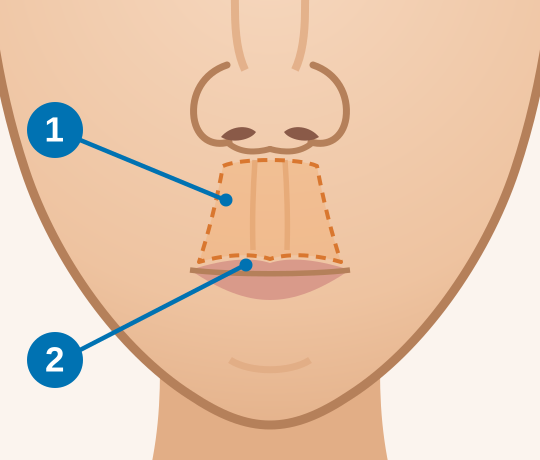
- 1Skin between the base of the nose and the lip border (philtrum), long
- 2Red part of the upper lip, thin
The overall proportions matter too: the position of the jaw and the teeth influences how much of the teeth shows. That is why the lower face is assessed as a whole.
Do Lip Fillers Help?
Fillers add volume to a thin lip and can roll the red part slightly outwards, which can make the lip look fuller. They do not shorten the skin part of the upper lip. With a clearly long philtrum, a lot of filler can make the lip heavier and pull it down rather than up. Read more under lip fillers and how to get bigger lips.
A systematic review also included non-surgical lifting techniques; their effect was temporary [2].
Lip Lift: Shortening the Distance
In a subnasal lip lift (“bullhorn” lift), a strip of skin is removed just below the base of the nose, the upper lip is moved up and the incision is closed in the natural crease under the nose. This shortens the skin part of the upper lip, shows more of the red lip and usually a little more of the upper teeth.
A systematic review of nine studies found that surgical lip lifts had a longer-lasting effect than non-surgical techniques, with good patient satisfaction, but always leave a scar [2]. In a series of 600 women who had a subnasal lip lift with tightening of the deeper tissue layer, 11 developed a slightly raised scar that was treated with fractional CO2 laser; no revision surgery was needed during a mean follow-up of 14.6 months [3]. Read more about the procedure under lip lift surgery.
Who Is a Lip Lift Suitable For?
- People whose upper lip skin is clearly long and whose upper teeth hardly show at rest.
- People in whom fillers have not given the desired result because the distance, not the volume, is the issue.
- People who accept a fine scar under the nose.
A lip lift is not suitable if a lot of gum already shows when you smile; it would increase the gum show. See gummy smile treatment. If the corners of the mouth turn down, this is a separate issue; see downturned mouth corners.
Risks and Warning Signs
Swelling, tightness and reduced feeling of the upper lip are common at first. The scar under the nose is red for some time; it can become raised or wide, and in a few cases it remains visible. If too much skin is removed, the lip can look unnatural or the nostrils can change shape. Asymmetry is possible.
Contact your treatment team the same day if after the operation you have a fever, increasing redness or swelling, discharge of pus, or a wound that opens. If you have difficulty breathing or swallowing, call emergency services straight away (112 in Turkey, 999 in the UK).
Is It Covered by Insurance?
A lip lift for cosmetic reasons is usually not covered by public health systems or private insurers, including the NHS. Clarify costs and follow-up before planning, especially if the operation is to take place abroad.
Frequently Asked Questions
Can exercises shorten the upper lip?
No. Facial exercises can make the lips more mobile but do not shorten the skin between nose and lip.
Lip lift or lip fillers?
Fillers suit a thin lip with a normal distance to the nose. A lip lift suits a long distance between nose and lip. Sometimes both are combined.
Does a lip lift change the smile?
Usually a little more of the upper teeth and the red lip show. That is why gum show is assessed beforehand.
Is the scar visible?
It lies in the crease under the nose. It is red at first and usually fades over months; in some people it stays visible or becomes raised and may need treatment [3].
Does a lip lift last?
The removed skin does not grow back. The lips continue to age, so the area can change again over the years.
Personal Assessment

References
- Raschke GF, Rieger UM, Bader RD, Schaefer O, Guentsch A, Gomez Dammeier M, Schultze-Mosgau S. Perioral aging – an anthropometric appraisal. J Craniomaxillofac Surg. 2014;42(5):e312–e317. doi:10.1016/j.jcms.2013.10.012
- Zhao H, Wang X, Qiao Z, Yang K. Different techniques and quantitative measurements in upper lip lift: a systematic review. Aesthetic Plast Surg. 2023;47(4):1364–1376. doi:10.1007/s00266-023-03302-5
- Ceran F, Askeroglu U, Pilanci O. SMAS modifications in subnasal lip lifting: evaluation of 600 patients. Aesthetic Plast Surg. 2026 (published online). doi:10.1007/s00266-026-06227-x
This article is for general information and does not replace a medical examination. The results of any surgical or interventional procedure vary from person to person. Please seek detailed advice from your doctor before any procedure.