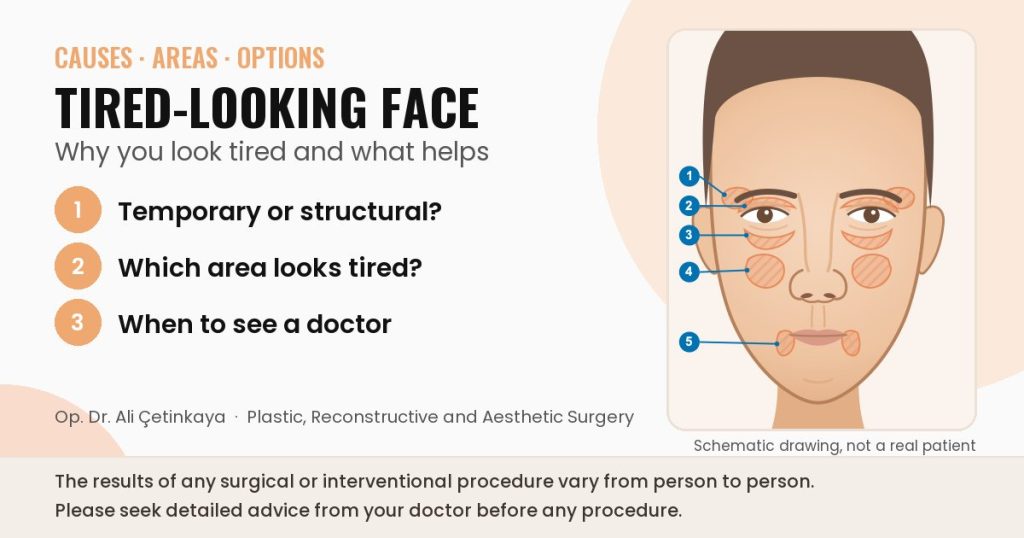
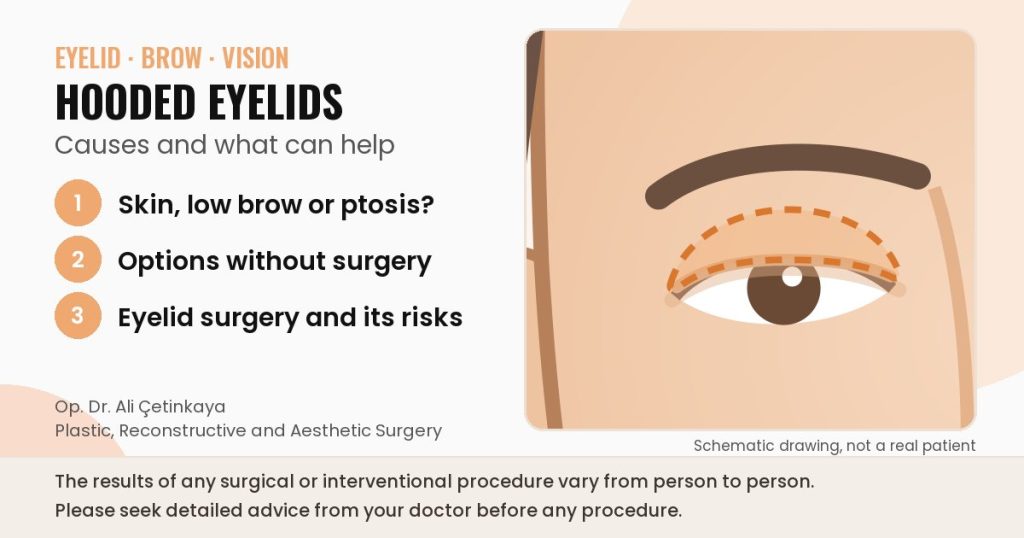
Your eyes look tired even though you have slept well? Eyeshadow smudges after a few hours and the eyelid crease has almost disappeared? Behind this are often hooded eyelids: excess skin on the upper eyelid that folds down over the crease.
Hooded eyelids are very common and usually harmless, but they can change your appearance and, in marked cases, even restrict your vision. Here you can read how to recognise them, how they differ from a low brow or a drooping lid margin, what helps without surgery and when upper eyelid surgery makes sense.
In short
- Hooded eyelids are excess, slack skin on the upper eyelid; the medical term is dermatochalasis.
- A low brow or a drooping lid margin (ptosis) can look similar but are treated differently.
- Creams, tapes and make-up help visually; excess skin cannot be removed without surgery.
- Upper eyelid surgery improved vision and everyday activities in cases with functional impairment [1].
- After eyelid surgery the brow sat slightly lower on average, so its position is checked beforehand [2][3].
What Are Hooded Eyelids?
Hooded eyelids are excess, slack skin on the upper eyelid that hangs over the natural lid crease. The medical term is dermatochalasis. Often a little fat from the eye socket also bulges forward, especially towards the inner corner, so the upper lid looks heavy and padded.
The key distinction: with hooded eyelids the skin hangs, while the lid margin itself (the edge with the lashes) sits at a normal height. If the lid margin hangs down and covers part of the pupil, this is called ptosis, a different problem with a different treatment.
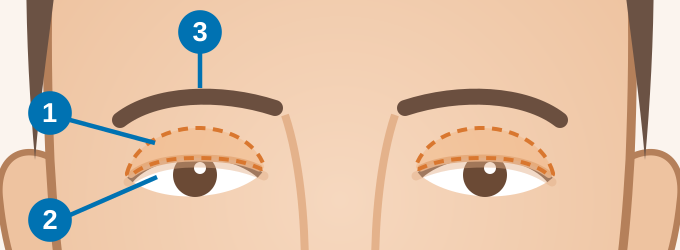
- 1Excess skin covering the lid crease
- 2Lid margin with the lashes, at its usual height
- 3Brow at its usual height
Typical Signs
- The lid crease is partly or completely hidden; little of the mobile lid is visible with the eyes open.
- Eyeshadow and eyeliner smudge or print onto the skin above.
- You look tired, sad or stern even when you feel fine.
- Your eyes feel heavy in the evening.
- You raise your brows without noticing to see more freely, which can cause forehead lines and a feeling of tension in the forehead.
- In marked cases, the upper field of vision is restricted, for example when driving or looking up.
What Causes Hooded Eyelids?
The skin of the upper eyelid is among the thinnest on the body. Over the years it loses collagen and elasticity, so hooded eyelids usually appear from middle age onwards. Other factors:
- Genetics: some people have a heavy upper lid or a low-set crease from a young age.
- Fat bulging: the tissue that holds the fat in the eye socket becomes weaker.
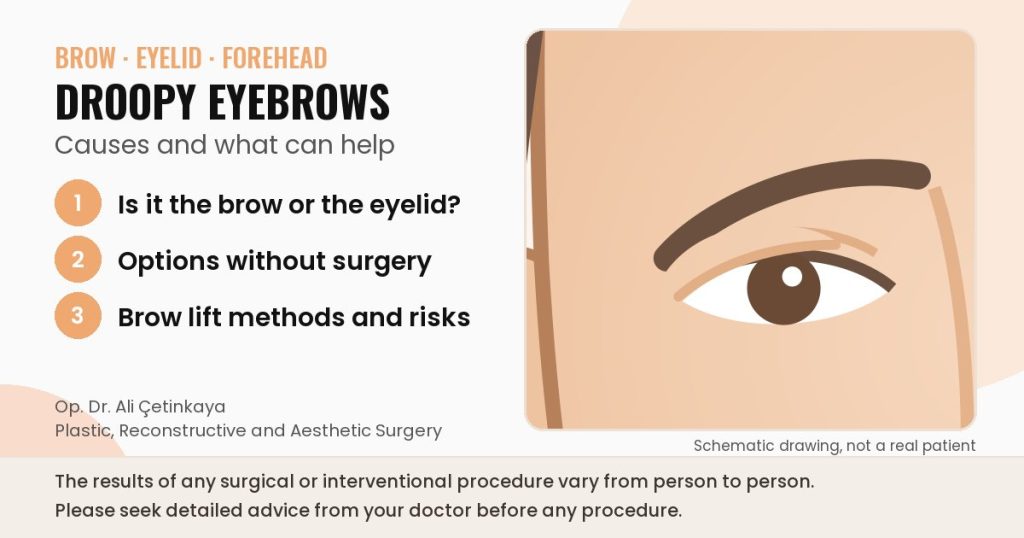
- A low brow: if the brow sits lower, it pushes extra skin onto the upper lid; see droopy eyebrows.
- External factors: UV light, smoking and frequent eye rubbing speed up skin ageing.
Hooded Lid, Low Brow or Ptosis?
Not every “droopy eye” is a hooded eyelid. Telling them apart decides which treatment helps:
| Finding | How you recognise it | Usual treatment |
|---|---|---|
| Hooded eyelid | Skin hangs over the lid crease; the lid margin sits normally | Upper eyelid surgery |
| Low brow | Gently lifting the brow with a finger largely removes the fold | Brow lift, often with eyelid surgery |
| Ptosis | The lid margin covers part of the pupil | Correction of the eyelid-lifting muscle |
Often two findings are present at the same time. That is why the position of the brow and the height of the lid margin belong in every examination before treatment.
Warning sign: if an eyelid droops suddenly, within hours or days, perhaps with double vision, headache or pupils of different sizes, this is not a hooded eyelid. Have it checked urgently; with sudden neurological symptoms such as weakness or speech problems, call emergency services straight away (112 in Turkey, 999 in the UK).
What Helps Without Surgery?
Excess skin cannot be removed without surgery. Some measures can improve the appearance temporarily:
- Creams and serums: care for the skin and soften fine lines but do not remove excess skin.
- Eyelid tapes: lift the fold for a few hours; they can irritate the skin.
- Make-up techniques: make the eye look more open (see below).
- Botulinum toxin: can lift the brow slightly for a few months if the brow is involved; it does not change the eyelid skin.
- Laser, radiofrequency, plasma: may tighten mild cases a little, usually over several sessions.
There is no evidence that eye exercises or facial exercises reverse hooded eyelids. Cool compresses help with morning puffiness, not with excess skin.
Make-up Tips for Hooded Eyes
- Prime the lid: an eyeshadow primer stops colour from creasing into the fold.
- Choose matte shades: shimmer emphasises the fold; matte colours make it recede.
- Work with your eyes open: place the contour slightly above the natural crease so it stays visible when the eye is open.
- Use waterproof products: eyeliner and mascara last much longer on a covered lid.
When Does Surgery Make Sense?
Surgery may be considered if the fold bothers you, if make-up no longer stays put or if your vision is restricted. The usual procedure is upper eyelid surgery (upper blepharoplasty): the incision lies in the natural lid crease, and excess skin and, if needed, part of the bulging fat are removed.
A report by the American Academy of Ophthalmology found that repairing upper eyelid dermatochalasis significantly improves vision, peripheral vision and everyday activities when there is functional impairment [1]. In a randomised trial of 54 patients, headache complaints fell after upper eyelid surgery [2].
If the brow also sits low, it should be treated as well; otherwise too much skin may be removed from the upper lid. A meta-analysis found that the brow sat significantly lower after upper eyelid surgery, by about 1.45 mm on average [3]. If ptosis is present, the eyelid-lifting muscle is corrected. Read more under upper eyelid surgery and eyebrow lift.
Risks and Warning Signs
Bruising, swelling and temporarily dry or irritated eyes are common after the operation. In a series of 836 eyelids, there were no major complications; minor complications occurred in 7.6–10.8%, most often small cysts along the scar (5.4%), wound openings (1.1%) and thickened scars (1.1%) [4]. Asymmetry or a noticeable scar is also possible.
Contact your treatment team the same day if after the operation you have increasing pain or swelling around the eye, a firm, bulging eyelid, reduced vision, or if you cannot close your eye. Sudden loss of vision is an emergency (112 in Turkey, 999 in the UK).
Is It Covered by Insurance?
Upper eyelid surgery for cosmetic reasons is usually not covered by public health systems or private insurers. If the excess skin measurably restricts your field of vision, funding may be possible in individual cases. As a guide, the American Academy of Ophthalmology lists signs of functional impairment such as a loss of at least 12 degrees or 24% of the upper field of vision, a chin-up head tilt to see, and discomfort or eye strain from the heavy lids [1]. In the UK this depends on local NHS criteria; the visual field is measured by an eye specialist. Clarify this before planning, especially if the operation is to take place abroad.
Frequently Asked Questions
Can hooded eyelids go away on their own?
No. Excess skin does not shrink back. Swelling, for example after a short night or with allergies, can make hooded eyelids look worse for a while.
Can you have hooded eyelids in your 20s or 30s?
Yes. Some people naturally have a heavy upper lid or a low-set crease. A low brow can also mimic hooded eyelids at a young age.
Are hooded eyelids different in men?
The causes are the same. In men the brow usually sits lower and straighter, so care is taken not to remove too much skin; otherwise the look quickly becomes unnatural.
Do hooded eyelids press on the eye?
No, they do not press on the eyeball. Many people describe heaviness and tired eyes because they keep raising their lids and brows. With pain in the eye, see an eye specialist.
Is there a scar after upper eyelid surgery?
The scar lies in the lid crease. It is red in the first weeks and usually becomes pale afterwards; with the eyes open it is usually hard to see.
Personal Assessment
References
- Cahill KV, Bradley EA, Meyer DR, Custer PL, Holck DE, Marcet MM, Mawn LA. Functional indications for upper eyelid ptosis and blepharoplasty surgery: a report by the American Academy of Ophthalmology. Ophthalmology. 2011;118(12):2510–2517. doi:10.1016/j.ophtha.2011.09.029
- Hollander MHJ, van der Hoeven JH, Verdonschot KHM, Delli K, Vissink A, Jansma J, et al. Effects of upper blepharoplasty techniques on headaches, eyebrow position, and electromyographic outcomes: a randomized controlled trial. Int J Environ Res Public Health. 2023;20(2):1559. doi:10.3390/ijerph20021559
- Liu R, Sun Y, Huang J, Long X. Brow position change and its potential risk factors following upper blepharoplasty: a systematic review and meta-analysis. Aesthetic Plast Surg. 2023;47(4):1394–1409. doi:10.1007/s00266-023-03288-0
- Hellman JB, Mahmood B, Lin LK. Safety and efficacy of resident-performed functional upper eyelid blepharoplasty. Ophthalmic Plast Reconstr Surg. 2019;35(6):578–580. doi:10.1097/IOP.0000000000001395
This article is for general information and does not replace a medical examination. The results of any surgical or interventional procedure vary from person to person. Please seek detailed advice from your doctor before any procedure.