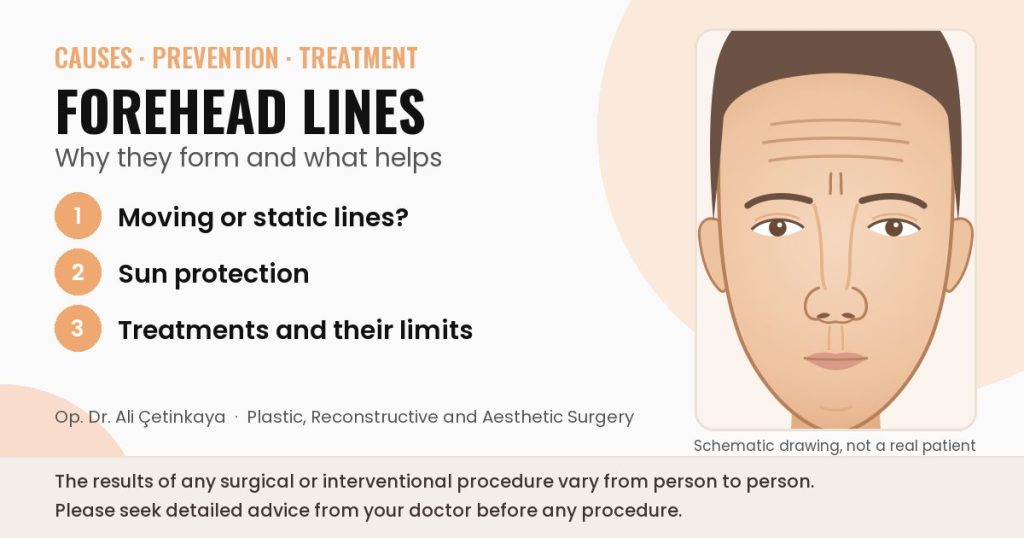
Forehead lines are the horizontal lines that appear when you raise your eyebrows, and that over time can stay visible even when your face is relaxed. They are among the first signs of facial ageing and are very common.
This guide explains why forehead lines form, how to tell moving lines from static ones, what sun protection and skin care can do, and what the treatment options are, including their limits and risks.
In short
- Forehead lines form mainly because the forehead muscle (frontalis) lifts the eyebrows thousands of times a day; sun damage, smoking, age and genetics add to them.
- Lines that appear only when you move your face (dynamic lines) respond differently from lines that stay at rest (static lines).
- Daily sunscreen slows skin ageing: in a randomised trial, skin ageing was 24% less with daily use [1].
- Botulinum toxin relaxes the forehead muscle and softens moving lines for a few months; fillers in the forehead carry a rare but serious risk and need particular care.
- If your eyebrows are low or your upper eyelids heavy, the forehead lines may be partly compensation; this changes which treatment is suitable.
Why Do Forehead Lines Form?
Forehead lines form mainly because of movement. The forehead muscle (frontalis) runs vertically under the skin of the forehead and lifts the eyebrows every time you look surprised, concentrate or open your eyes wide. The skin folds across the direction of the muscle, so the lines are horizontal.
- Age: with age the skin loses collagen and elasticity, so the folds no longer smooth out completely.
- Sun: UV light speeds up skin ageing (photoageing); regular sunscreen use measurably slows it [1].
- Smoking: smoking damages the skin’s supporting tissue and is associated with earlier wrinkles.
- Genetics and habits: skin type and how expressive your face is differ from person to person.
The short vertical lines between the eyebrows (frown lines or “11 lines”) come from a different muscle group that pulls the brows together; they are often treated together with forehead lines.
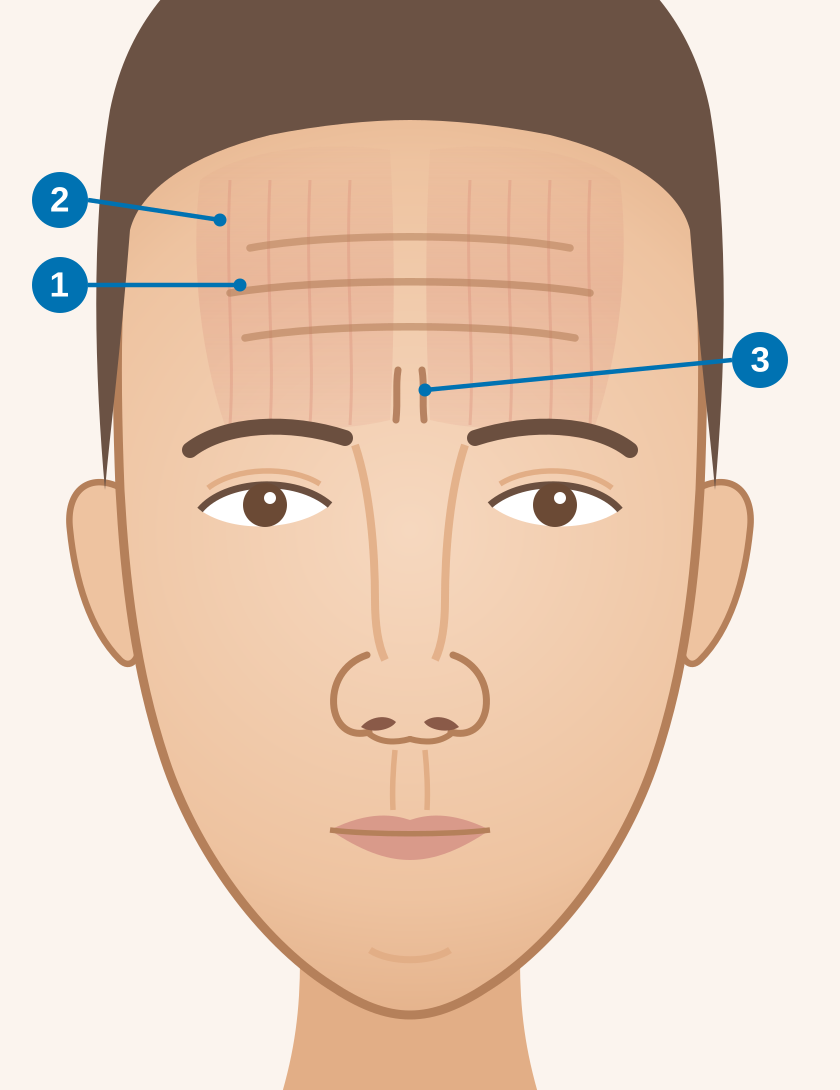
- 1Horizontal forehead lines
- 2Forehead muscle (frontalis), which lifts the brows
- 3Frown lines between the brows
Moving or Static Lines?
The difference decides which treatment can help. You can check it yourself in a mirror: relax your face completely, then raise your eyebrows.
| Type | What you see | What usually helps |
|---|---|---|
| Dynamic (moving) lines | Visible only when you raise your brows; the forehead is smooth at rest | Sun protection; botulinum toxin if they bother you |
| Static lines | Still visible when the face is relaxed | Botulinum toxin softens them, but often not completely; skin treatments or, carefully, filler may be added |
| Lines with low brows or heavy lids | You raise your brows all the time to see better or look more awake | Assessment of the brows and eyelids first; a brow lift or eyelid surgery may be more suitable |
When Forehead Lines Are a Sign of Low Brows or Heavy Lids
Some people lift their eyebrows almost constantly without noticing, because their brows have dropped or their upper eyelids feel heavy. The forehead muscle then works all day, and the lines deepen. In this case, relaxing the forehead muscle can make the brows sit lower and the eyelids feel heavier.
That is why the position of the brows and the eyelids is checked before any forehead treatment. If they are the main issue, an eyebrow lift or eyelid surgery may be the more suitable step.
How to Prevent Forehead Lines
You cannot stop the face from moving, but you can slow the skin ageing that turns moving lines into static ones.
- Daily sunscreen: in a randomised trial of 903 adults under 55, skin ageing over 4.5 years was 24% less in those who used a broad-spectrum sunscreen every day than in those who used it as they wished [1].
- Not smoking.
- Skin care: moisturisers make the skin look smoother in the short term. Prescription creams for sun-damaged skin should be chosen with a dermatologist.
- Face exercises and massage: there is no good evidence that they reduce forehead lines; the forehead muscle is already one of the most active in the face.
Treatment Options
Which option is suitable depends on the type of line, the position of the brows and your skin. An overview:
| Option | What it does | Limits |
|---|---|---|
| Botulinum toxin injection | Relaxes the forehead muscle; moving lines soften | Temporary; can lower the brows if they are already low |
| Skin treatments (e.g. laser, peels, prescription creams) | Improve the surface of sun-damaged skin | Several sessions; done by a dermatologist |
| Filler | Fills fine static lines | The forehead is a higher-risk area for blood vessel complications [3]; only with careful technique |
| Forehead lift or endoscopic forehead lift | Lifts low brows and the forehead | An operation; considered when the brows are low, not for lines alone |
A filler for forehead contour (rather than for lines) is a separate topic, explained on our forehead filler page.
Botulinum Toxin: What to Expect
Botulinum toxin is a prescription medicine that temporarily blocks the signal from nerve to muscle. In the forehead, small amounts are injected into the frontalis muscle, usually together with the muscles between the brows.
- Effect: starts after a few days and is usually fullest after about two weeks. In a randomised trial, about 9 in 10 people treated in the forehead and between the brows had no or only mild forehead lines after 30 days, compared with about 2 in 100 with placebo [2].
- Duration: usually about 3–4 months, sometimes longer; the treatment is then repeated if you wish.
- The procedure: takes a few minutes with very fine needles; most people return to their day straight away.
- Natural look: the aim is to soften the lines, not to stop all movement. A small dose in the forehead keeps some expression and reduces the risk of the brows dropping.
More on lower-dose treatment is on our baby Botox page.
Risks and Warning Signs
Common, usually short-lived effects are small bruises at the injection points, mild swelling and a headache. Less often, the brows or an upper eyelid droop temporarily, until the effect wears off.
Contact your doctor the same day if after a filler injection you have increasing pain, skin that turns pale or bluish, or any change in your vision. Sudden vision loss is an emergency: call emergency services straight away (112 in Turkey, 999 in the UK). After botulinum toxin, seek urgent help if you have difficulty swallowing, speaking or breathing.
Coming to Istanbul for an Assessment
If you are travelling from abroad, the assessment and any treatment are planned together. The examination takes place at the practice in Ataşehir, Istanbul.
- Before you travel: photos of your face at rest and with raised eyebrows, or a video call, give preliminary information. Whether the lines are dynamic, static or linked to low brows is confirmed at the in-person examination.
- Injections: are done at the practice; the effect is checked about two weeks later, which can also be done by photo or video call.
- Surgery: if a forehead or brow lift is planned, the length of stay and the check-ups are agreed at the examination.
Is It Covered by Insurance?
Treatment of forehead lines for cosmetic reasons is usually not covered by public health systems or private insurers. In the UK, the NHS does not fund cosmetic treatments of this kind. If low brows or heavy eyelids limit your field of vision, the situation may be different; check this with your insurer in advance.
Frequently Asked Questions
Can forehead lines go away on their own?
Moving lines come and go with expression. Static lines do not disappear on their own, but sun protection slows their progression [1].
From what age do forehead lines appear?
Moving lines can be seen in the twenties in people with expressive faces; static lines usually develop later and depend on skin type, sun exposure and smoking.
Can botulinum toxin make my eyebrows drop?
Yes, especially if the brows are already low or the dose in the forehead is too high. This is why the brows are assessed first and the dose is planned carefully.
Is filler a good option for forehead lines?
For fine static lines it is sometimes used, but the forehead is one of the areas where rare blood vessel complications have been reported, including vision loss [3]. It should only be done by an experienced doctor with careful technique.
Do face exercises help?
There is no good evidence that they reduce forehead lines. Daily sunscreen and not smoking are the measures with the clearest benefit.
Personal Assessment

References
- Hughes MC, Williams GM, Baker P, Green AC. Sunscreen and prevention of skin aging: a randomized trial. Ann Intern Med. 2013;158(11):781–790. doi:10.7326/0003-4819-158-11-201306040-00002
- Solish N, Rivers JK, Humphrey S, et al. Efficacy and safety of onabotulinumtoxinA treatment of forehead lines: a multicenter, randomized, dose-ranging controlled trial. Dermatol Surg. 2016;42(3):410–419. doi:10.1097/DSS.0000000000000626
- Beleznay K, Carruthers JDA, Humphrey S, Carruthers A, Jones D. Update on avoiding and treating blindness from fillers: a recent review of the world literature. Aesthet Surg J. 2019;39(6):662–674. doi:10.1093/asj/sjz053
This article is for general information and does not replace a medical examination. The results of any surgical or interventional procedure vary from person to person. Please seek detailed advice from your doctor before any procedure.