Medical review: This article has been reviewed by Op. Dr. Ali Çetinkaya, specialist in plastic, reconstructive and aesthetic surgery. Last updated:
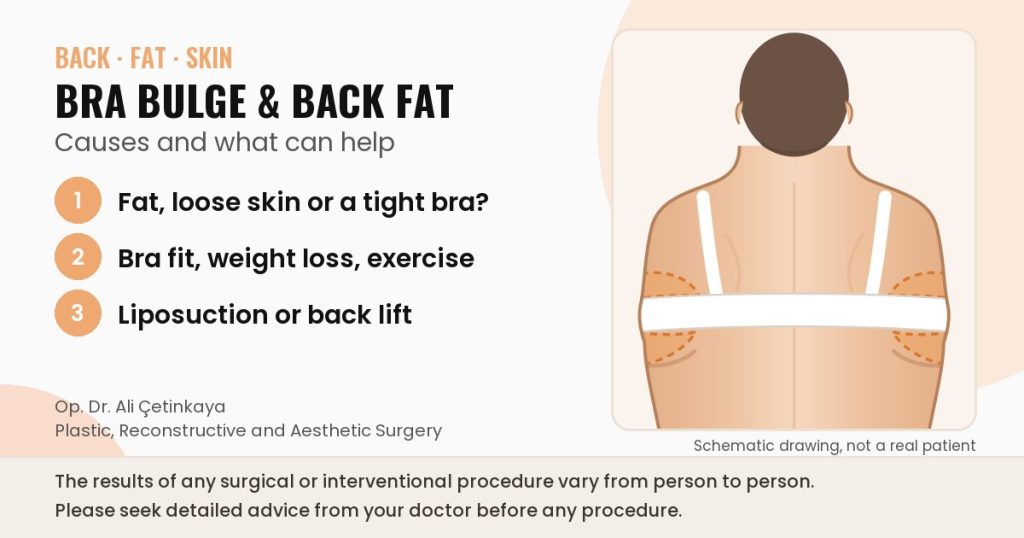
“Bra bulge” means the rolls on the back that push out above and below the bra band or at the sides under the armpits. They show most in close-fitting clothes. Often fat is behind it, but after major weight loss it can also be loose, excess skin.
What helps depends on exactly that. Here you can read what a well-fitting bra, weight loss and exercise can do, when liposuction makes sense and when a back lift may be considered, along with the limits.
In short
- Back rolls come from fat, loose skin, a bra band that is too tight, or a combination.
- A wider, well-fitting band can make rolls less visible straight away.
- Exercise reduced fat under the skin of the abdomen in a meta-analysis [4]; whether training one area burns noticeably more fat there is still debated [3].
- Liposuction removes fat, not skin; performed alone, major complications were rare in a large registry (0.7%) [2].
- Excess back skin after major weight loss can only be removed surgically [1].
What Causes Bra Bulge?
- Fat distribution: where the body stores fat is partly inherited. In some people it collects mainly on the back and flanks.
- Weight gain: as weight goes up, the fat on the back increases too.
- Major weight loss: if the skin was stretched for a long time, it often stays loose and folds into rolls.
- Age: the skin loses firmness over the years.
- A bra band that is too tight: a band that is too tight or too narrow cuts in and makes rolls stand out more.
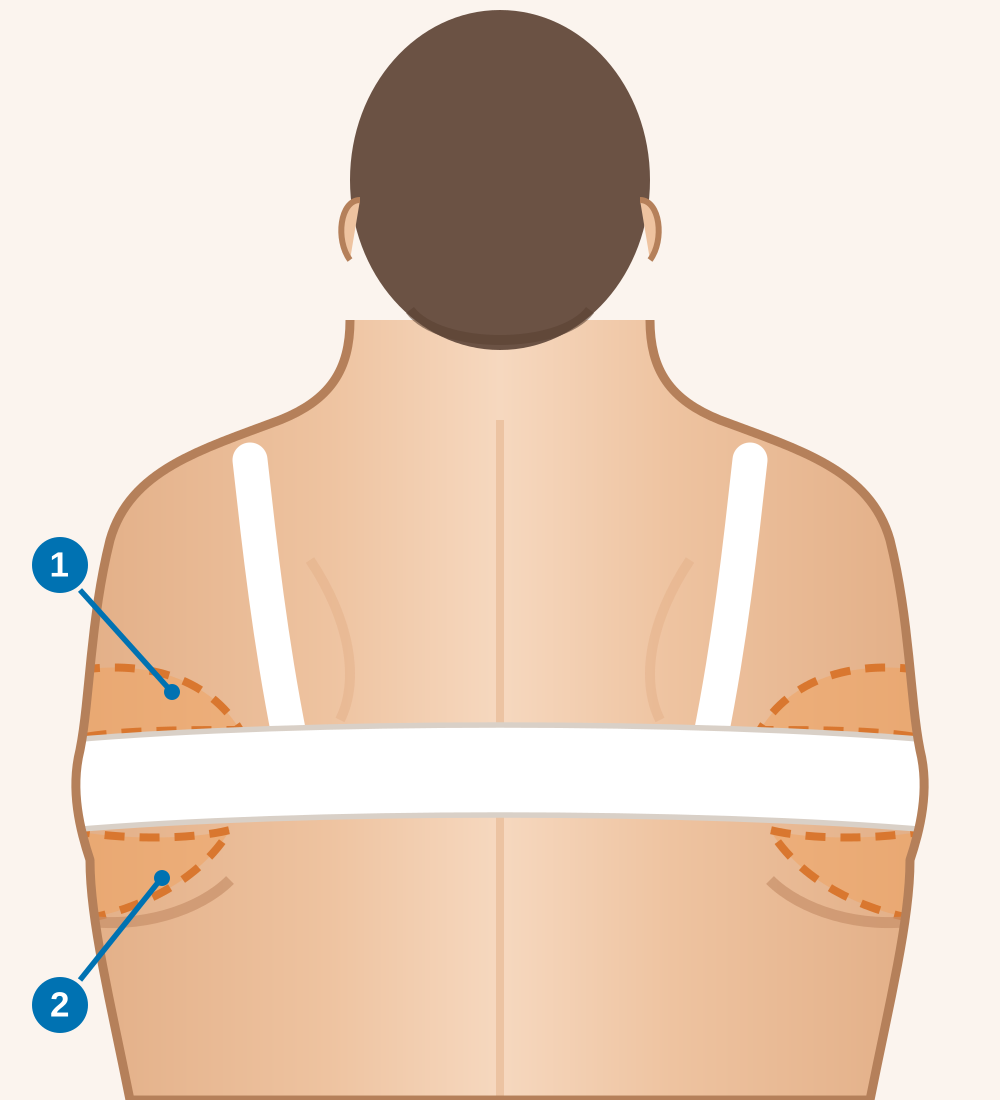
- 1Fold pushing out above the bra band
- 2Fold pushing out below the bra band
Fat or Loose Skin?
This distinction decides which treatment makes sense:
| Finding | How you recognise it | What can help |
|---|---|---|
| Mainly fat | Firm rolls, the skin is still tight | Weight loss, targeted liposuction |
| Mainly loose skin | Soft skin folds, often after major weight loss | Back lift |
| Fat and loose skin | Full rolls with excess skin | Back lift, often with liposuction |
| Pressure from the bra | Rolls only where the band sits | A well-fitting bra with a wider band |
What Helps Without Surgery?
- A well-fitting bra: a wider band that is not too tight spreads the pressure so the rolls cut in less. A professional fitting is worthwhile. If heavy breasts also strain your neck and shoulders, see heavy breasts and back pain.
- Weight loss: when your weight goes down, the fat on the back gets smaller too. Where the body loses fat first can hardly be controlled.
- Exercise: rowing, pull-ups and back exercises shape the back and improve posture. In a meta-analysis of 43 trials, aerobic, strength and combined training all reduced fat under the skin of the abdomen [4]. Whether training one area burns noticeably more fat there is debated: in a small 10-week trial in 16 men, adding abdominal exercises reduced trunk fat by about 3% more than running alone [3]. Loose skin does not shrink back through exercise.
- Creams and devices: a clear effect on fat rolls or loose skin on the back has not been shown.
When Does Liposuction Help?
Liposuction removes fat tissue through small openings a few millimetres wide. It is suitable if the skin on the back is still firm and can settle well after the fat is removed. If the skin is already loose, liposuction alone can make the sagging worse.
In a large registry of 31,010 liposuction procedures, major complications occurred in 0.7% when liposuction was performed alone; when it was combined with other operations, the risk rose clearly [2]. Read more under liposuction and stubborn fat.
Back Lift: When Skin Has to Be Removed
As more people lose a lot of weight, removing excess upper back skin has become more common; it is often planned together with surgery on the chest or breasts [1]. In a back lift, excess skin is removed together with the fat beneath it; the scar usually runs horizontally along the bra line so that clothing can cover it.
Your weight should have been stable for several months beforehand. You can read about the procedure and recovery under back lift surgery and back lift recovery.
Risks and Warning Signs
With liposuction, swelling, bruising and contour irregularities can occur. In the registry, the most common major complications of liposuction alone were haematoma, lung complications, infection and thrombosis, each in 0.15% of cases or fewer; a higher body mass index and older age increased the risk [2]. A back lift adds wound-healing problems along the scar, fluid collections under the skin (seroma) and noticeable scarring. Smoking also impairs wound healing.
Contact your treatment team the same day if after the operation you have a fever, increasing redness or swelling, discharge of pus, or a swollen, painful calf on one side. If you suddenly become short of breath or have chest pain, call emergency services straight away (112 in Turkey, 999 in the UK).
Is It Covered by Insurance?
Liposuction or a back lift for cosmetic reasons is usually not covered by public health systems or private insurers. With marked excess skin and persistent problems after major weight loss, funding may be possible in individual cases; in the UK this depends on local NHS criteria. Clarify this before planning, especially if the operation is to take place abroad.
Frequently Asked Questions
Can you get rid of bra bulge with exercise?
Exercise strengthens the back muscles and helps with weight loss. Whether it burns noticeably more fat on the back itself is debated [3]; loose skin does not shrink back through exercise.
Which bra helps with back rolls?
A bra with a wide, well-fitting band that does not cut in. Often a band that is too tight or the wrong size is the cause.
Is there a scar after a back lift?
Yes. It usually runs along the bra line so that clothing can cover it. It is red at first and fades over months; how visible it remains varies.
How long should my weight be stable before a back lift?
Several months. After weight-loss surgery, decide on the timing together with your treatment team. Loose skin after weight loss often affects other areas too: see sagging belly skin, saggy arm skin and loose thigh skin.
Can the fat come back after liposuction?
Removed fat cells do not grow back, but if you gain weight, the remaining fat cells can get bigger. A stable weight helps the result last.
Personal Assessment
References
- Shermak MA. Management of back rolls. Aesthet Surg J. 2008;28(3):348–356. doi:10.1016/j.asj.2008.03.005
- Kaoutzanis C, Gupta V, Winocour J, Layliev J, Ramirez R, Grotting JC, Higdon K. Cosmetic liposuction: preoperative risk factors, major complication rates, and safety of combined procedures. Aesthet Surg J. 2017;37(6):680–694. doi:10.1093/asj/sjw243
- Brobakken MF, Krogsaeter I, Helgerud J, Wang E, Hoff J. Abdominal aerobic endurance exercise reveals spot reduction exists: a randomized controlled trial. Physiol Rep. 2023;11(22):e15853. doi:10.14814/phy2.15853
- Yarizadeh H, Eftekhar R, Anjom-Shoae J, Speakman JR, Djafarian K. The effect of aerobic and resistance training and combined exercise modalities on subcutaneous abdominal fat: a systematic review and meta-analysis of randomized clinical trials. Adv Nutr. 2021;12(1):179–196. doi:10.1093/advances/nmaa090
This article is for general information and does not replace a medical examination. The results of any surgical or interventional procedure vary from person to person. Please seek detailed advice from your doctor before any procedure.