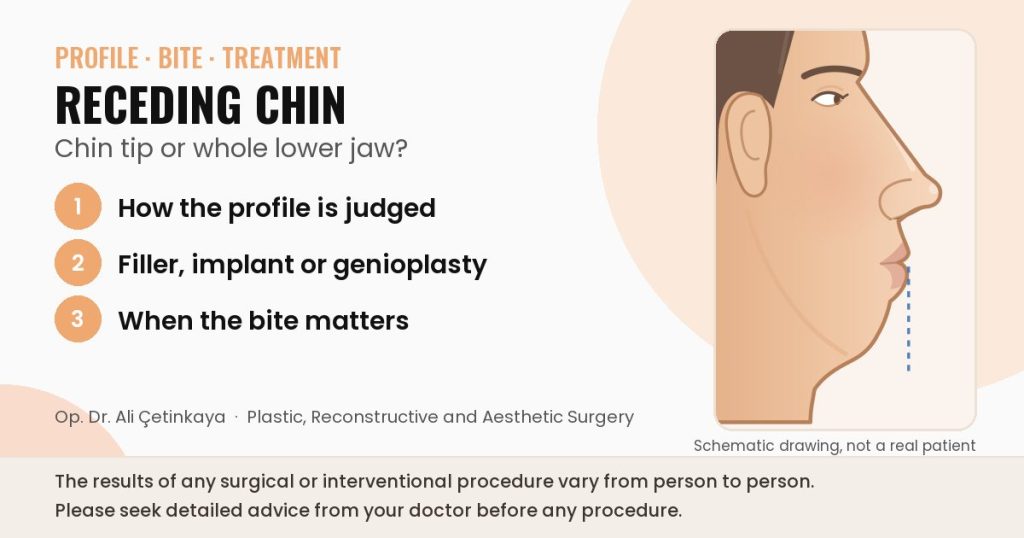
A receding chin (weak chin) sits clearly behind the line of the lips and forehead in profile. The nose and neck then often look more prominent, and the angle between jaw and neck is less defined.
Whether and how this can be changed depends mainly on one question: is only the tip of the chin set back, or is the whole lower jaw too far back – often together with a bad bite? Here you can read how to tell the difference and what the options are, along with their limits.
In short
- A careful profile analysis is the basis for choosing the right treatment [1].
- If only the chin tip is set back and your bite is normal, filler, a chin implant or a bony chin advancement (genioplasty) are possible [2][3][4].
- If the whole lower jaw is set back with a bad bite, orthodontics and jaw surgery are needed; a chin correction alone does not change the bite.
- Exercises and “mewing” cannot move the bone.
- Loud snoring with breathing pauses should be checked for sleep apnoea; surgery that moves the jaws forward is one of its treatments [5].
Chin Tip or the Whole Lower Jaw?
This distinction is the most important step, because it decides the treatment route. A common way to judge the profile is a vertical line dropped from the lower lip: the further the chin lies behind it, the more receding it looks. There are several measurement methods for soft tissue and bone; experts stress that a careful profile analysis comes before any decision [1].
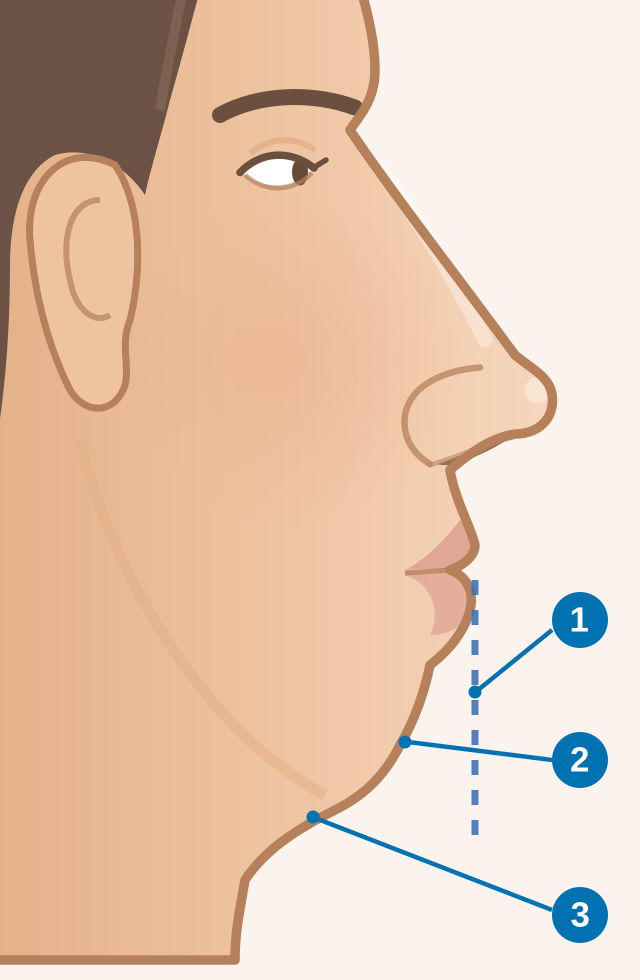
- 1Vertical reference line from the lower lip
- 2Chin tip lying behind the line
- 3Transition from chin to neck
- Only the chin tip is set back: your teeth meet normally, but the chin itself is small or flat. Cosmetic procedures on the chin are possible here.
- The whole lower jaw is set back: often the upper front teeth sit well in front of the lower ones (overjet). Then it is not just about appearance but also about bite, chewing and sometimes breathing during sleep. This belongs to orthodontists and oral and maxillofacial surgeons; a chin correction alone does not change the bite.
What Causes a Receding Chin?
- Genetics: the size and shape of the chin and lower jaw are largely inherited.
- Jaw growth: if the lower jaw grows less during adolescence, the chin later sits further back.
- Bite problems: an overbite strengthens the impression of a receding chin.
- Soft tissue and neck: a double chin or loose neck skin make the chin look even smaller; read more under disappearing jawline.
What Are the Options?
| Option | What is done | Evidence and limits |
|---|---|---|
| Hyaluronic acid filler | Volume is injected into the chin without surgery | Rated safe and effective for a set-back chin in a randomised trial [3]; temporary, broken down over time |
| Chin implant | An implant is placed in front of the chin bone | Review of more than 3,100 patients: low overall complication rates; the surgical approach influenced complications [4] |
| Bony chin advancement (genioplasty) | The front of the chin bone is cut, moved forward and fixed | Advancement of 8.2 mm on average stayed largely stable after one year (bone moved back 0.1–2.1 mm) [2] |
| Lower jaw advancement | Orthodontic preparation and surgery on the lower jaw | For a set-back lower jaw with a bad bite; a larger operation with a longer treatment |
Read more about the individual procedures under chin implant surgery; the bony technique (genioplasty) is described under chin reduction surgery. If the chin points to one side rather than backwards, see asymmetrical jaw.
What Helps Without Surgery?
Facial exercises and “mewing” cannot change the position of the bone. Upright posture makes the jawline look a little clearer in everyday life but does not change the anatomy.
Hyaluronic acid filler can bring the chin forward without surgery; in a randomised trial in people with a set-back chin, it was rated safe and effective [3]. The result is temporary because the body breaks the material down. Rare but serious complications include blocked blood vessels [6], so treatment belongs in experienced medical hands.
Chin Implant or Genioplasty?
There is no general answer. An implant adds volume in front of the bone; in a review, implant materials differed, for example in the rate of numbness [4]. Genioplasty moves your own bone and can also change the height of the chin; its forward position was largely stable after one year [2]. Which suits you depends on your anatomy, your bite and your wishes.
Risks and Warning Signs
- Filler: swelling and bruising are common; rarely, filler can block a blood vessel [6].
- Chin implant: infection, shifting, asymmetry, numbness; possibly correction or removal [4].
- Genioplasty: swelling, temporary numbness of the lower lip and chin, rarely lasting changes in sensation; slight relapse of the bone [2].
- Jaw surgery for sleep apnoea: moving both jaws forward was successful in 79.6% in a meta-analysis but came with more infections and hardware removal than standard jaw surgery [5].
Contact your treatment team the same day if after surgery you have a fever, increasing swelling or redness, pus inside the mouth or severe pain. If you have difficulty breathing or severe swelling in the mouth and neck, call emergency services straight away (112 in Turkey, 999 in the UK).
Coming to Istanbul for an Assessment
Whether only the chin tip is set back or the lower jaw and bite are involved is shown by an examination with profile analysis. It takes place at the practice in Ataşehir, Istanbul.
- Before you travel: profile photos with a relaxed face and a photo of your teeth when biting together give first clues.
- With a bad bite or snoring: an orthodontic or sleep assessment at home first is sensible.
Is It Covered by Insurance?
Chin correction for cosmetic reasons is usually not covered by public health systems or private insurers. If there is a marked jaw deformity that needs orthodontic and surgical treatment, or sleep apnoea, funding may be possible; in the UK this is decided after referral to an NHS orthodontic, maxillofacial or sleep team.
Frequently Asked Questions
Can you fix a receding chin with exercises?
No. Exercises strengthen muscles but do not move the bone. Good posture can make the jawline look slightly clearer.
Is a chin implant or genioplasty better?
Neither is better in general. An implant adds volume in front of the bone [4]; genioplasty moves your own bone and was largely stable after one year [2].
Does the nose matter?
Yes. Nose, lips and chin together shape the profile. A receding chin can make the nose look larger, so the whole profile is considered when planning [1].
From what age does treatment make sense?
Usually only once facial growth is complete. With a bad bite, assessment often starts in the teenage years with an orthodontist.
Is a receding chin linked to snoring?
Loud snoring with breathing pauses should be checked for sleep apnoea, especially with a set-back lower jaw. Surgery that moves the jaws forward is one of the treatments for sleep apnoea [5].
Personal Assessment

References
- Arroyo HH, Olivetti IP, Lima LFR, Jurado JRP. Clinical evaluation for chin augmentation: literature review and algorithm proposal. Braz J Otorhinolaryngol. 2016;82(5):596–601. doi:10.1016/j.bjorl.2015.09.009
- Janssens E, Shujaat S, Shaheen E, Politis C, Jacobs R. Long-term stability of isolated advancement genioplasty, and influence of associated risk factors: a systematic review. J Craniomaxillofac Surg. 2021;49(4):269–276. doi:10.1016/j.jcms.2021.01.013
- Nikolis A, Metelitsa A, Raco L, Safran T. Safety and effectiveness of two high-G′ soft tissue fillers for chin augmentation: a prospective, randomized, comparator-controlled, evaluator-blinded trial. Aesthet Surg J. 2026;46(5):503–508. doi:10.1093/asj/sjaf222
- Liao CD, Rodriguez E, Zhao K, Kunda N, George F. Complications following alloplastic chin augmentation: a systematic review of implant materials and surgical techniques. Ann Plast Surg. 2023;90(6S Suppl 5):S515–S520. doi:10.1097/SAP.0000000000003423
- Kassir MF, Walker A, Howser LA, et al. Comparative meta-analysis of complications of maxillomandibular advancement for OSA versus orthognathic surgeries for dentofacial deformities. Otolaryngol Head Neck Surg. 2026;175(5):1005–1017. doi:10.1002/ohn.70352
- Beleznay K, Carruthers JDA, Humphrey S, Carruthers A, Jones D. Update on avoiding and treating blindness from fillers: a recent review of the world literature. Aesthet Surg J. 2019;39(6):662–674. doi:10.1093/asj/sjz053
This article is for general information and does not replace a medical examination. The results of any surgical or interventional procedure vary from person to person. Please seek detailed advice from your doctor before any procedure.