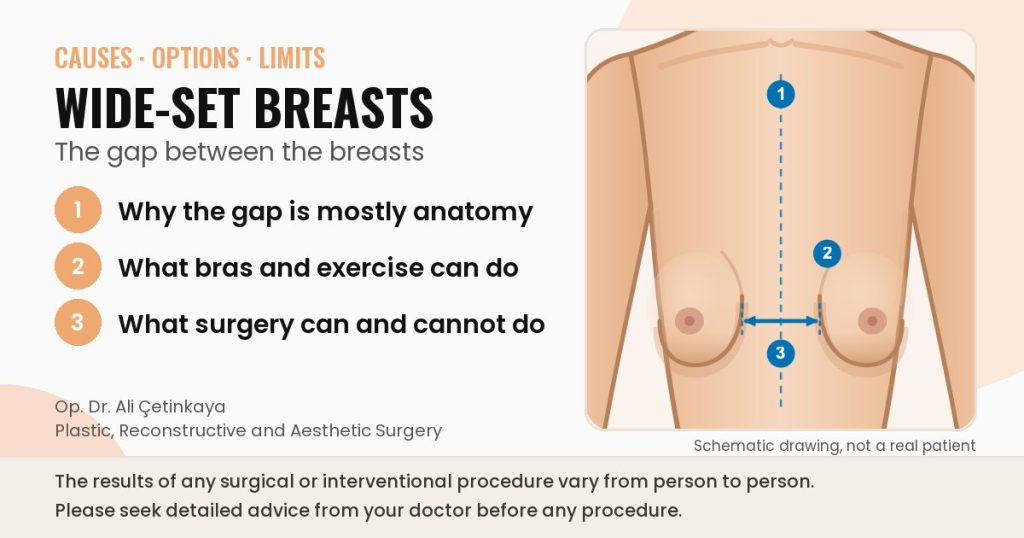
Wide-set breasts have a broad gap between them, so even in a bra they barely meet to form a cleavage. Many women notice this from puberty; others only after pregnancy, breastfeeding or weight loss.
The gap is mostly a matter of anatomy and can only be changed within limits. This guide explains why it happens, what bras, exercise and surgery can and cannot do, and where the limits lie.
In short
- Where each breast begins on the chest wall is something you are born with. If it starts further out, a wider gap stays, whatever the breast size.
- A wide gap is very common and in itself is not a health problem.
- Push-up and plunge bras are the simplest way to shape a cleavage. Chest exercises improve posture but do not move the breasts closer together.
- Breast augmentation, a breast lift or fat grafting can narrow the gap. How far it narrows depends on your chest, the position of the breast base and the thickness of your tissue.
- Implants that are too wide, or a pocket made too far towards the midline, can lead to synmastia (the breasts merging across the breastbone). A safe plan respects the midline, so some gap often remains.
Why Are Some Breasts Wide-Set?
In most women, wide-set breasts are simply the shape they were born with. Several factors can add to it:
- Anatomy: where the breast base starts on the chest wall is inherited. If it starts further out, a wider gap remains, regardless of breast size.
- Shape of the chest: a breastbone that sticks out or is sunken (pectus carinatum or pectus excavatum) and a broad rib cage can make the breasts look further apart.
- Little breast tissue: with small breasts the gap often looks larger, because there is little volume towards the middle. More on this in our article on choosing implant size.
- Sagging: after pregnancy, breastfeeding or weight loss, the breasts sink and fall outwards, which makes the gap in the middle look wider.
- Particular breast shapes: in a tuberous (tubular) breast the base is narrow and the breasts often sit far apart.
Is a Wide Gap Normal, and How Is It Measured?
Yes, a wide gap is normal. The distance between the breasts varies a great deal from woman to woman and is usually not a health problem. A check-up is worthwhile if the shape of one breast changes, or if you feel a new lump.
Before any procedure, the surgeon measures the chest. The key measurements are the width of each breast base, the distance between the inner edges of the breasts (the intermammary distance), and how thick the skin and tissue are. Planning systems in breast augmentation use measurements like these to match the implant to your own tissues, rather than forcing the tissues towards a desired look [3].
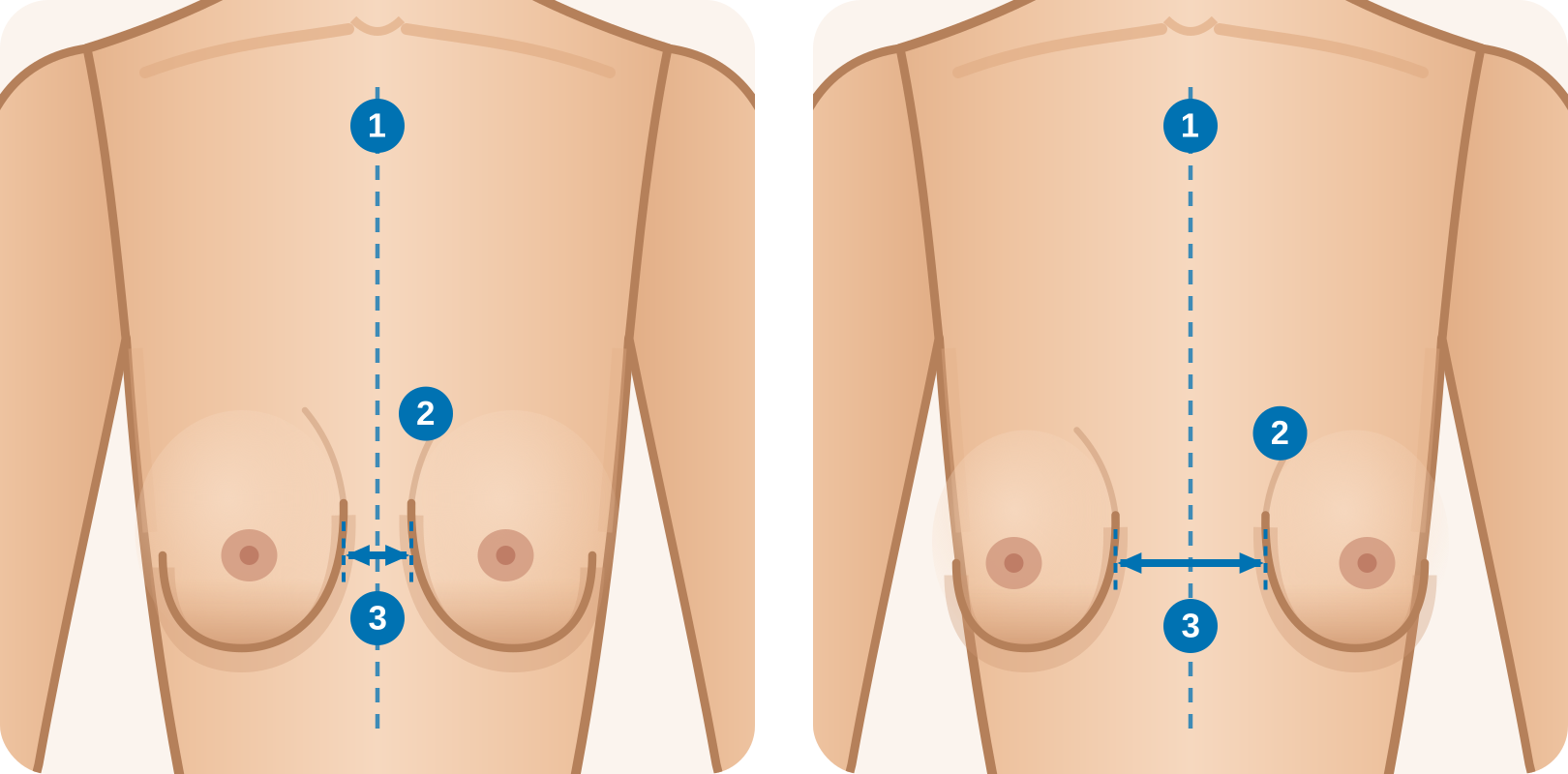
- 1Midline of the breastbone
- 2Inner edge of the breast base
- 3Distance between the breasts (intermammary distance)
What Helps Without Surgery?
A well-fitting bra is the only non-surgical option that visibly changes the cleavage; exercise and creams do not change the gap.
- Bra choice: push-up and plunge bras push the breasts towards the middle and are the simplest way to shape a cleavage. A good fit matters more than the brand.
- Exercise: chest-muscle training improves posture and firmness. It does not change the gap, because the breast itself is made of glandular and fatty tissue, not muscle.
- Creams and devices: there is no evidence that they change the distance between the breasts.
Which Procedures Are Considered?
Whether, and by how much, the gap can be narrowed depends mainly on your chest, where your breast base starts and the thickness of your skin and tissue. Surgeons have only limited control over this [1].
| Finding | Possible procedure | What it can do |
|---|---|---|
| Small breasts, gap in the middle | Breast augmentation with implants | More fullness towards the middle; the gap gets smaller, but not without limit |
| Sagging breasts that fall outwards | Breast lift, with an implant if needed | The breasts are lifted and reshaped |
| Slight gap or asymmetry | Fat grafting to the inner side | Fine correction; part of the fat is reabsorbed |
| Pectus carinatum or excavatum | Assessment of the chest wall | Planning depends on the shape of the chest |
In one study, 86 women who were having breast augmentation, breast reduction, a lift or reconstruction also had fat grafted into the inner part of the breasts. After twelve months, the average distance between the breasts fell from 3.0 to 1.7 cm, and there were no major complications [1]. The results come from a single clinic, and the women were also having other breast surgery, so they cannot be applied to every starting point.
More on implant types, implant position and recovery is on our breast augmentation page.
Why Implants Cannot Close the Gap Completely
Implants can bring the breasts closer, but only as far as the breastbone and the skin attached over it allow. Wanting a very close cleavage sometimes leads to implants that are too large, or to a pocket that is opened too far towards the middle.
This can cause synmastia: the breasts run into each other across the breastbone, with no visible separation. In a review of 20 women with synmastia, ten had had several previous breast operations, and twelve had implants that looked too wide for their chest. The authors named multiple operations, implants that are too large and too much dissection towards the midline as the main risk factors [2]. Synmastia is difficult to correct. A safe result therefore respects the natural midline, and some gap often remains.
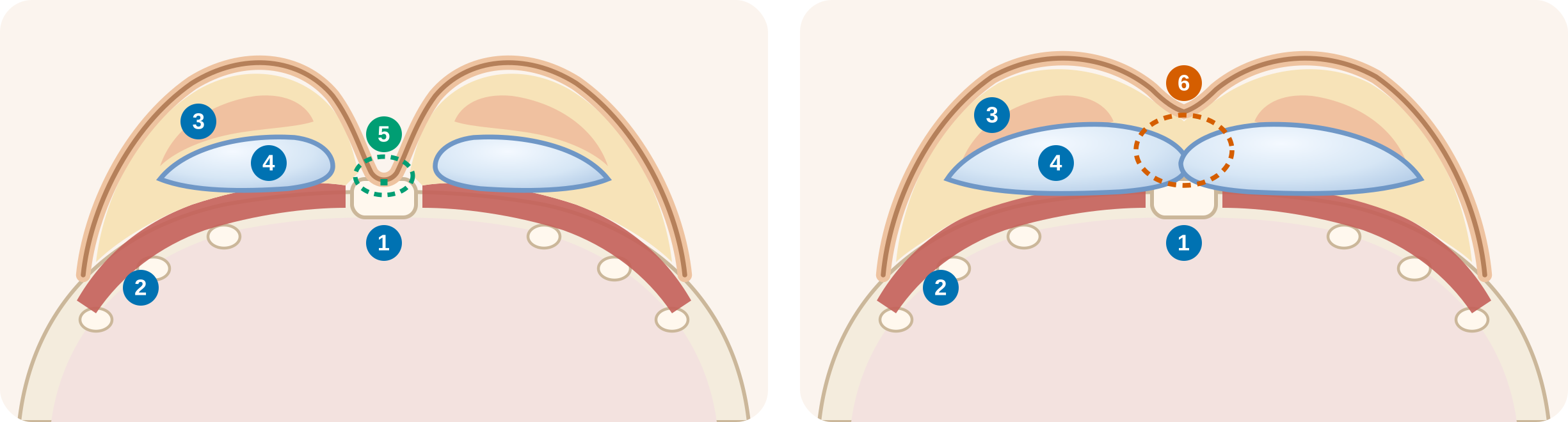
- 1Breastbone (sternum)
- 2Chest muscle (pectoralis major)
- 3Breast tissue (gland and fat)
- 4Implant
- 5Skin still attached over the breastbone
- 6Pocket that has crossed the midline
Surgery and Recovery
Breast augmentation is done under general anesthesia and takes about 1–2 hours; you usually stay one night in hospital. The incision is placed in the fold under the breast. Desk work is often possible after 5–7 days, and strenuous exercise after 4–6 weeks.
An implant is not a lifelong product; it may need to be exchanged over the years. When and how implants are removed is explained in our article on breast implant removal.
Warning signs after surgery: contact your care team the same day if you have a fever, increasing redness, clearly one-sided swelling, or severe pain in one breast. If you have sudden shortness of breath or chest pain, call emergency services straight away (112 in Turkey, 999 in the UK).
Coming to Istanbul for an Assessment
If you are travelling from abroad, the consultation, surgery, check-up and journey home are planned together. The examination takes place at the practice in Ataşehir, Istanbul; the operation takes place in a hospital operating theatre (Memorial Göztepe Hospital).
- Before you travel: front and side photos, or a video call, give preliminary information. Whether and how far the gap can be narrowed is only confirmed at the in-person examination and measurement.
- Length of stay: for breast augmentation, a stay of about 5–7 days in Istanbul is usually advised. The exact length is decided at the examination.
- Flying home: for a long flight you usually wait until after the first check-up. Walk regularly on board.
- After you return: agree in advance how remote follow-up will work and what to do if a problem appears at home.
Is It Covered by Insurance?
Surgery done only to change the distance between the breasts is a cosmetic procedure and is usually not covered by public health systems or private insurers. In the UK, the NHS does not usually fund cosmetic breast surgery. With a marked chest wall deformity the situation may be different; check this with your insurer in advance.
What determines the fee is explained on the breast augmentation page; a firm price is given only after examination and measurement.
Frequently Asked Questions
Is a large gap between the breasts normal?
Yes. The distance varies widely from woman to woman and is usually not a health problem. See a doctor if the shape of one breast changes or you feel a new lump.
Can exercise bring wide-set breasts closer together?
No. Training strengthens the chest muscle underneath the breast and improves posture. It does not change where the breast tissue sits or the distance between the breasts.
Can implants close the gap completely?
Usually not completely. Your anatomy limits how close the breasts can come. Implants that are too large, or a pocket made too far towards the middle, increase the risk of synmastia.
Does a breast lift help with wide-set breasts?
If the breasts have sagged and fall outwards, a breast lift can improve their shape. If the main issue is low volume, an implant or fat grafting may be discussed.
Is fat grafting enough on its own?
For a slight gap or asymmetry it may be. Part of the transferred fat is reabsorbed, so more than one session may be needed. In the study above, fat grafting was done together with other breast surgery [1].
Personal Assessment

References
- Serra-Mestre JM, Fernandez Peñuela R, Foti V, D’Andrea F, Serra-Renom JM. Breast cleavage remodeling with fat grafting: a safe way to optimize symmetry and to reduce intermammary distance. Plast Reconstr Surg. 2017;140(5):665e–672e. doi:10.1097/PRS.0000000000003788
- Spear SL, Bogue DP, Thomassen JM. Synmastia after breast augmentation. Plast Reconstr Surg. 2006;118(7 Suppl):168S–171S. doi:10.1097/01.prs.0000246107.70668.97
- Tebbetts JB, Adams WP. Five critical decisions in breast augmentation using five measurements in 5 minutes: the high five decision support process. Plast Reconstr Surg. 2006;118(7 Suppl):35S–45S. doi:10.1097/01.prs.0000191163.19379.63
This article is for general information and does not replace a medical examination. The results of any surgical or interventional procedure vary from person to person. Please seek detailed advice from your doctor before any procedure.