Exercise, weight gain, creams, and still the breasts do not grow? Many women wonder at some point whether something is wrong with their small breasts. In most cases the answer is reassuring: small breasts are a normal variation of the body, not a disease.
This guide explains what decides breast size, when a medical check is worthwhile, which methods really make a difference and which do not, and when surgery may be considered.
In short
- Breast size is decided mainly by inheritance, hormones during puberty and body fat. Small breasts are usually a normal variant.
- Breast development usually starts between the ages of 8 and 13 and is largely complete by the late teens or early twenties.
- See a doctor if breast development has not started by about 13, if periods have not started by 15, or if a breast changes suddenly.
- Exercise, creams, pills and vacuum devices do not make breast tissue grow; a well-chosen bra changes the look, not the size.
- Breast augmentation with implants or fat transfer is the only lasting way to add volume. It is considered only after breast development is complete, and a tuberous breast or a marked asymmetry needs particular planning.
What Decides Breast Size?
Breast size depends mainly on three things: inheritance, hormones and body fat. The breast is made of glandular tissue, fatty tissue and connective tissue.
- Inheritance: breast size runs strongly in families. If your mother, grandmother or sisters have small breasts, yours are likely to be similar.
- Hormones: during puberty, mainly oestrogen and progesterone drive the development of the breast gland [1]. How strongly the tissue responds to these hormones differs from person to person.
- Body fat: a large part of the breast is fat. With very low body fat, for example in competitive athletes, the breasts often stay small.
When Do Breasts Stop Growing?
Breast development usually begins between the ages of 8 and 13 and is largely complete by the late teens, at the latest in the early twenties. After that, size changes mainly with weight, pregnancy, breastfeeding and age; the glandular tissue itself does not grow much further.
Why Are My Breasts Small?
By far the most common reason is a normal, inherited build. Other reasons include:
- Low body weight or marked weight loss.
- Volume loss after pregnancy and breastfeeding: the breasts may afterwards be smaller and softer than before.
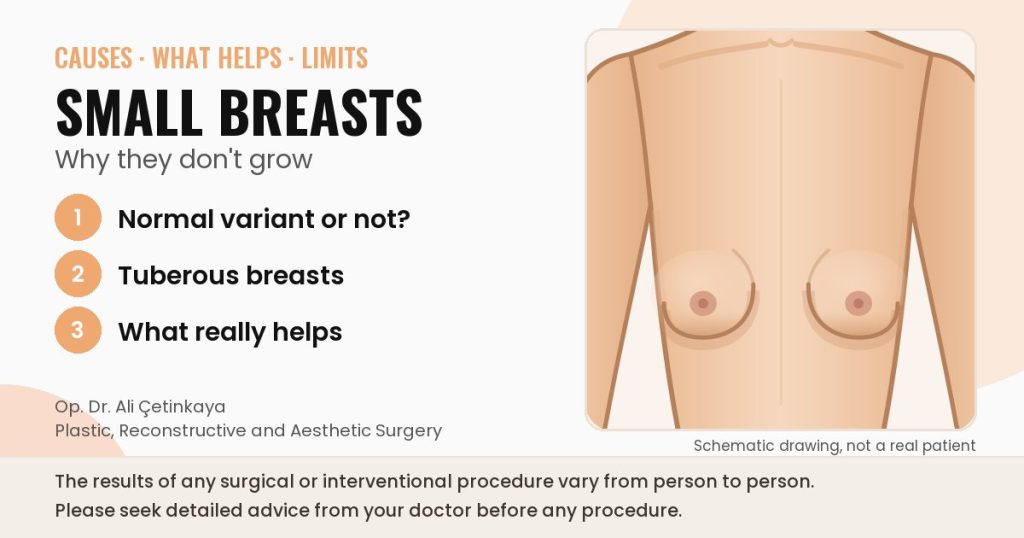
- Developmental differences: in a tuberous breast the base is narrow, the fold under the breast sits high and the areola bulges forward. Marked differences between the sides, and very rare conditions such as Poland syndrome, also occur. Slight asymmetry is completely normal.
- Hormonal disorders are rarely the reason for small breasts when puberty has otherwise been normal.
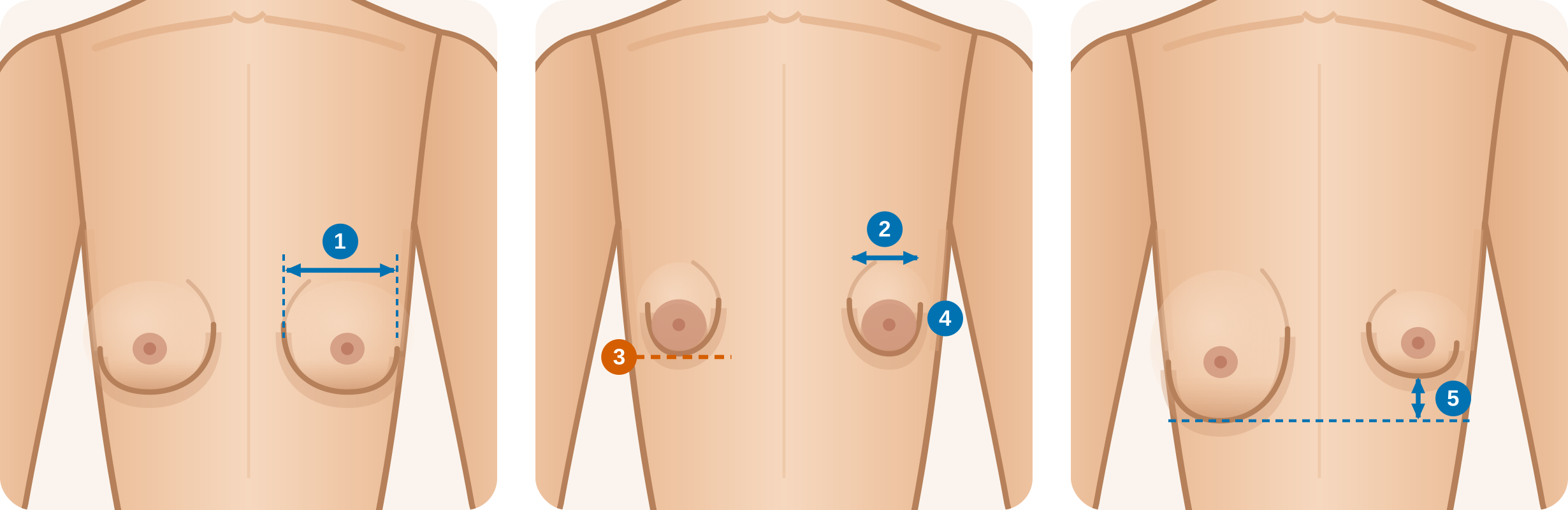
- 1Normal small breast: the base is wide
- 2Tuberous breast: narrow base
- 3Tuberous breast: the fold under the breast sits high
- 4Tuberous breast: large areola that bulges forward
- 5Asymmetry: difference in size between the sides
When Should I See a Doctor?
A check-up is worthwhile if breast development has not started by about the age of 13, if periods have not started by 15, or if a breast changes suddenly. In medical guidelines, no periods by 15 despite otherwise normal puberty, or by 13 with no signs of puberty, is called primary amenorrhoea and is a reason for assessment [3]. The first point of contact is your GP or a gynaecologist; for a teenager, a paediatrician.
See a doctor promptly if you notice a new lump, a change in the skin or nipple, or a clear change in the size or shape of one breast. These signs are not related to breast size and should always be checked.
Tuberous (Tubular) Breasts: How to Recognise Them
A tuberous breast is a congenital developmental difference that often becomes noticeable during puberty. It occurs in varying degrees of narrowing, low volume, lack of skin, a bulging areola and asymmetry [2]. Typical signs are:
- a narrow, rather tube-shaped breast with a small base;
- a fold under the breast that sits high and is short;
- a large areola that bulges forward;
- often a clear difference between the two sides.
An implant alone is usually not enough here: the breast base is widened, the fold under the breast is lowered and the areola is reduced if needed; volume is added with an implant or fat. In a series of 26 women (51 breasts) treated with this kind of plan, 47 breasts were corrected in one operation and 4 in two stages; complications included capsular contracture in two breasts and implant malposition in two [2]. These results come from one surgeon’s series and cannot be applied to everyone, which is why careful examination and planning matter.
What Helps, and What Does Not?
Only weight gain and surgery change the volume of the breast; everything else changes posture or the look in clothes.
| Method | What it does | Limits |
|---|---|---|
| Chest exercises | Strengthen the muscle under the breast; posture and contour look a little firmer | The breast tissue itself does not grow |
| Creams, pills, herbal products | No proven lasting effect | Products with plant oestrogens only after speaking to a doctor |
| Vacuum devices | Short-term swelling | No lasting volume |
| Weight gain | The breasts often grow a little | Cannot be targeted; disappears with weight loss |
| Bra, swimwear, clothing | More fullness and shape in clothes | Only changes the look |
| Breast augmentation | Lasting, planned increase in volume | An operation with risks; thorough advice needed |
Bras and Swimwear for Small Breasts: Five Tips
- Push-up and balconette bras lift the breasts and shape a cleavage.
- Bralettes and triangle bras often fit small breasts better than bras with large cups that stand away from the body.
- Have your size measured: many women with small breasts wear a band that is too loose.
- Bikini tops with ruffles, knots or patterns make the breasts look fuller; bandeau tops with removable padding add shape.
- Clothing with details at the neckline, such as gathering, wrap styles or pockets, draws the eye.
Breast Augmentation: Implants or Fat Transfer
If you feel persistently uncomfortable with your breast size, breast augmentation is the only method that adds volume in a lasting, planned way. There are two main options:
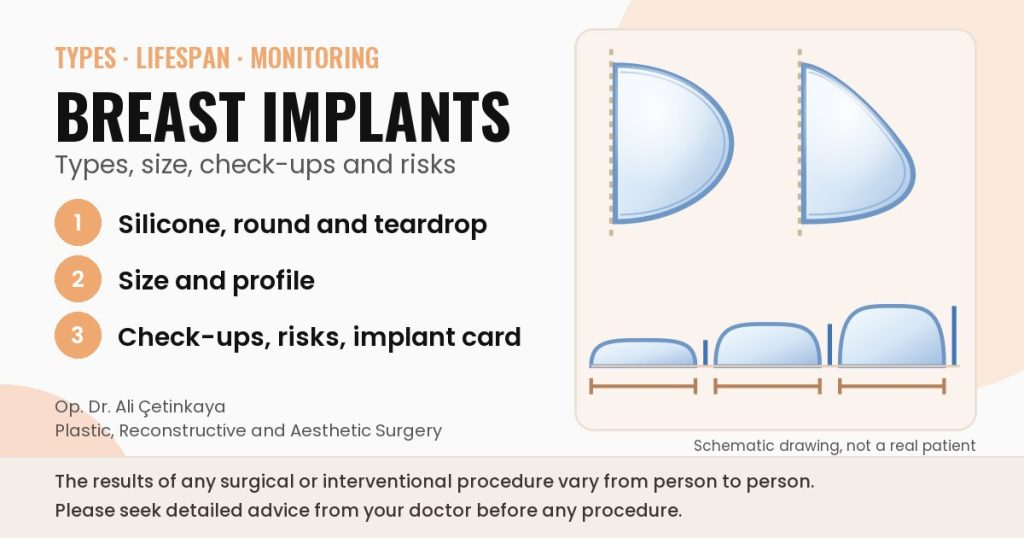
- Implants: allow a clear, planned increase in size. Shape, size and position (in front of or behind the chest muscle) are chosen to suit your build and your wishes. More on implant types, how long they last and check-ups is in our guide to breast implants, and on choosing the size in our implant size guide.
- Fat transfer: fat is removed by liposuction elsewhere and transferred to the breasts. This suits a moderate increase and needs enough donor fat; part of the fat is reabsorbed. More on fat transfer.
Surgery is considered only once breast development is complete. In the United States, for example, saline implants are approved for breast augmentation from age 18 and silicone gel implants from age 22 [4]. A tuberous breast or a marked asymmetry needs particular planning. The procedure, recovery and what determines the fee are explained on our breast augmentation page.
Whether you want to change anything is entirely your decision. Small breasts are not a flaw, and good advice will also tell you when an operation is not a good idea.
Surgery and Recovery
Breast augmentation is done under general anaesthesia and takes about 1–2 hours; you usually stay one night in hospital. Desk work is often possible after 5–7 days, and strenuous exercise after 4–6 weeks.
An implant is not a lifelong product; it may need to be exchanged over the years. When and how implants are removed is explained in our article on breast implant removal.
Warning signs after surgery: contact your care team the same day if you have a fever, increasing redness, clearly one-sided swelling, or severe pain in one breast. If you have sudden shortness of breath or chest pain, call emergency services straight away (112 in Turkey, 999 in the UK).
Coming to Istanbul for an Assessment
If you are travelling from abroad, the consultation, surgery, check-up and journey home are planned together. The examination takes place at the practice in Ataşehir, Istanbul; the operation takes place in a hospital operating theatre (Memorial Göztepe Hospital).
- Before you travel: front and side photos, or a video call, give preliminary information. Whether you have a normal small breast, a tuberous breast or an asymmetry, and which options suit you, is confirmed only at the in-person examination.
- Length of stay: for breast augmentation, a stay of about 5–7 days in Istanbul is usually advised. The exact length is decided at the examination.
- Flying home: for a long flight you usually wait until after the first check-up. Walk regularly on board.
- After you return: agree in advance how remote follow-up will work and what to do if a problem appears at home.
Is It Covered by Insurance?
Breast augmentation only to increase size is a cosmetic procedure and is usually not covered by public health systems or private insurers. In the UK, the NHS does not usually fund cosmetic breast surgery. With a marked congenital deformity, such as a severe tuberous breast or Poland syndrome, the situation may be different; check this with your insurer in advance.
What determines the fee is explained on the breast augmentation page; a firm price is given only after an examination.
Frequently Asked Questions
Do breasts still grow after the age of 20?
The glandular tissue hardly grows after that. The breasts can still get bigger with weight gain, pregnancy or hormonal changes, and smaller again later.
Does the contraceptive pill make breasts bigger?
Some women notice slight tenderness or a little more volume on the pill, often from fluid retention. This is not a reliable effect, and the pill should never be taken for this reason.
Can I breastfeed with small breasts?
Yes. How much milk is made depends on the glandular tissue and on the baby’s demand, not on breast size. More on breastfeeding after breast surgery is in our article on breastfeeding after breast surgery.
Is it normal for one breast to be smaller?
Yes, most women have a slight difference between the sides. If the difference is marked or distressing, it can be evened out with surgery.
Does strength training help with small breasts?
Training strengthens the chest muscle and improves posture, so the breasts look a little firmer. It does not make the breast tissue bigger.
Personal Assessment

References
- Javed A, Lteif A. Development of the human breast. Semin Plast Surg. 2013;27(1):5–12. doi:10.1055/s-0033-1343989
- Kolker AR, Collins MS. Tuberous breast deformity: classification and treatment strategy for improving consistency in aesthetic correction. Plast Reconstr Surg. 2015;135(1):73–86. doi:10.1097/PRS.0000000000000823
- Profka E, Rodari G, Citterio V, et al. Induction of puberty in hypogonadal forms of primary amenorrhoea: current evidence and future perspectives. Endocr Connect. 2026;15(4):e250811. doi:10.1530/EC-25-0811
- U.S. Food and Drug Administration. Types of breast implants. fda.gov
This article is for general information and does not replace a medical examination. The results of any surgical or interventional procedure vary from person to person. Please seek detailed advice from your doctor before any procedure.