Medical review: This article has been reviewed by Op. Dr. Ali Çetinkaya, specialist in plastic, reconstructive and aesthetic surgery. Last updated:
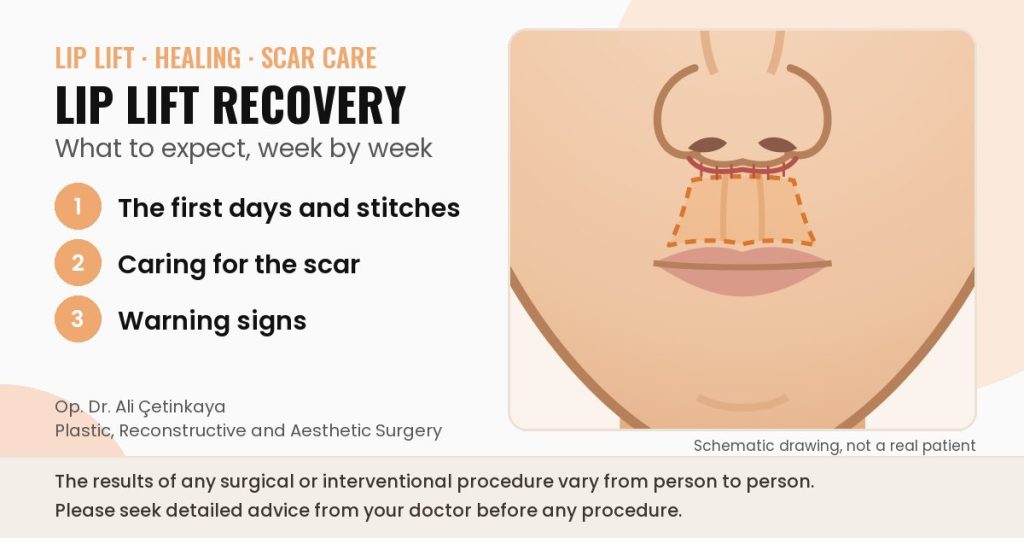
A lip lift is done through a small incision in the crease under the nose. Most of the healing happens in the first weeks, while the scar keeps maturing for months.
This page explains what to expect in the first days, how to care for the stitches and the scar, when you can return to work and exercise, and which warning signs need a doctor. How the operation is done and who it suits is covered under lip lift surgery and long upper lip.
In short
- Swelling, tightness and reduced feeling of the upper lip are common at first.
- Swelling and bruising typically resolve within 7–10 days; light activities are often possible after 1–2 weeks and strenuous exercise after 4–6 weeks.
- The scar under the nose is red at first and usually fades over months; in a series of 600 lip lifts, 11 patients developed a slightly raised scar that was treated with laser, and none needed revision surgery [2].
- Smokers had about twice the odds of delayed healing or wound opening after surgery [3].
- In a review of 1,754 patients, complications after lip lift were mostly mild and short-lived; 0.6–6.7% had a revision [1].
The First Days
A lip lift is usually done under local anaesthesia and takes about 30 minutes to 1 hour; most patients go home the same day. Have someone drive you home.
- Sleep on your back with your head elevated.
- Avoid talking excessively for the first few days.
- Choose soft foods that need little chewing.
- Take the medication you have been prescribed as instructed.
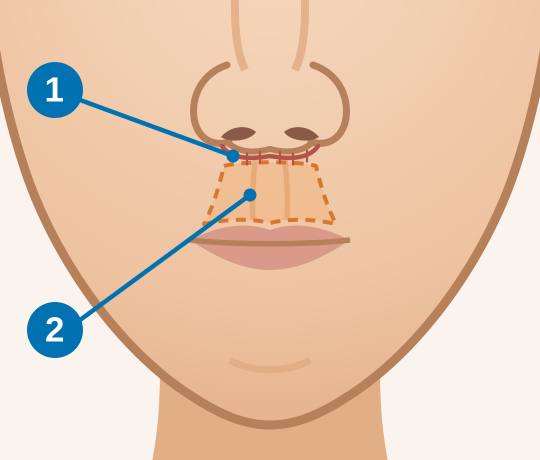
- 1Incision and stitches in the crease under the nose
- 2Upper lip skin: swelling, tightness and reduced feeling in the first weeks
Recovery Timeline
| When | What to expect |
|---|---|
| Day of surgery | Local anaesthesia; about 30 minutes to 1 hour; home the same day |
| First few days | Head elevated, little talking, soft foods; swelling and tightness are most noticeable |
| Stitches | Removed a few days after the procedure at a check-up, or they dissolve on their own, depending on the technique |
| 7–10 days | Swelling and bruising typically resolve |
| 1–2 weeks | Return to light activities and desk work is often possible |
| 4–6 weeks | Strenuous exercise again |
| 3–6 months | The final result settles; the scar continues to fade |
Swelling, Tightness and Numbness: What Is Normal?
Swelling, tightness and reduced feeling of the upper lip are common at first. The lip can feel stiff, and smiling widely or opening the mouth fully may feel restricted for a while. These changes usually settle as the swelling goes down. Everyone heals at a different pace; your check-ups show whether healing is on track.
Stitches and Wound Care
Keep the incision clean and dry and follow the care instructions you are given. Do not rub the area or pick at crusts. Depending on the technique, the stitches are removed a few days after the procedure at a check-up, or they dissolve on their own. Ask your team when you may wash your face and shower.
Caring for the Scar Under the Nose
The incision lies in the natural crease under the nose. It is red at first and usually fades over months; in some people it stays visible or becomes raised or wide.
- Sun protection: Protect the healing scar from strong sun.
- Silicone gel: A meta-analysis of six randomised trials with 375 patients found that silicone gel applied after surgery improved scar colour, height and pliability compared with placebo or no treatment [4]. For treating scars that are already raised, the evidence is of low or very low certainty [5]. Ask your surgeon whether and when you should start.
- Raised scar: In the series of 600 lip lifts, the 11 slightly raised scars were treated with fractional CO2 laser [2]; read more under fractional CO2 laser.
Smoking and Healing
Smoking slows wound healing. In a meta-analysis of 140 cohort studies with 479,150 patients, smokers had about twice the odds of delayed healing or wound opening and higher odds of wound infection than non-smokers; in randomised trials, stopping smoking around the time of surgery reduced wound infections [3]. Ask your surgeon for how long you should avoid smoking around the operation.
Work, Exercise and Travel
Light activities and desk work are often possible after 1–2 weeks; strenuous exercise should be avoided for at least 4–6 weeks. If you are travelling from abroad for surgery, agree the date of your return flight with your surgeon before booking.
Warning Signs
Contact your treatment team the same day if after the operation you have a fever, increasing redness or swelling, discharge of pus, or a wound that opens. If you have difficulty breathing or swallowing, call emergency services straight away (112 in Turkey, 999 in the UK).
When Does the Result Look Final?
It may take 3–6 months for the final result to settle. The removed skin does not grow back, but the lips continue to age, so the area can change again over the years. In a systematic review of seven studies with 1,754 patients, complications were mostly mild and short-lived, and 0.6–6.7% of patients had a revision [1].
Is It Covered by Insurance?
A lip lift for cosmetic reasons is usually not covered by public health systems or private insurers, including the NHS. Clarify costs and follow-up before planning, especially if the operation is to take place abroad.
Frequently Asked Questions
How long does swelling last after a lip lift?
Swelling and bruising typically resolve within 7–10 days; the final shape can take a few months to settle completely.
When are the stitches removed?
Depending on the technique, a few days after the procedure at your check-up, or they dissolve on their own. Your surgeon will tell you the date.
When can I go back to work?
Many patients return to light activities and desk work within 1–2 weeks.
When can I exercise again?
Avoid strenuous exercise for at least 4–6 weeks.
When does the lip lift scar fade?
It is red at first and usually fades over months; in some people it stays visible or becomes raised and may need treatment [2].
Can I smile and talk normally after a lip lift?
In the first days it is better to talk little. The lip can feel tight and smiling widely may be restricted for a while; this usually improves as the swelling goes down.
Personal Assessment

References
- Komisarek O, Banasiak Ł, Olichwer V, Burduk P. The bullhorn and beyond: evidence-based review and clinical recommendations for lip lift techniques. J Cosmet Dermatol. 2026;25(3):e70703. doi:10.1111/jocd.70703
- Ceran F, Askeroglu U, Pilanci O. SMAS modifications in subnasal lip lifting: evaluation of 600 patients. Aesthetic Plast Surg. 2026 (published online). doi:10.1007/s00266-026-06227-x
- Sørensen LT. Wound healing and infection in surgery. The clinical impact of smoking and smoking cessation: a systematic review and meta-analysis. Arch Surg. 2012;147(4):373–383. doi:10.1001/archsurg.2012.5
- Wang F, Li X, Wang X, Jiang X. Efficacy of topical silicone gel in scar management: a systematic review and meta-analysis of randomised controlled trials. Int Wound J. 2020;17(3):765–773. doi:10.1111/iwj.13337
- Jiang Q, Chen J, Tian F, Liu Z. Silicone gel sheeting for treating hypertrophic scars. Cochrane Database Syst Rev. 2021;9:CD013357. doi:10.1002/14651858.CD013357.pub2
This article is for general information and does not replace a medical examination. The results of any surgical or interventional procedure vary from person to person. Please seek detailed advice from your doctor before any procedure.