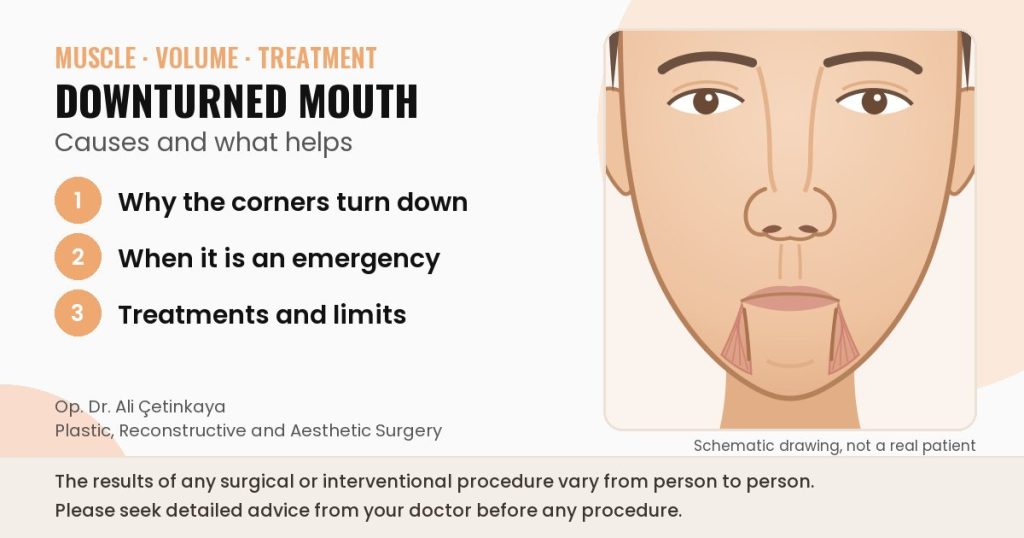
Downturned mouth corners can make a face look tired, stern or sad, even when you are not. They usually develop slowly through muscle pull, volume loss and skin ageing; a mouth corner that droops suddenly, on the other hand, can be an emergency.
Here you can read why the corners of the mouth move downwards, when you need medical help straight away, and what exercises, botulinum toxin, hyaluronic acid filler and surgery can achieve according to current evidence.
In short
- A muscle below the corners of the mouth, the depressor anguli oris, pulls them down [1]; with age its pull dominates, and loss of volume and elasticity adds to the effect.
- If one corner of the mouth suddenly droops, perhaps together with slurred speech, weakness or numbness on one side of the body, it may be a stroke: call emergency services straight away (112 in Turkey, 999 in the UK).
- Small doses of botulinum toxin into the depressor muscle can lift the corners of the mouth slightly for a few months [1][2][3].
- Hyaluronic acid filler softens marionette lines; in one study they had improved in around 8 out of 10 people after 12 weeks [4].
- A classic lip lift below the nose shortens the upper lip but does not raise the corners of the mouth; there are separate procedures for that [6][7].
Why Do the Corners of the Mouth Turn Down?
The position of the mouth corners is a balance: lifting muscles pull them up, and the depressor anguli oris pulls them down. It runs like a small triangle from the corner of the mouth to the edge of the lower jaw. Over the years its pull dominates, fat and supporting tissue in the lower face decrease, and the skin becomes looser.
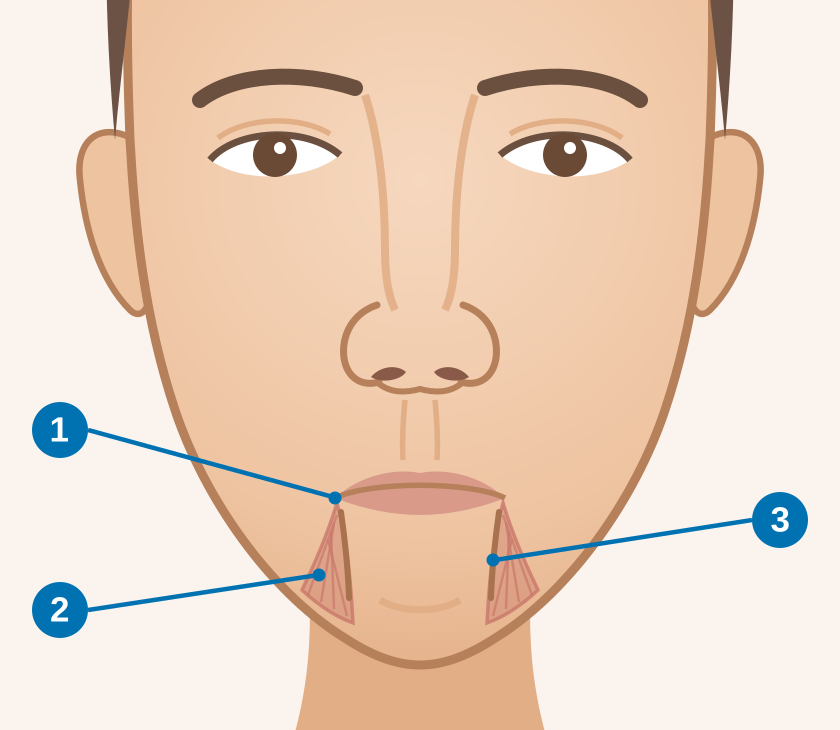
- 1Downturned corner of the mouth
- 2Depressor anguli oris, the muscle that pulls the corner down
- 3Marionette line
This often produces so-called marionette lines, which run from the corners of the mouth towards the chin. If jowls sit along the jawline as well, the mouth looks pulled down even more; read more under jowls.
When Is It an Emergency?
A mouth corner that suddenly droops is not a cosmetic problem. If slurred speech, weakness or numbness in the arm or leg on one side, or vision problems occur as well, it may be a stroke: call emergency services straight away (112 in Turkey, 999 in the UK) and note the time. One-sided facial weakness without other signs must also be examined by a doctor on the same day.
Causes at a Glance
- Muscle pull: a strong depressor muscle pulls the corners of the mouth down, in some people even at a young age [1].
- Ageing: volume loss, weaker supporting tissue and looser skin let the lower face descend.
- Genetics and face shape: the shape of the lips and jaw is partly inherited.
- Sun and smoking: both speed up skin ageing.
- Teeth and jaw: lost teeth or a reduced bite height can make the mouth area sink in.
Do Exercises Help?
Facial exercises are often recommended. A small study found slightly fuller cheeks after several months of daily training [5]; there is no evidence that exercises lift downturned mouth corners for the long term. They do no harm but do not replace treatment when muscle pull or volume loss is the cause. Daily sun protection and not smoking make sense.
Treatments: What the Studies Show
| Treatment | Principle | Evidence |
|---|---|---|
| Botulinum toxin | Small doses weaken the depressor muscle so that the lifting muscles dominate | In randomised trials, the corners of the mouth rose measurably; the effect lasts a few months [2][3]. An expert panel recommends a low dose at one point beside the marionette line to protect lip movement [1] |
| Hyaluronic acid filler | Fills marionette lines and supports the corner of the mouth from below | Improvement in around 8 out of 10 people after 12 weeks in one study [4]; swelling and pain afterwards are common, usually temporary [8] |
| Corner of the mouth lift | A small piece of skin above the mouth corner is removed and the corner raised | Described mainly as an addition when the corners still droop after a facelift [6]; leaves a fine scar at the lip border |
| Facelift or neck lift | Lifts jowls and the soft tissues of the lower face | Often changes the mouth corners themselves only a little [6] |
Treatments are often combined, for example botulinum toxin for the muscle pull and filler for the line. Which option suits you depends on whether muscle pull, volume loss or jowls are the main factor. Read more under low-dose botulinum toxin and lip fillers.
Lip Lift or Corner Lift?
The two are often confused. The classic lip lift (“bullhorn” incision below the nose) shortens a long upper lip and shows more of the red of the lip [7]; it hardly raises the corners of the mouth. If mainly the corners droop, a corner of the mouth lift or treatment of the depressor muscle is usually discussed instead [6]. Read more about the lip lift under lip lift surgery.
Risks and Warning Signs
- Botulinum toxin: bruising, rarely an uneven smile or temporarily restricted lip movement if the effect spreads to neighbouring muscles [1].
- Filler: swelling, pain and lumps are common and usually temporary [8]. Rarely, filler blocks a blood vessel.
- Surgery: scar at the lip border, asymmetry, swelling.
Contact your doctor the same day if after a filler injection the pain increases or the skin turns pale or bluish. After botulinum toxin, seek urgent help if you have difficulty swallowing, speaking or breathing; in an emergency call 112 in Turkey or 999 in the UK.
Coming to Istanbul for an Assessment
Whether muscle pull, volume loss or jowls are the main cause can only be judged reliably at an examination. It takes place at the practice in Ataşehir, Istanbul.
- Before you travel: photos from the front and side, relaxed and smiling, give first clues.
- Injections: the effect of botulinum toxin is assessed after about two weeks, also by photo or video call.
- Surgery: if an operation is planned, the length of stay and check-ups are agreed at the examination.
Is It Covered by Insurance?
Treatment of downturned mouth corners for cosmetic reasons is usually not covered by public health systems or private insurers. In the UK, the NHS does not fund cosmetic treatments of this kind.
Frequently Asked Questions
Can downturned mouth corners be lifted without surgery?
Often partly, yes: botulinum toxin in the depressor muscle and filler in the marionette lines improve the appearance for a few months [2][3][4]. The effect is temporary and needs to be repeated.
How long does botulinum toxin last at the corners of the mouth?
A few months; the effect then wears off and the corners return to their previous position. Exactly how long depends on the dose and the strength of the muscle.
Does a lip lift raise the corners of the mouth?
The classic lip lift below the nose hardly does; it mainly shortens the upper lip [7]. There are separate procedures for the corners [6].
Are facial exercises worth it?
For the corners of the mouth there is no good evidence. A small study showed slightly fuller cheeks after months of training [5].
At what age do the corners of the mouth turn down?
This varies a lot. In some people a strong depressor muscle is visible early, in others it only appears with the typical ageing signs of the lower face.
Personal Assessment

References
- Fundarò S, Molinari P, Brunelli G, et al. Italian consensus and review in lower face mimetic muscle treatment with botulinum toxin-A. Toxins (Basel). 2026;18(8):332. doi:10.3390/toxins18080332
- Zhang M, Yang Y, Zhao N, et al. Optimizing injection sites of botulinum toxin type A for improving oral commissure position: a two-stage, prospective, double-blind, randomized trial. Plast Reconstr Surg. 2026. doi:10.1097/PRS.0000000000013362
- Munoz-Lora VRM, Rogerio V, Roschel P, et al. Injection mapping and dose escalation for botulinum toxin treatment on the lower face: a randomized, double-blind clinical trial. Aesthet Surg J. 2026. doi:10.1093/asj/sjag165
- Gerber PA, da Mota R, Gauglitz G, et al. Effectiveness and safety of Belotero Intense ± lidocaine for the correction of nasolabial folds, marionette lines, and lip volume enhancement: a randomized post-market clinical follow-up study. Aesthet Surg J Open Forum. 2026;8:ojag031. doi:10.1093/asjof/ojag031
- Alam M, Walter AJ, Geisler A, et al. Association of facial exercise with the appearance of aging. JAMA Dermatol. 2018;154(3):365–367. doi:10.1001/jamadermatol.2017.5142
- Perkins SW. The corner of the mouth lift and management of the oral commissure grooves. Facial Plast Surg Clin North Am. 2007;15(4):471–476. doi:10.1016/j.fsc.2007.08.005
- Komisarek O, Banasiak Ł, Olichwer V, Burduk P. The bullhorn and beyond: evidence-based review and clinical recommendations for lip lift techniques. J Cosmet Dermatol. 2026;25(3):e70703. doi:10.1111/jocd.70703
- Cruz VMS, Sousa-Neto SS, Pedroso CM, et al. Adverse events in nonsurgical facial aesthetic procedures: a systematic review and meta-analysis. Oral Dis. 2026;32(2):384–394. doi:10.1111/odi.70109
This article is for general information and does not replace a medical examination. The results of any surgical or interventional procedure vary from person to person. Please seek detailed advice from your doctor before any procedure.