



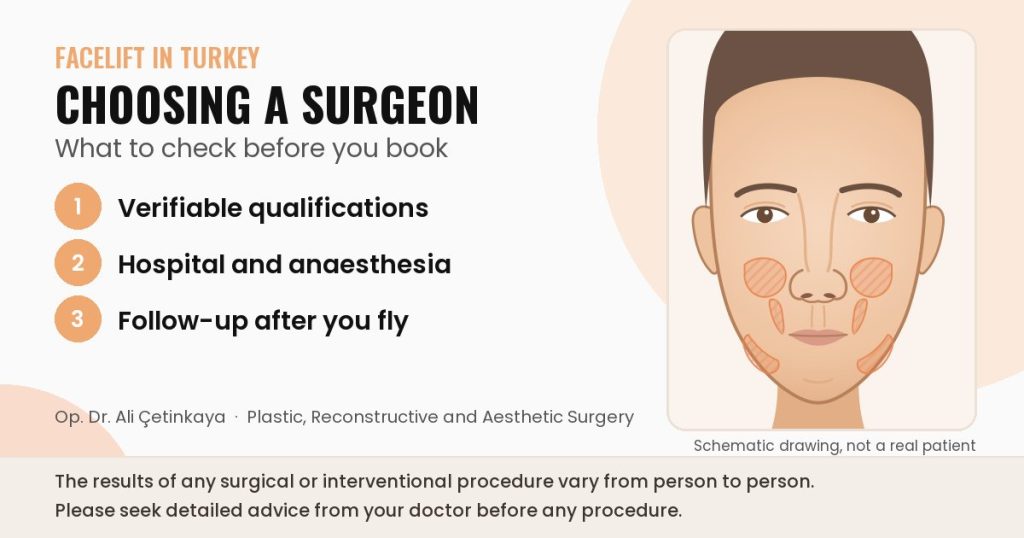
There is no single best facelift surgeon in Turkey that fits everyone. The right surgeon for you is one whose training you can verify, who operates in a properly equipped hospital, and whose plan and follow-up fit your face and your travel.
This guide explains how to check a surgeon’s qualifications, what really matters for safety and cost, and which questions to ask before you book.
In short
- “Top 10” lists are usually compiled by booking platforms or advertisers; ask how a list was made before trusting it.
- Check three things yourself: the surgeon’s specialty title, their membership of the national plastic surgery society, and the hospital where the operation will take place.
- The technique matters less than whether it suits your anatomy; published reviews show that complication rates differ between techniques.
- Safety abroad depends on planning: who operates, who gives the anaesthesia, and how check-ups continue after you fly home.
- A firm price can only be given after an examination; ask for a written plan that states what is included.
Is There a Single Best Facelift Surgeon in Turkey?
No. There is no official ranking of facelift surgeons in Turkey, and online “best surgeon” lists are not independent assessments. Many are published by platforms that earn money when you book, so a high position can reflect a commercial agreement rather than results.
A more useful question is: which surgeon can show me verifiable qualifications, explain a plan that fits my face, and take responsibility for my follow-up? The sections below turn that question into concrete checks.
How to Check a Facelift Surgeon’s Qualifications
Start with facts you can confirm yourself, not with adjectives on a website.
- Specialty: the operating surgeon should be a specialist in plastic, reconstructive and aesthetic surgery. Ask for the year the specialty title was obtained.
- National society: in Turkey, membership of the Turkish Society of Plastic, Reconstructive and Aesthetic Surgeons (TPRECD) can be checked on the society’s public member list.
- International titles: if a surgeon lists a European or international title or membership, ask which organisation issued it and check it on that organisation’s own website.
- Who operates: confirm in writing that the surgeon you consult is the one who performs the operation, and who else is in the surgical team.
- Where: ask for the name of the hospital and confirm that the operation takes place in a hospital operating theatre with an anaesthesia team.
- Facelift focus: ask how often the surgeon performs facelifts and which techniques they use, and why they would choose one for you.
A longer checklist for the consultation itself is on our facelift page.
Does the Technique Matter?
It matters, but there is no technique that is right for everyone. A facelift can address the deeper support layer of the face (SMAS) in different ways: by folding it (plication), by removing part of it, by lifting it as a flap, or by working beneath it (deep plane).
A meta-analysis of 183 studies found statistically significant differences in complication rates between SMAS techniques, for example in temporary facial nerve weakness; the authors concluded that the technique should be chosen on the quality of the result for the patient, not on the complication profile alone [1]. A review of 27 studies with 6,086 patients reported temporary facial nerve weakness in 0.85% and skin necrosis in 0.41% of patients, with permanent nerve injury very rare [2].
What you can take from this: ask the surgeon why a particular technique suits your face and neck, and what the specific risks of that technique are. The techniques are explained on our facelift and deep plane facelift pages.
Where Is the Best Place to Get a Facelift in Turkey?
The city matters less than the setting. Istanbul has many private hospitals and most international patients travel there, but what decides safety and outcome is the surgeon, the hospital where the operation takes place, and whether your check-ups can happen before you fly home.
When you compare options, compare the same things: the surgeon’s specialty, the named hospital, the anaesthesia arrangements, how many days you are asked to stay, and how follow-up continues after you return.
Is It Safe to Get a Facelift in Turkey?
A facelift carries the same risks in Turkey as anywhere else: the most common early problem is a blood collection under the skin (haematoma); temporary changes in facial movement or sensation can occur and usually improve. Risks and warning signs are explained in detail on our facelift page.
Travel adds one specific risk: problems that start after you fly home. A systematic review of 36 publications described 370 patients with infections after cosmetic surgery abroad; reported destinations included the Dominican Republic, Turkey and Colombia [3]. The lesson is not to avoid travel, but to plan it: your first check-ups should take place before you fly, and you should know in advance how to reach the surgical team and what happens if a problem appears at home.
After any facelift, contact your surgical team the same day if you have swelling that increases quickly on one side, severe pain, fever or a wound that opens. If you have sudden shortness of breath or chest pain, call emergency services straight away (112 in Turkey, 999 in the UK).
How Much Does a Facelift Cost in Turkey?
A firm price can only be given after an examination, because it depends on the plan. The main factors are:
- the technique and whether the neck is treated as well;
- added procedures, such as eyelid surgery or fat transfer;
- the hospital, the length of the hospital stay and the anaesthesia;
- check-ups, dressings and remote follow-up after you return home.
Ask for the plan in writing: the procedures, the hospital, the type of anaesthesia, who operates, and what the fee includes and excludes. More on cost factors is on our facelift page.
What Is the Best Hospital in Turkey for Plastic Surgery?
There is no single best hospital either. For a facelift, check that the hospital has a full operating theatre, an anaesthesia team present throughout the operation, and the means to manage a complication overnight. If a hospital states an accreditation, ask which body awarded it and check it on that body’s website.
Facelifts by Op. Dr. Ali Çetinkaya take place in a hospital operating theatre at Memorial Göztepe Hospital, Istanbul; examinations take place at the practice in Ataşehir.
Red Flags When Choosing a Surgeon Abroad
- A fixed price or “package” offered before anyone has examined your face.
- The surgeon’s name, specialty or hospital is not stated, or changes during the conversation.
- Pressure to book quickly, or discounts for deciding today.
- Promises of a guaranteed result, “no scars” or a set number of years younger.
- No clear answer to who performs the operation and who gives the anaesthesia.
- No written follow-up plan for after you fly home.
Questions to Ask at Your Consultation
- Are you a specialist in plastic, reconstructive and aesthetic surgery, and since when?
- Which national society are you a member of, and where can I check it?
- Who will perform my operation, and who gives the anaesthesia?
- In which hospital will it take place, and how long will I stay?
- Which technique do you suggest for me, and why?
- What are the main risks of that technique for me?
- When are the check-ups, and when can I fly home?
- How does follow-up work after I return, and whom do I contact if there is a problem?
About Op. Dr. Ali Çetinkaya: Facts You Can Check
We list only details that you can verify; we do not rank ourselves against other surgeons.
- Specialty: Specialist in Plastic, Reconstructive and Aesthetic Surgery (2017); working in plastic surgery since 2012, including specialty training.
- Societies: member of the Turkish Society of Plastic, Reconstructive and Aesthetic Surgeons (TPRECD) — member record, the Aesthetic Plastic Surgery Association (EPCD) and the International Society of Aesthetic Plastic Surgery (ISAPS).
- Operations: Memorial Göztepe Hospital, Istanbul. Examinations: practice in Ataşehir, Istanbul.
- Languages: consultations in Turkish, English and German.
More about training and the medical review of this website is on the about page.
Frequently Asked Questions
How do I know if a “best surgeon” list is independent?
Look for who publishes it and how it earns money. If the site takes bookings or commissions, the list is advertising. An independent check is the surgeon’s own verifiable specialty title, society membership and named hospital.
Is a deep plane facelift better than other techniques?
Not for everyone. Techniques differ in which tissue layer is lifted and in their risk profile; the choice depends on your anatomy, the degree of sagging and whether the neck is treated. See our deep plane facelift page.
Can I have an online consultation first?
Yes. Photos or a video call give preliminary information. The plan, the technique and the price are confirmed only at the in-person examination.
Personal Assessment

References
- Jacono AA, Alemi AS, Russell JL. A meta-analysis of complication rates among different SMAS facelift techniques. Aesthet Surg J. 2019;39(9):927–942. doi:10.1093/asj/sjz045
- Mortada H, Alkilani N, Halawani IR, et al. Evolution of superficial muscular aponeurotic system facelift techniques: a comprehensive systematic review of complications and outcomes. JPRAS Open. 2024;39:166–180. doi:10.1016/j.jpra.2023.06.003
- Gilardi R, Galassi L, Del Bene M, Firmani G, Parisi P. Infective complications of cosmetic tourism: a systematic literature review. J Plast Reconstr Aesthet Surg. 2023;84:9–29. doi:10.1016/j.bjps.2023.05.021
This article is for general information and does not replace a medical examination. The results of any surgical or interventional procedure vary from person to person. Please seek detailed advice from your doctor before any procedure.


