After pregnancy, many women find that their belly stays rounded for longer than expected, and when they sit up from lying down a ridge or a dip appears down the middle. Often the reason is diastasis recti: the two halves of the straight abdominal muscle have moved apart in the midline. It is very common and usually harmless, but it can leave the abdomen bulging and the core feeling less stable.
This guide explains how to recognise diastasis recti, how to check yourself with a simple finger test, what exercises can and cannot do, and when surgery is worth considering.
In short
- Diastasis recti is a widening of the connective tissue (linea alba) between the two rectus abdominis muscles. It is not a hernia.
- It is very common after pregnancy and often improves on its own during the first year.
- A gap of more than about 2 cm (two finger widths) is usually considered noticeable; an ultrasound measures it more precisely.
- Targeted training is the first step; it mainly improves core function rather than fully closing the gap.
- Surgery may be considered if the bulge or weakness persists after about 12 months of consistent training, or if there is a hernia or excess skin.
What Is Diastasis Recti?
The straight abdominal muscle (rectus abdominis) consists of two vertical bands running from the lower ribs to the pubic bone. In the middle they are joined by a strip of connective tissue called the linea alba. If this tissue is overstretched and widens, the distance between the two muscle bands increases. This is called diastasis recti (rectus diastasis, or diastasis recti abdominis).
Important: diastasis recti is not a hernia. The abdominal wall is weakened but not torn through. It can, however, occur together with an umbilical or abdominal wall hernia, which is one reason why a medical examination is worthwhile.
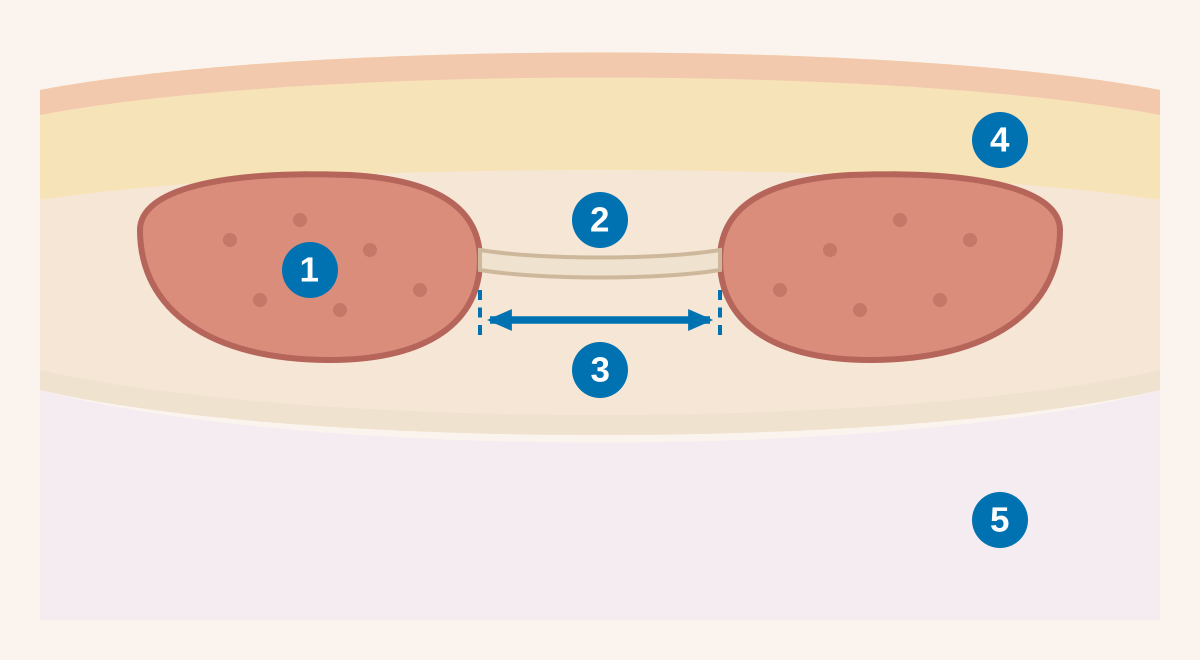
- 1Rectus abdominis (left and right)
- 2Widened linea alba
- 3Gap between the muscles
- 4Skin and fat
- 5Abdominal cavity
Studies use different thresholds for diagnosis. A gap of more than about 2 cm, or two finger widths, is commonly regarded as noticeable [2].
How Common Is Diastasis Recti After Pregnancy?
Very common, and in the first months after birth often temporary. In a Norwegian study of 300 first-time mothers, 60% had diastasis recti six weeks after giving birth; after six months the figure was about 45%, and after twelve months about 33% [1]. So part of it resolves on its own, but in roughly one in three women it is still present after a year.
Causes: Why Do the Abdominal Muscles Separate?
During pregnancy, the growing uterus stretches the abdominal wall from the inside, and hormones such as relaxin make connective tissue more pliable. The linea alba gives way, a natural process that makes room for the baby. Whether it fully recovers afterwards depends, among other things, on:
- several or closely spaced pregnancies, and multiple pregnancies,
- a large baby or a lot of amniotic fluid,
- individual connective tissue quality (partly inherited),
- large weight changes and abdominal fat,
- frequent heavy lifting while holding the breath (straining).
Diastasis Recti Without Pregnancy and in Men
Men, and women who have never been pregnant, can also have diastasis recti. Typical triggers are a lot of abdominal fat pressing on the abdominal wall from inside, major weight gain followed by weight loss, and intensive strength training with high abdominal pressure. In men, diastasis often shows as a ridge above the belly button (upper abdomen) that appears when sitting up.
Symptoms: What Does a Belly With Diastasis Recti Look Like?
Diastasis recti is mainly something you can see and feel. Typical signs are:
- a lengthwise ridge or a groove in the middle of the abdomen, especially when sitting up from lying down (“doming” or “tenting”),
- a belly that still bulges despite a normal weight (“I still look pregnant”),
- a soft, yielding feeling in the midline when you press on it,
- a feeling of reduced strength and stability in the core.
Some people also report back or pelvic pain, digestive complaints or pelvic floor problems. A direct link has not been clearly shown: in the study mentioned above, women with and without diastasis recti had lower back and pelvic pain equally often at twelve months [1], and a systematic review found no consistent association with back pain [3]. Such complaints should therefore also be checked for other causes.
Warning sign: a painful bulge at the belly button or in the abdominal wall that can no longer be pushed back may be a trapped (incarcerated) hernia. Seek medical help immediately.
How to Check Yourself: the Finger Test
A simple self-test can show whether diastasis recti may be present:
- Lie on your back with your knees bent and your feet flat on the floor.
- Place the fingertips of one hand across the middle of your abdomen, just above the belly button.
- Lift your head and shoulders slightly, as if starting a small crunch. This tenses the straight abdominal muscles.
- Feel how many fingers fit into the gap between the muscle bands and how deep your fingers sink in.
- Repeat the test at the level of the belly button and about 4–5 cm below it.
If two or more fingers fit into the gap, diastasis recti is likely. Besides the width, tension matters: a midline that feels firm when you tense is more favourable than a deep, soft dip. The self-test does not replace an examination. An ultrasound measures the gap more precisely and can also detect an accompanying hernia.
Classification by Width
The German Hernia Society (DHG) and the International Endohernia Society (IEHS) have proposed a classification based on the width of the gap [2]:
| Grade | Width | What it means in practice |
|---|---|---|
| W1 | under 3 cm | Common after childbirth; often improves partly on its own. Targeted training is the first step. |
| W2 | 3 to 5 cm | Training is worthwhile; if the bulge persists after 12 months, surgery can be discussed. |
| W3 | over 5 cm | Marked weakening of the abdominal wall; surgical repair is more often appropriate. |
Doctors also record where the diastasis is (above, at or below the belly button), whether there is a hernia, and how much excess skin there is. These points determine which treatment is suitable.
Which Doctor Should You See?
- First assessment: your obstetrician or gynaecologist (for example at the postnatal check-up) or your family doctor.
- Training: a physiotherapist experienced in postnatal or pelvic health.
- Hernia or marked diastasis: a surgeon specialising in hernia repair.
- Diastasis with excess skin or a hanging belly: a plastic and aesthetic surgeon. Here the muscle repair is usually combined with a tummy tuck.
Diastasis Recti Exercises: What Helps and What Doesn’t
For mild and moderate diastasis, targeted training is the first choice. The aim is less to “close” the gap completely and more to improve tension in the midline and stability of the trunk. In a randomised trial, a general postpartum exercise programme did not reduce how often diastasis recti was present [4]; the width of the gap often changes little with training, while function can improve.
Usually suitable:
- activating the deep transverse abdominal muscle (transversus abdominis), for example by gently drawing in the lower belly while breathing out,
- pelvic floor training coordinated with breathing,
- belly breathing and breathing exercises to control abdominal pressure,
- postnatal recovery exercises and, later, adapted exercises such as pelvic tilts or easy forearm plank variations, as long as the midline stays flat.
Be careful with:
- classic sit-ups and crunches in the early phase, if a ridge forms in the midline,
- heavy lifting while holding your breath,
- exercises where the belly visibly domes or “tents”.
Ideally, have a physiotherapist show you the exercises. They can judge whether your midline stays stable during an exercise and progress the programme step by step.
When Is Surgery Considered?
Surgery may be considered if diastasis recti persists despite consistent training for about 12 months and the bulge or lack of stability affects your daily life. Further reasons are an accompanying umbilical or abdominal wall hernia, and excess skin after pregnancy or major weight loss. European hernia guidelines note that the evidence is still limited and that surgery can be considered for selected patients, usually after conservative treatment such as physiotherapy [5].
Before surgery, the following should be in place:
- Your last birth was at least 6 to 12 months ago and you have stopped breastfeeding.
- Your family planning is complete; another pregnancy can stretch the result again.
- Your weight is stable and as close as possible to your goal weight.
- You do not smoke, or can stop for several weeks around the operation, because smoking impairs wound healing.
Which Surgical Options Are There?
| Situation | Usual approach |
|---|---|
| Diastasis with excess skin and fat on the lower abdomen | Tummy tuck (abdominoplasty): the muscle edges are brought together in the midline with stitches (plication) and excess skin is removed. |
| Diastasis without much excess skin, with a hernia | Minimally invasive or endoscopic hernia surgery, sometimes reinforced with mesh. |
| Diastasis with more fat but good skin quality | Plication, possibly combined with liposuction, depending on the findings. |
Which option fits depends on the findings: width and location of the diastasis, whether there is a hernia, excess skin, and your wishes. A tummy tuck leaves a scar on the lower abdomen that can usually be hidden in the bikini area. More about the procedure on our tummy tuck and liposuction pages.
Recovery After Surgery and Risks
- Getting up and taking short walks is usually possible the day after surgery.
- Many patients return to light daily activities after about 2 to 4 weeks; physically demanding work takes longer.
- A compression garment or abdominal binder is usually worn for about 6 weeks.
- Heavy lifting, abdominal training and sports that increase abdominal pressure are avoided for about 6 weeks; after that, the load is increased gradually.
As with any operation, there are risks, such as bruising, fluid collections (seromas), wound healing problems, blood clots or noticeable scars. A thorough consultation with an examination is therefore essential.
Is Surgery Covered by Insurance?
This depends on your country and insurer and is decided case by case. Coverage is more likely when there is a hernia or clearly documented symptoms. If the treatment is mainly about the appearance of the belly or excess skin, it is usually self-paid. Ask your insurer before treatment, including if you plan to have surgery abroad.
Frequently Asked Questions About Diastasis Recti
Does diastasis recti go away on its own?
Part of it resolves in the first months after birth. If the gap is still present after about a year, complete recovery without treatment is unlikely. Training can still improve function noticeably.
When is diastasis recti dangerous?
Diastasis recti itself is not dangerous. Have it checked if you have pain, a swelling at the belly button, or a bulge that is getting bigger. A painful swelling that can no longer be pushed back is an emergency.
Can I exercise with diastasis recti?
Yes, movement is helpful. Choose exercises in which your midline stays flat and stable, and increase the load slowly. Swimming, walking and adapted strength training are usually fine.
Do Pilates or hula hoops help?
Pilates can help if the exercises are adapted to the diastasis and target the deep abdominal muscles. There is no reliable evidence for hula hoops; what matters is that the midline does not bulge during the movement.
Can I still get pregnant after surgery?
In principle, yes. However, another pregnancy can stretch the abdominal wall again and affect the result. This is why surgery is usually recommended only after family planning is complete.
How much does diastasis recti surgery cost?
Under the health advertising regulations we are subject to, we do not publish prices on our website. You will receive personal information after your consultation.
Personal Assessment

References
- Sperstad JB, Tennfjord MK, Hilde G, Ellström-Engh M, Bø K. Diastasis recti abdominis during pregnancy and 12 months after childbirth: prevalence, risk factors and report of lumbopelvic pain. Br J Sports Med 2016;50(17):1092–1096. doi:10.1136/bjsports-2016-096065
- Reinpold W, Köckerling F, Bittner R, Conze J, et al. Classification of rectus diastasis — a proposal by the German Hernia Society (DHG) and the International Endohernia Society (IEHS). Front Surg 2019;6:1. doi:10.3389/fsurg.2019.00001
- Benjamin DR, Frawley HC, Shields N, van de Water ATM, et al. Relationship between diastasis of the rectus abdominis muscle (DRAM) and musculoskeletal dysfunctions, pain and quality of life: a systematic review. Physiotherapy 2019;105(1):24–34. doi:10.1016/j.physio.2018.07.002
- Gluppe SL, Hilde G, Tennfjord MK, Engh ME, et al. Effect of a postpartum training program on the prevalence of diastasis recti abdominis in postpartum primiparous women: a randomized controlled trial. Phys Ther 2018;98(4):260–268. doi:10.1093/ptj/pzy008
- Hernández-Granados P, Henriksen NA, Berrevoet F, Cuccurullo D, et al. European Hernia Society guidelines on management of rectus diastasis. Br J Surg 2021;108(10):1189–1191. doi:10.1093/bjs/znab128
This article is for general information and does not replace a medical examination. The results of any surgical or interventional procedure vary from person to person. Please seek detailed advice from your doctor before any procedure.