A breast implant is a medical device placed behind the breast tissue or the chest muscle to add volume or reshape the breast. Implants are used in cosmetic breast augmentation and in breast reconstruction after cancer surgery.
This guide explains the types of implants, how size is chosen, how long implants last, which check-ups are recommended and which risks you should know about. The operation itself, recovery and scars are covered on our breast augmentation page.
Looking for an external breast form worn in the bra after mastectomy? This article is about implants placed inside the body. Your treating team can advise you on external prostheses.
In brief
- Breast implants are not lifetime devices, but there is no rule that they must be replaced after a fixed number of years.
- A rupture of a silicone implant often causes no symptoms. Regular ultrasound or MRI is therefore recommended even if you feel well.
- There is no single “right” size and no “best” implant. The choice depends on your chest width, tissue thickness and skin elasticity.
- Breast implants belong to the highest risk class of medical devices; you should receive an implant card after surgery.
- New swelling, a lump or hardening years after surgery should always be examined.
What is a breast implant?
Every breast implant has an outer silicone shell and a filling. The everyday term “silicone implant” usually refers to an implant filled with silicone gel; “breast implant” and “breast prosthesis” describe the same device.
Under the EU Medical Device Regulation and Turkey’s harmonised Medical Device Regulation, breast implants are class III devices, the highest risk class [7]. They are therefore subject to strict rules from manufacture to use.
Types of breast implants
By filling: silicone gel and saline
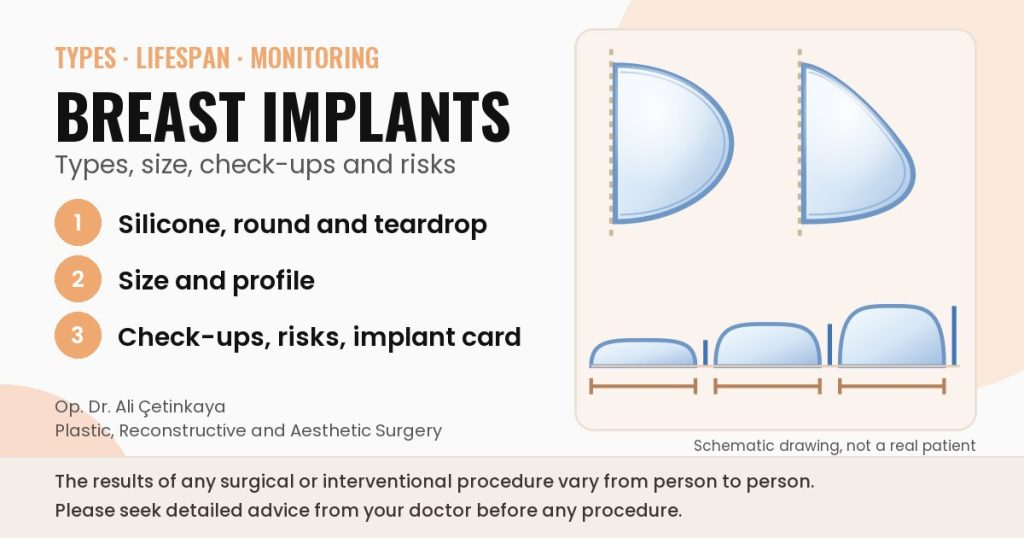
Most implants used today are filled with cohesive silicone gel, which largely holds together even if the shell is damaged. Saline implants are filled with sterile salt water; if they rupture, the fluid is absorbed by the body and the breast shrinks quickly, so the rupture is easy to notice.
By shape: round and teardrop (anatomical)
Round implants are symmetrical in every direction. Teardrop (anatomical) implants are fuller in the lower part. A meta-analysis found no aesthetic advantage of teardrop over round implants; plastic surgeons could identify the implant shape from photographs only about half the time (52%) [4]. If a teardrop implant rotates, the breast shape can be distorted, so its placement needs extra care.
By surface: smooth, micro-textured and macro-textured
The shell surface may be smooth or textured to different degrees. Textured surfaces were developed to help the implant stay in place. However, the rare implant-associated lymphoma (BIA-ALCL) has been linked particularly to macro-textured surfaces [5]. Which surface is used is decided at consultation, taking this information into account.
By profile: low, moderate and high
Profile describes how far the implant projects forward. Of two implants with the same volume, the one with a narrow base and high profile projects more, while the one with a wide base and low profile looks flatter. This is why volume alone is not enough when choosing an implant.
| Feature | Options | Worth knowing |
|---|---|---|
| Filling | Cohesive silicone gel, saline | Silicone ruptures are often silent; saline ruptures are noticeable |
| Shape | Round, teardrop (anatomical) | No proven aesthetic advantage of teardrop; risk of rotation |
| Surface | Smooth, micro-textured, macro-textured | Rare BIA-ALCL has been linked to macro-textured surfaces |
| Profile | Low, moderate, high | Same volume looks different depending on the base width |
How is implant size chosen?
There is no single correct volume in cc. The volume is chosen according to the width of the chest and of the breast base, the thickness of the existing breast tissue, skin elasticity and the distance between the nipple and the breast fold. An implant that suits the tissue looks more natural and may reduce the chance of further surgery to change size later [6].
The same volume looks larger on a narrow chest and smaller on a wide one, and implants larger than the tissue can support may thin the skin and speed up sagging. We explain the measurements and the selection process in detail in our breast implant size guide.
Where is the implant placed?
The implant can be placed under the breast tissue (subglandular), under the chest muscle (submuscular), or partly under the muscle at the top and under the breast tissue at the bottom (dual plane). The incision is most often made in the fold under the breast, where the scar sits within the crease; incisions around the areola and in the armpit are also options. If you plan to breastfeed in the future, mention this at consultation so it can be taken into account when the incision and placement are discussed.
Which placement suits you depends on your tissue thickness. If the breast also sags (see why breasts sag), an implant alone will not lift it; a breast lift with implants is then planned.
- Chest muscle
- Glandular tissue
- Fat
- Implant
- Rib
What to look for when choosing an implant brand
There is no single answer to “which is the best breast implant?”. More important than the brand are these points:
- The implant has the conformity documents required for use and is registered in the national product tracking system
- Long-term safety data are available
- The surface type (smooth, micro- or macro-textured) is clearly stated
- You receive an implant card with the serial number after surgery
A manufacturer’s warranty is not the same as the lifespan of the implant. A warranty is a commitment about replacement costs in certain situations; it does not tell you how long the implant will remain trouble-free in your body.
How long do breast implants last?
The U.S. Food and Drug Administration (FDA) states that breast implants are not considered lifetime devices, and that the longer an implant is in place, the more likely complications and further surgery become [1]. On the other hand, there is no rule that implants must be replaced every 10 years. An implant without problems can stay in place; replacement is considered when a problem or a new wish arises.
In a study following 715 patients for ten years, the first implant was still in place at the end of year 10 in 81.8% of cosmetic augmentation patients [2]. We explain the operation on our breast implant exchange page.
Do you need check-ups if you have no symptoms?
Yes. Most ruptures of silicone implants cause no symptoms (“silent rupture”) [1]. For people with silicone gel implants and no symptoms, the FDA recommends the first ultrasound or MRI 5–6 years after surgery and then every 2–3 years; if there are symptoms or the ultrasound is unclear, MRI is recommended [1]. For saline implants this kind of screening is not recommended, because a rupture is noticed on its own [1].
When you have a mammogram for breast cancer screening, always mention that you have implants. They can make imaging more difficult, and the radiographer may take additional views with the implant pushed back [1].
What happens if a breast implant ruptures?
When a silicone implant ruptures, the gel usually stays within the capsule that forms around the implant. Sometimes the breast changes shape, becomes firm, painful or swollen. If a rupture is suspected, it is assessed with MRI; if it is confirmed, replacement or removal of the implant is recommended.
What to do if you have symptoms
Rupture rates vary widely by manufacturer, implant type and the method of monitoring. In one MRI-monitored group, rupture was found in 13% of patients (about 1 in 8) over 10 years [2]; in another manufacturer’s 10-year study the rate for first-time augmentation patients was 24.2% (about 1 in 4) [3]. A single “rupture rate” would therefore be misleading.
Capsular contracture, displacement and rippling
The body forms a thin membrane (capsule) around every implant. Sometimes this capsule thickens and tightens, making the breast firm and distorting its shape; this is called capsular contracture. In a 10-year study the rate among augmentation patients was 18.9% (about 1 in 5): 15.7% for implants under the muscle and 26.3% for implants under the breast tissue [2]. An analysis of almost 100,000 patients reported capsular contracture as the most common reason for reoperation after breast augmentation [8].
The severity of capsular contracture is usually described with the four-grade Baker classification [12]:
- Grade I: The breast is soft and looks natural.
- Grade II: The breast is a little firm but looks normal.
- Grade III: The breast is firm and visibly distorted.
- Grade IV: The breast is hard and painful, with marked distortion.
Advanced grades that cause symptoms and distortion are usually assessed for surgery; the right approach is decided at examination. We describe the surgical options on our breast implant exchange and breast implant removal pages.
Implants can also shift, teardrop implants can rotate, and in thin tissue the edges may be felt as ripples. You can read when pain is considered normal in our article on silicone breast implant pain.
Do breast implants cause cancer? BIA-ALCL
Breast implants have not been shown to increase the risk of breast cancer. However, BIA-ALCL (breast implant-associated anaplastic large cell lymphoma), a rare lymphoma that is different from breast cancer, can develop in the capsule around the implant.
A Dutch national study calculated a cumulative risk of 29 per million women with implants at age 50 and 82 per million at age 70; about 6,920 women would need to have implants for one case to occur before age 75. Of the implants in these cases, 82% had a macro-textured surface [5].
BIA-ALCL usually appears years after surgery as persistent swelling (fluid collection), a lump or pain in the breast [1]. If you have these symptoms, see a doctor. The Turkish Society of Plastic, Reconstructive and Aesthetic Surgeons does not recommend removing implants as a precaution in people without symptoms; it recommends regular check-ups [9].
What is “breast implant illness”?
Some women attribute symptoms such as fatigue, joint pain or difficulty concentrating to their implants. This is referred to as “breast implant illness”. It is not a recognised medical diagnosis and a cause-and-effect relationship with implants has not been proven; still, the symptoms should be taken seriously and other causes investigated. If you are considering having your implants removed, we explain the options on our breast implant removal page.
Daily life: exercise, flying and weight change
Exercise: Returning to strenuous exercise after surgery usually takes 4–6 weeks; your surgeon will confirm the exact timing at your follow-up. A detailed recovery timeline is on our breast augmentation page.
Flying: In a laboratory study, implants showed significant volume changes only under unusual conditions such as going to high altitude straight after a dive; the researchers considered these conditions extremely unlikely to occur in everyday life [13]. If you scuba dive, tell your doctor.
Weight change: The volume of the implant does not change with your weight; the breast tissue around it does. Significant weight gain or loss can change the shape of the breast and how easily the implant can be felt.
Pregnancy and breastfeeding
Most women with implants can breastfeed. However, a meta-analysis found a lower rate of exclusive breastfeeding among women with implants [10]. Because the breast grows and shrinks during pregnancy and breastfeeding, its shape may change afterwards; the implant itself does not grow or shrink. It is advisable to discuss your breastfeeding plans with your surgeon before surgery. See also our articles on breastfeeding after breast surgery and breast changes after pregnancy.
Implant card and registration: your rights as a patient
Under the Medical Device Regulation, the manufacturer must supply an implant card with every breast implant. It contains the device name, serial or lot number, unique device identifier (UDI), warnings, expected lifetime and necessary follow-up information, and the healthcare institution gives it to the patient [7]. If you have surgery in Turkey, the implant used is also reported to the national Product Tracking System (ÜTS) with the patient’s identity details [11], so that in the event of a recall it is possible to trace which patient has which implant.
Keep your card: you will need it to know the exact details of your implant at a future check-up, exchange or other operation. If you do not have a card, you can ask the institution where you had surgery for the records showing the name, size and serial number of your implants.
When should you see a doctor?
- One breast rapidly enlarging, tightening or becoming increasingly painful in the days after surgery
- Fever of 38 °C (100.4 °F) or higher, redness of the breast or discharge from the incision
- New swelling, a lump or hardening in the breast months or years later
- A marked change in the shape or size of the breast
If you develop sudden shortness of breath or chest pain, call 112 in Turkey or your local emergency number without delay.
Frequently asked questions
Can breast implants be felt?
This depends on tissue thickness, implant size and placement. In thin tissue and with implants placed under the breast tissue, the edges are easier to feel.
Can breast implants move?
An implant can shift over time and teardrop implants can rotate. Correct sizing and pocket preparation reduce this risk but do not eliminate it.
Do breast implants last a lifetime?
No. Implants are not considered lifetime devices, but as long as there are no problems they do not have to be replaced after a fixed period [1].
What does “new generation breast implant” mean?
The term is usually used for current implants with cohesive gel filling and different surface technologies. It has no standard definition; what matters are the filling, surface and profile of the implant and its safety data. Some implants contain a microchip carrying the serial information; with or without a chip, your implant details are recorded on your implant card and in the national registration system.
Do breast implants interfere with mammograms?
No, but they can make imaging more difficult. Always mention your implants; additional views may be needed.
How much do breast implants cost?
Under the health advertising regulations that apply to us in Turkey, we do not publish prices on our website. You will receive personalised information after a consultation.
Personal assessment

References
- U.S. Food and Drug Administration. Breast Implants – Certain Labeling Recommendations to Improve Patient Communication. Guidance, 29 September 2020. fda.gov/media/131885
- Spear SL, Murphy DK. Natrelle round silicone breast implants: Core Study results at 10 years. Plast Reconstr Surg 2014;133(6):1354–1361. doi:10.1097/PRS.0000000000000021
- Caplin DA, Calobrace MB, Wixtrom RN, Estes MM, et al. MemoryGel breast implants: final safety and efficacy results after 10 years of follow-up. Plast Reconstr Surg 2021;147(3):556–566. doi:10.1097/PRS.0000000000007635
- Cheng F, Cen Y, Liu C, Liu R, et al. Round versus anatomical implants in primary cosmetic breast augmentation: a meta-analysis and systematic review. Plast Reconstr Surg 2019;143(3):711–721. doi:10.1097/PRS.0000000000005371
- de Boer M, van Leeuwen FE, Hauptmann M, Overbeek LIH, et al. Breast implants and the risk of anaplastic large-cell lymphoma in the breast. JAMA Oncol 2018;4(3):335. doi:10.1001/jamaoncol.2017.4510
- Tebbetts JB, Adams WP. Five critical decisions in breast augmentation using five measurements in 5 minutes: the high five decision support process. Plast Reconstr Surg 2005;116(7):2005–2016. PMID:16327616
- Turkish Medical Device Regulation (Official Gazette 2 June 2021, No. 31499 bis), Article 18 and Annex VIII Rule 8 (harmonised with EU Regulation 2017/745). titck.gov.tr
- Coroneos CJ, Selber JC, Offodile AC, Butler CE, et al. US FDA breast implant postapproval studies: long-term outcomes in 99,993 patients. Ann Surg 2019;269(1):30–36. doi:10.1097/SLA.0000000000002990
- Turkish Society of Plastic, Reconstructive and Aesthetic Surgeons. Public statement on BIA-ALCL, 29 March 2017 (in Turkish). plastikcerrahi.org.tr
- Cheng F, Dai S, Wang C, Zeng S, et al. Do breast implants influence breastfeeding? A meta-analysis of comparative studies. J Hum Lact 2018;34(3):424–432. doi:10.1177/0890334418776654
- Turkish Medicines and Medical Devices Agency. Product Tracking System (ÜTS) Guideline on Individual Movement Notifications, 2022 (in Turkish). titck.gov.tr
- Spear SL, Baker JL Jr. Classification of capsular contracture after prosthetic breast reconstruction. Plast Reconstr Surg 1995;96(5):1119–1123. doi:10.1097/00006534-199510000-00018
- Vann RD, Riefkohl R, Georgiade GS, Georgiade NG. Mammary implants, diving, and altitude exposure. Plast Reconstr Surg 1988;81(2):200–203. doi:10.1097/00006534-198802000-00010
This article is for general information and does not replace an examination or a personal medical assessment. The results of any surgical or interventional procedure vary from person to person. Please seek detailed advice from your doctor before any procedure.