



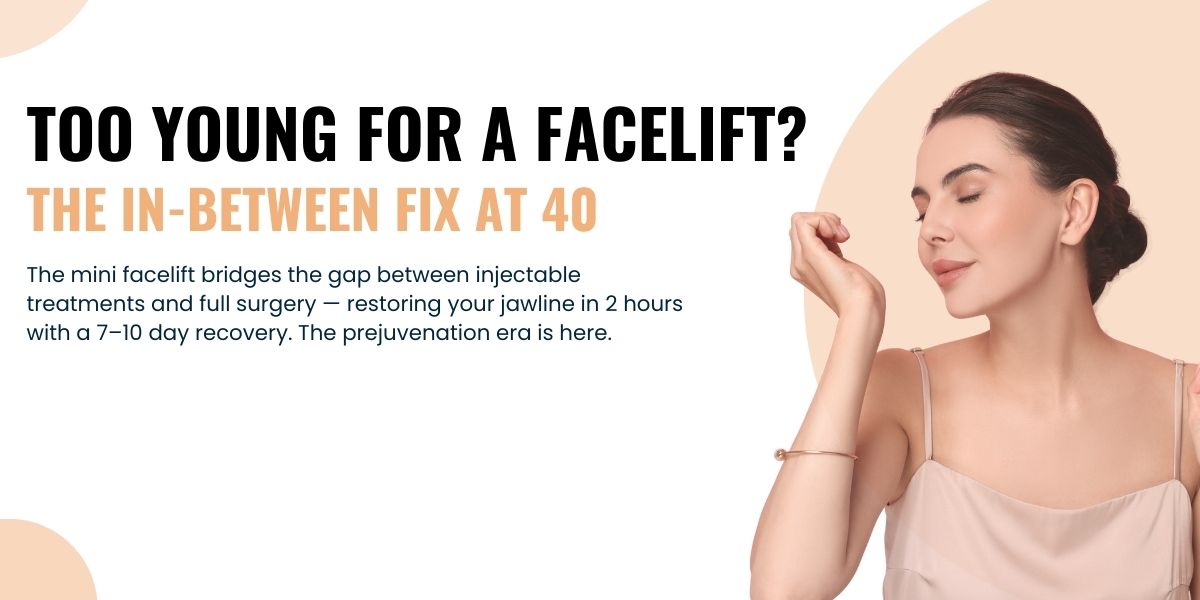
You’re in your 40s. You still feel young. But lately, something in the mirror doesn’t quite match how you feel inside. Your jawline isn’t as sharp as it used to be. There’s a softness forming along the chin that wasn’t there five years ago. Fillers helped for a while—but they’re not doing enough anymore. And yet, when you think about a facelift, it feels like too much, too soon.
If this sounds familiar, you’re not alone. This “in-between” stage—too young for a full facelift, too old for fillers alone—is one of the most common frustrations in facial aesthetics. And it’s exactly the gap that the mini facelift was designed to fill.
In this guide, we’ll explain the early signs of facial aging that appear in your 40s, break down exactly what a mini facelift is and how it differs from a full facelift, and explore the “prejuvenation” movement that’s changing when and why people choose surgery. If you’ve been wondering whether it’s time to act—or whether you should wait—this article gives you the clarity you need.
Early Signs of Aging That Start in Your 40s
Your 40s are when facial aging shifts from surface-level changes to structural ones. Fine lines and crow’s feet may have appeared in your 30s, but the 40s bring a fundamentally different kind of aging: the underlying framework of your face—bone, muscle, fat, and ligaments—begins to lose volume and support, causing visible descent that no topical product can reverse.
Recognizing these early signs helps you understand why fillers start losing their effectiveness—and why early intervention can produce dramatically better long-term results than waiting until aging has advanced significantly. Here’s what typically changes:
Jawline Softening — The once-crisp line of the jaw begins to lose definition as skin elasticity decreases and small amounts of fat start migrating downward. You may notice your face looking slightly “heavier” or less angular than before, especially in photos taken from below or the side. This is often the very first structural aging sign people notice—and the one that bothers them most.
Early Jowling — Even before full jowls develop, you may notice a subtle pouching or irregularity along the jawline—a slight disruption of the smooth jaw-to-neck transition. This occurs as the mandibular retaining ligaments begin to stretch, allowing a small amount of tissue to slip below the jaw’s edge. At this stage, the change is visible mainly to you, but it signals the beginning of progressive descent.
Deepening Nasolabial Folds — The creases running from the sides of your nose to the corners of your mouth become more pronounced as the cheek fat pads lose volume and migrate downward. Fillers can temporarily plump these folds, but the underlying cause—tissue descent—continues to progress, requiring more filler at shorter intervals to maintain the same effect.
Marionette Lines Appearing — Lines begin forming from the corners of your mouth downward toward the chin. These “marionette lines” create a tired or slightly sad expression, even when your face is at rest. They’re caused by volume loss and early tissue descent in the lower face—changes that accelerate noticeably in the mid-to-late 40s.
Neck Changes Beginning — Early signs of neck aging often accompany lower face changes: the skin under the chin may feel looser, the angle between jaw and neck becomes less defined, and faint horizontal lines (“necklace lines”) start appearing. While not yet “turkey neck,” these changes hint at what’s coming if the underlying structures continue to weaken.
The critical difference: In your 30s, aging is mostly about skin quality—fine lines, texture, early sun damage. In your 40s, aging becomes structural—involving tissue descent, volume redistribution, and ligament weakening that no cream, serum, or injectable can adequately address. This is precisely the stage where a mini facelift offers the most strategic advantage.
The key insight: addressing these changes early—before they become severe—means less extensive surgery, faster recovery, more natural results, and a longer period of looking like a refreshed version of yourself.
What Exactly Is a Mini Facelift?
A mini facelift (also called a short-scar facelift or limited-incision facelift) is a surgical procedure that targets the lower face and jawline through shorter incisions, less extensive dissection, and faster recovery than a traditional full facelift. It’s specifically designed for patients with early to moderate aging signs who need more than fillers can provide—but don’t yet require the comprehensive correction of a full facelift.
Despite the “mini” name, the procedure still involves real surgical lifting of the SMAS layer—the deep connective tissue that holds your facial structure in place. This is what separates a mini facelift from non-surgical treatments: it addresses the cause of sagging, not just the surface appearance.
How the procedure works:
• Shorter incisions: Typically placed around the ear—starting near the sideburn, following the ear’s natural contour, and ending behind the earlobe. Significantly shorter than a full facelift incision, meaning less visible scarring.
• SMAS tightening: The deep tissue layer is lifted and repositioned, pulling the sagging lower face upward and restoring jawline definition. This is the same structural correction used in full facelifts—just focused on a smaller area.
• Limited skin removal: A small amount of excess skin is trimmed after the deeper tissues have been secured, creating a smooth, natural contour without tension.
• Anesthesia options: Many mini facelifts can be performed under local anesthesia with sedation, rather than general anesthesia—reducing risk and recovery time.
• Procedure time: Typically 1.5 to 2.5 hours, compared to 3 to 5 hours for a comprehensive facelift.
What a mini facelift can improve:
• Early to moderate jowling along the jawline
• Loss of jawline definition and crispness
• Mild sagging in the lower cheeks and chin area
• Early nasolabial fold deepening (when caused by tissue descent)
• Mild neck laxity when combined with limited neck work
Think of it this way: A mini facelift is the Goldilocks solution for patients in their 40s and early 50s—not too little (like fillers), not too much (like a full facelift), but just right for the stage of aging they’re experiencing. Ali Cetinkaya MD carefully evaluates each patient to determine whether a mini facelift will deliver the result they want—or whether a more comprehensive approach is needed.
The best candidates for a mini facelift are patients with good skin elasticity, early structural aging (primarily in the lower face and jawline), and realistic expectations about what the procedure can achieve.
Mini Facelift vs Full Facelift: How to Choose
The decision between a mini and full facelift depends on the degree of aging, which areas are affected, and your specific goals. Neither procedure is inherently “better”—each is designed for a different stage and type of facial aging. Choosing the wrong one means either underwhelming results (mini when you needed full) or unnecessary surgery (full when mini would suffice).
| Feature | Mini Facelift | Full Facelift |
|---|---|---|
| Ideal age range | Early 40s to early 50s | Late 40s to 70s+ |
| Best for | Early jowling, jawline softening, mild sagging | Significant jowls, deep folds, midface descent, neck laxity |
| Incision length | Shorter; around the ear only | Longer; extends into hairline and behind ear |
| Areas addressed | Lower face and jawline primarily | Lower face, midface, jawline, and neck |
| Anesthesia | Local with sedation (often); general available | General anesthesia (typically) |
| Procedure duration | 1.5–2.5 hours | 3–5 hours |
| Recovery time | 7–10 days to resume social activities | 2–3 weeks to resume social activities |
| Result longevity | 5–8 years | 7–15 years (deep plane: 12–15 years) |
| Cost range (US) | $6,000–$15,000 | $15,000–$40,000 |
| Scarring | Minimal; shorter scar hidden around ear | Well-hidden in hairline and behind ear; slightly longer |
“How do I know which one I need?” A simple self-test: look in the mirror and gently pull the skin in front of your ear upward and backward. If this small movement restores your jawline definition and you’re happy with the improvement—a mini facelift may be sufficient. If you still see significant sagging in the midface, deep nasolabial folds, or neck laxity, a full facelift will likely produce a more satisfying result.
Important: A mini facelift done at the right time can delay the need for a full facelift by 8 to 10 years. However, a mini facelift done on someone who actually needs a full facelift will produce disappointing, short-lived results. Honest surgical assessment is everything—and Dr. Ali Cetinkaya is known for recommending the most appropriate technique, even when it means suggesting a less expensive option.
The goal is always to match the procedure to the problem. A skilled surgeon will never perform a full facelift when a mini will suffice—and will never promise mini facelift results when a more comprehensive approach is needed.
The “Prejuvenation” Movement: Why More People Are Acting Early
A significant shift is happening in facial aesthetics: patients are choosing to intervene earlier rather than waiting for aging to become severe. Called “prejuvenation”—a blend of prevention and rejuvenation—this approach treats early signs of structural aging before they compound, producing subtler results with less invasive procedures and faster recovery.
The data supports this trend. According to the American Academy of Facial Plastic and Reconstructive Surgery (AAFPRS) 2025 annual survey, 57% of surgeons reported an increase in patients under 30 requesting cosmetic procedures. AAFPRS surgeons overwhelmingly predict the average age of facelift patients will continue trending younger. The projected 19% increase in facial procedures nationwide in 2025—totaling an estimated 1.6 million procedures—reflects patients choosing strategic, earlier intervention over dramatic, late-stage correction.
Why acting early produces better outcomes:
• Better skin elasticity: Younger skin heals faster, contracts more smoothly, and produces less visible scarring. Patients who have a mini facelift in their mid-40s typically achieve more natural-looking results than those who wait until their late 50s.
• Less surgery needed: Addressing early descent requires shorter incisions, less tissue manipulation, and less time under anesthesia—all of which reduce risk and recovery time.
• Results look more natural: Small, early corrections are virtually undetectable. People notice you look “refreshed” or “well-rested” rather than “different.”
• Longer benefit window: A mini facelift at 45 gives you 5–8 years of results, potentially delaying a full facelift until your mid-50s or beyond—meaning you spend more of your life looking your best.
• Breaks the filler cycle: Many patients find themselves trapped in an escalating cycle of fillers—more volume, more frequently, at higher cost—without the results improving. A mini facelift can reset the clock and reduce or eliminate filler dependency.
The old mindset vs the new: The previous generation waited until aging was advanced before considering surgery—resulting in more dramatic procedures with longer recovery. Today’s approach is proactive: address structural changes early, maintain with good skincare and occasional non-surgical treatments, and stay ahead of the aging curve rather than chasing it.
Prejuvenation isn’t about vanity—it’s about strategy. Just as preventative health care produces better long-term outcomes than reactive treatment, early facial rejuvenation allows for more subtle, natural-looking results with less invasive intervention.
Recovery: How Quickly Can You Get Back to Normal Life?
One of the biggest advantages of a mini facelift is its remarkably fast recovery compared to a full facelift. Because the incisions are shorter, the dissection is less extensive, and many procedures are performed under local anesthesia, patients typically return to social and professional activities within 7 to 10 days—roughly half the downtime of a comprehensive facelift.
| Timeline | What to Expect | Activity Level |
|---|---|---|
| Day 1 | Mild swelling and tightness around ears and jawline; light bandage or compression garment in place | Rest at home; head elevated |
| Days 2–4 | Peak swelling (less intense than full facelift); mild bruising possible; discomfort easily managed | Short walks; light household activities |
| Days 5–7 | Swelling noticeably decreasing; bruising (if present) fading; sutures checked or removed | Can work from home; avoid strenuous activity |
| Days 7–10 | Most visible signs of surgery resolved; jawline improvement already visible; makeup can conceal residual changes | Return to office/social activities; avoid heavy exercise |
| Week 3–4 | Remaining swelling resolves; results continue refining; scars beginning to fade | Light exercise resumes; full activity by week 4 |
| Month 2–6 | Final result fully visible; scars thin, flat, and concealed within ear contour | No restrictions; enjoy your refreshed appearance |
“Can I have a mini facelift over a long weekend?” While some marketing calls it a “weekend facelift,” this is slightly misleading. You’ll look and feel noticeably better by day 7–10, but you won’t be photo-ready by Monday morning if you have surgery on Friday. A more realistic expectation: plan for 7 to 10 days before you’re comfortable in social or professional settings without anyone noticing.
- The “In-Between” Fix for People Who Feel Too Young for a Facelift - February 26, 2026
- 7 Hidden Reasons Your Face Ages Faster Than It Should - February 26, 2026
- Why Your Jowls Won’t Respond to Fillers Anymore - February 26, 2026


