



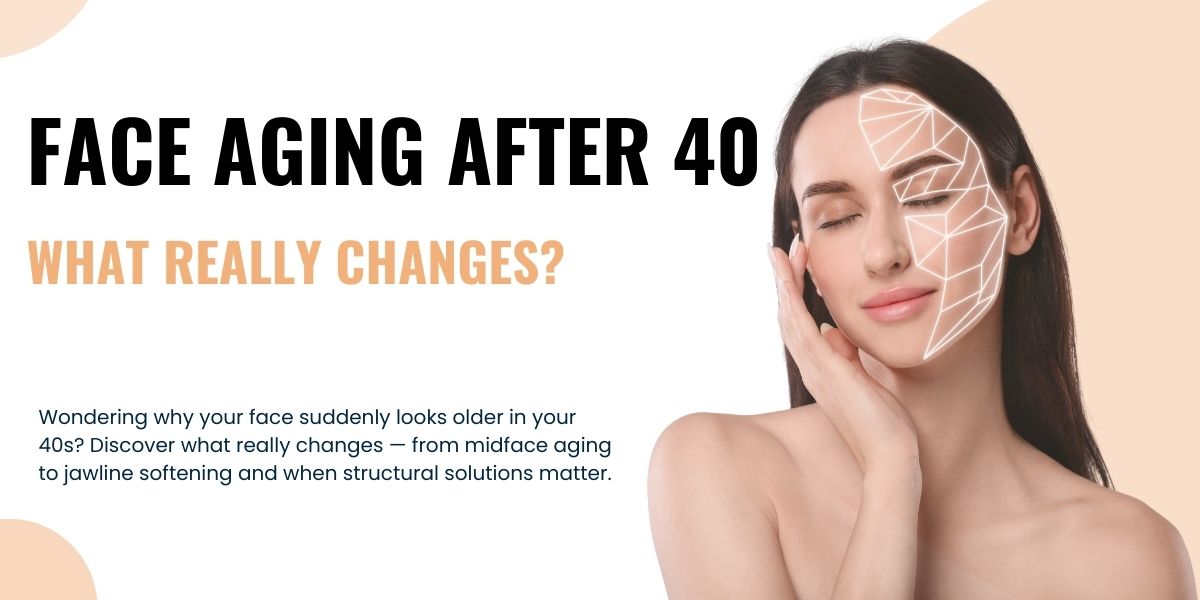
Have you looked in the mirror recently and thought, “Why does my face suddenly look older in my 40s?” Many people describe it as a shift that seems to happen almost overnight. One year you look like yourself — the next, something feels different. Softer. Heavier. Slightly unfamiliar.
This phase is often called the “40s face shift” — a period when subtle structural changes begin to show more clearly. It’s not just about wrinkles. It’s about volume descent, midface aging, jawline softening, and the early appearance of jowls. These deeper shifts can make the face appear tired or older — even when your energy hasn’t changed.
In this article, we’ll explore questions like “Why did I age so fast in one year?”, “What is midface aging?”, and “Is this something skincare alone can fix?” Understanding what truly changes after 40 is the first step toward choosing the right approach — whether that means prevention, subtle support, or structural correction.
What Actually Changes After 40?
The changes that happen in your 40s are not random — and they’re not just about wrinkles. They are primarily structural. While the skin does become thinner and less elastic, the more noticeable shift occurs beneath the surface.
Contrary to popular belief, aging in your 40s becomes more visible in the mid and lower face rather than the upper face. Understanding these structural transitions is key to choosing the right solution.
A) Volume Descent (Midface Aging)
One of the earliest and most significant changes is volume descent. The fat pads in the cheeks — which once provided youthful fullness and lift — gradually begin to shift downward. This process is known as midface aging.
As these cheek fat pads descend:
- Under-eye hollows become more visible
- Nasolabial folds appear deeper
- The midface loses its natural projection
So, what is midface aging? It is the downward shift of facial volume and support structures in the central portion of the face, leading to a tired or heavier appearance — even when the skin itself is relatively healthy.
B) Jawline Softening
Another hallmark of the 40s face shift is the gradual loss of mandibular definition. The sharp contour that once separated the face from the neck begins to soften.
This occurs due to a combination of skin laxity, gravity, and the weakening of facial retaining ligaments. As structural support diminishes, tissues no longer stay in their original position.
C) Early Jowls Formation
As midface volume descends and jawline definition softens, the lower third of the face begins to change. This is when early jowls may form.
You may notice:
- A sense of heaviness in the lower face
- A subtle shadowing effect along the jawline
- A loss of the clean contour between the cheek and chin
In your 40s, aging becomes less about fine lines and more about structural descent. The most visible changes typically occur in the middle and lower thirds of the face — not the forehead or eye area. Recognizing this shift allows for more precise, effective solutions.
Why Does It Feel Like It Happened So Fast?
Many people in their 40s say the same thing: “I feel like I aged five years in one.” The shift can seem sudden — almost abrupt. But biologically, it’s rarely overnight. What often happens is something called a collagen threshold crossing.
For years, your body gradually loses collagen and elastin. The change is slow and subtle — until it reaches a tipping point. Once structural support drops below a certain level, the face can no longer compensate. That’s when sagging, hollowing, and softening become noticeably visible.
In women especially, hormonal shifts during perimenopause accelerate this process. Declining estrogen levels affect collagen production, skin thickness, and fat distribution. The face may begin to look less firm, less lifted, and more fatigued — even if lifestyle habits haven’t changed.
At the same time, facial fat redistribution occurs. Volume doesn’t simply disappear — it moves. Fat pads descend, and the ligaments that once held them in place weaken. This gradual loss of structural support creates heaviness in the lower face and hollowness in the midface.
It’s not that you aged in one year.
Your support system shifted.
Understanding this distinction changes everything. When you recognize that the issue is structural rather than superficial, you can approach aging with clarity — choosing solutions that address the root cause rather than just the surface.
Can Skincare Fix Structural Aging?
Skincare plays an important role in maintaining healthy, radiant skin. Ingredients like retinoids, antioxidants, peptides, and sunscreen can improve texture, reduce pigmentation, and stimulate collagen production. But it’s important to understand their limits.
Creams primarily work on the surface. They enhance skin quality — not structural positioning. When aging is driven by deeper tissue descent, improving the skin alone may not fully restore facial contours.
Dermal fillers, on the other hand, add volume. They can temporarily soften folds or restore fullness in certain areas. However, volume loss is only part of the story.
In many cases after 40, the issue is not just that volume has disappeared — it’s that it has shifted downward. Fat pads descend, ligaments weaken, and structural support changes. Simply adding more volume does not correct this downward movement.
Adding volume is not the same as repositioning tissue. When descent is the primary cause, restoring youthful contours requires addressing the structure — not just filling the space.
Understanding the difference between surface aging, volume loss, and structural descent helps you choose the most appropriate approach — whether that’s optimized skincare, strategic injectables, or structural correction.
Mini Facelift vs Deep Plane Facelift
This is the most important decision point. Understanding the difference between a Mini Facelift and a Deep Plane Facelift is essential for choosing the right procedure. Both aim to restore a youthful appearance—but they differ significantly in depth, longevity, and the type of aging they address.
The key difference: A Mini Facelift focuses primarily on skin tightening, while a Deep Plane Facelift repositions deeper facial structures for a more comprehensive and longer-lasting rejuvenation.
Mini Facelift
A Mini Facelift is a less invasive procedure designed for patients experiencing early facial laxity. The correction is more surface-level, with limited lifting compared to deeper techniques.
- Skin tightening dominant
- Suitable for early sagging
- Limited lift effect
- Shorter downtime
- Primarily surface correction
Who is it suitable for?
- Early jowl formation
- Minimal facial descent
- Patients in their early 40s (approximately 40–45)
- Those seeking subtle refinement rather than dramatic change
Deep Plane Facelift
A Deep Plane Facelift goes beyond the skin. It involves releasing and repositioning tissues beneath the SMAS layer, allowing the surgeon to restore midface volume and redefine the jawline while preserving natural facial movement.
- Dissection beneath the SMAS layer
- Fat pad repositioning
- Midface elevation
- Jawline and neck harmony
- More natural dynamic movement preservation
Who is it suitable for?
- Noticeable midface aging
- Softened or blurred jawline
- Shadow-creating jowls
- Patients seeking a longer-lasting and more structural solution
Decision clarity matters. Choosing between a Mini and Deep Plane approach is not about age alone—it’s about anatomical changes, tissue descent, and long-term expectations. A personalized consultation with an experienced facial plastic surgeon ensures the technique matches your facial structure and aesthetic goals.
Why Modern Facelifts Don’t Look “Done”
One of the biggest fears people have about facelift surgery is looking “pulled,” artificial, or obviously operated on. This concern often comes from outdated techniques that focused mainly on tightening the skin rather than respecting natural anatomy.
Modern facelift techniques are fundamentally different. Instead of pulling the face backward, surgeons now use a vertical vector lift — meaning tissues are repositioned upward, in the direction they originally descended. This mirrors natural facial anatomy and creates a softer, more authentic result.
Equally important is natural movement preservation. By working beneath the surface layers and repositioning deeper structures rather than over-tightening the skin, facial expressions remain dynamic and balanced.
- No pulled mouth corners
- No overly tight jawline
- No frozen or wind-swept expression
A well-executed modern facelift doesn’t change who you are.
It restores structural support — so you simply look like yourself, refreshed.
When performed with anatomical precision and aesthetic restraint, today’s facelift techniques aim for harmony, not exaggeration. The goal is subtle rejuvenation — not transformation.
- The “In-Between” Fix for People Who Feel Too Young for a Facelift - February 26, 2026
- 7 Hidden Reasons Your Face Ages Faster Than It Should - February 26, 2026
- Why Your Jowls Won’t Respond to Fillers Anymore - February 26, 2026


