



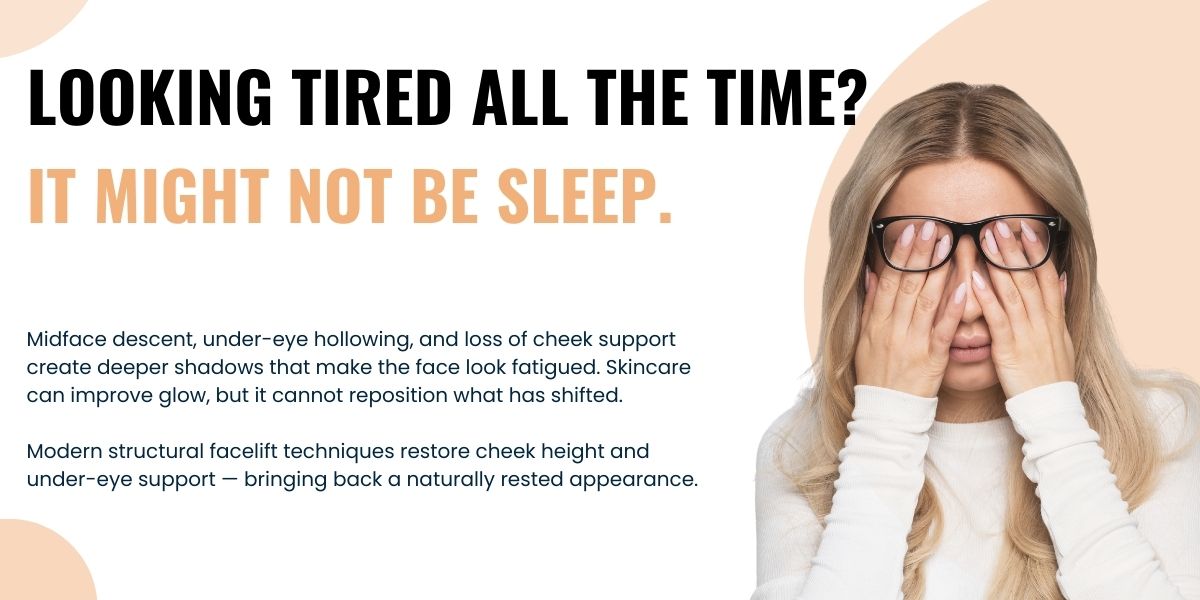
Many people hear the same comment over and over: “You look tired.” Even after a full night’s sleep, the reflection in the mirror can still seem exhausted. That’s why so many ask: “Why do I look tired even when I’m not?”
A tired appearance isn’t always about sleep. It’s often linked to midface descent, under-eye hollowing, and loss of cheek support. As facial tissues gradually shift downward, shadows deepen and the face can appear fatigued — even when you feel energized. Subtle changes in volume distribution, light reflection, and structural support all contribute to this look.
In this article, we’ll explore questions like “What causes a tired face?”, “How can I look refreshed naturally?”, and “When is it more than just skincare?” Whether you’re seeking natural solutions or considering structural rejuvenation, this guide will help you understand what truly makes a face look rested.
I’m Not Tired… So Why Do I Look Like This?
Many people hear the same comment repeatedly: “Are you okay?” or “You look tired.” Even after a full night’s sleep, the mirror reflects a face that seems drained of energy.
💡 Here’s the surprising truth: If you sleep well but still look exhausted, the issue may not be fatigue. In many cases, it’s related to subtle structural changes in the midface and under-eye area.
A tired appearance isn’t always about lifestyle. Sometimes, it’s about how facial tissues shift over time — altering light, shadow, and contour.
What Causes a Tired Face?
A tired-looking face is rarely caused by just one factor. Instead, it’s usually the result of combined anatomical changes that affect facial balance.
💡 Key contributors include: midface descent, under-eye hollow formation, tear trough deepening, cheek flattening, and early jowling shadows.
When volume shifts downward and shadows deepen, the face begins to appear fatigued — even if energy levels remain high. In short, a tired appearance is often the combination of descent and shadow.
The Role of Under-Eye Hollow
Under-eye hollowing is one of the strongest visual triggers of a tired face. However, not all hollows are simply volume loss.
💡 Important distinction: Some cases respond well to filler, while others worsen if the real issue is tissue descent rather than missing volume.
When support structures weaken, the hollow appears deeper due to shifting tissues. This means hollowing isn’t always about adding volume — sometimes it’s about restoring support.
Midface Descent: The Hidden Cause
One of the most overlooked reasons for a tired appearance is midface descent. Over time, cheek fat pads gradually shift downward.
💡 This leads to: increased infraorbital shadowing, deeper nasolabial folds, and a longer lower eyelid–cheek junction.
As the cheeks descend, light reflection changes and shadows intensify — creating the impression of fatigue. When cheek support drops, the entire face can appear less vibrant.
How to Look Refreshed Naturally
There are effective non-surgical ways to improve a tired appearance — especially in early stages.
💡 Helpful approaches include: consistent sleep hygiene, proper hydration, targeted skincare, radiofrequency tightening, and strategic filler in selected cases.
These methods enhance skin quality and brightness. However, they improve surface appearance — not deeper structural descent.
When Tiredness Is Structural
Sometimes, no matter how much rest or filler is applied, the face still lacks freshness.
💡 Warning signs: filler fails to restore brightness, shadows persist, or cheeks appear heavier rather than lifted.
In such cases, the issue may not be volume deficiency — but midface positioning. Structural descent requires structural solutions.
How Modern Facelift Restores a Rested Look
Modern facelift techniques focus on repositioning deeper tissues rather than simply tightening the skin.
💡 By elevating the midface, restoring under-eye support, and re-establishing natural cheek height, facial harmony can be refreshed without an artificial look.
It’s not about pulling tighter — it’s about restoring foundational support where it has shifted over time.
Why Repositioning Looks More Natural Than Filling
Overfilling can sometimes create puffiness or an unnatural “pillow face” effect.
💡 Repositioning tissues instead of adding bulk restores natural light reflection and recreates youthful facial contours.
A tired appearance is largely a matter of shadow and structure. Correcting the position of facial tissues often produces a more authentic and balanced result.


